
Geopolitics of Nuclear Energy
China, Russia, the West, Accidents, New Tech
Remastered: 15 November 2026
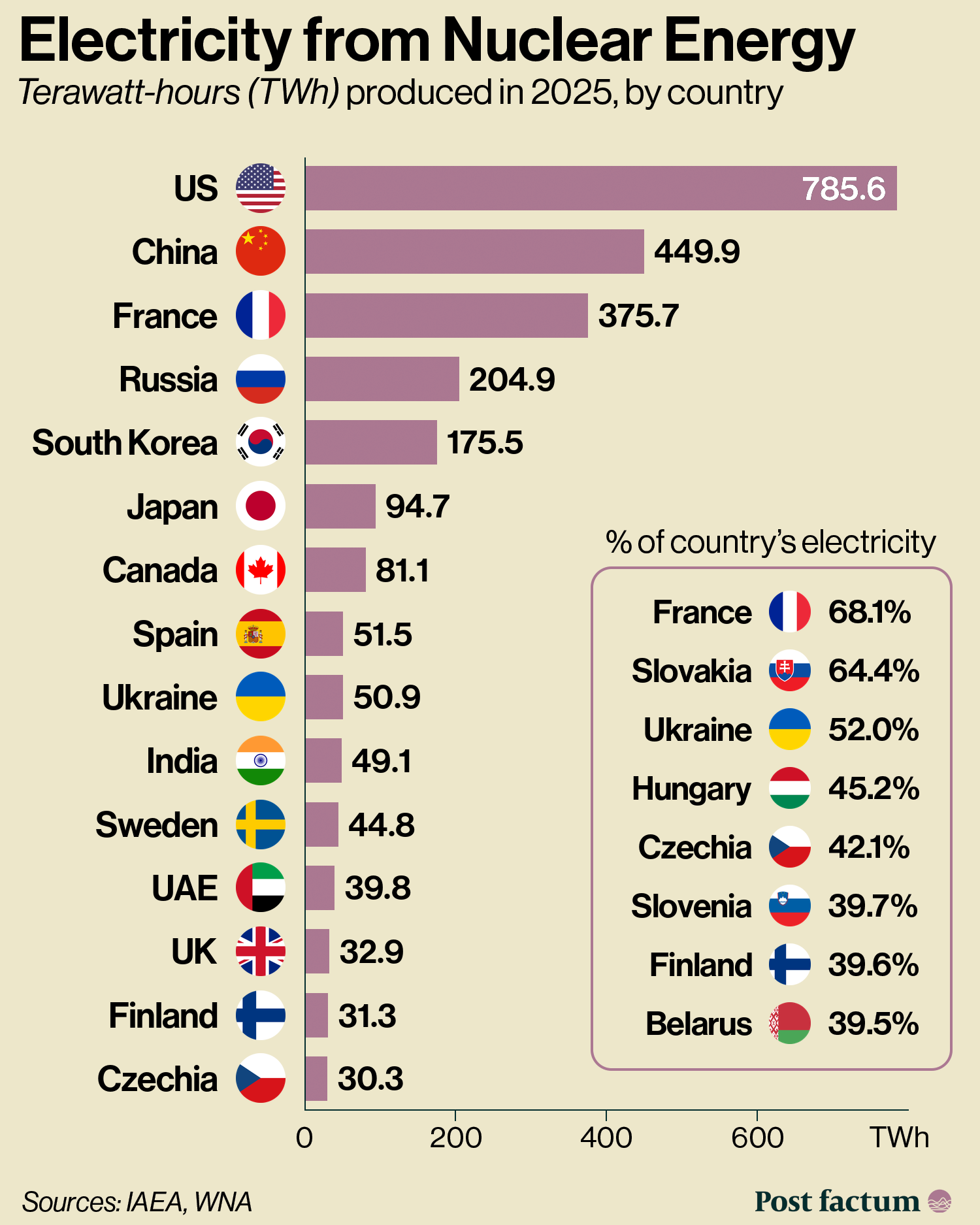
Nuclear power plants make electricity from the heat released by splitting uranium atoms.
- Steady output: reactors can run day and night, in almost any weather.
- Low emissions: zero air pollution, but the radioactive waste needs managing.
- Fuel reserve: most reactors need to be reloaded with uranium every 1-2 years, and EU plants hold over 2 years’ worth of uranium fuel in stock.
- Safety: nuclear energy is 100 times safer than gas and 1,000 times safer than coal, per unit of electricity (on par with wind and solar), counting deaths from accidents, pollution and other causes.
However, reactors take a long time to build, are expensive and require rare technical expertise to both construct and operate.
Extreme heat and dry weather lowered output of reactors in France, Hungary and Switzerland in 2025-26.
95% of reactors are built by countries that possess nuclear weapons.
The average reactor is 33 years old; China’s are 11 years old on average.
- Most US reactors are licensed to work for 60+ years, with life extensions being common.
What limits growth?
- Upfront costs: long-term investment needs to be secured for any new reactor (often state-backed). Recent French and US reactors cost 2-7 times their first budgets.
- Build time: a long wait adds to uncertainty and risk. All 16 reactors completed in 2023-25 were behind schedule.
- Enrichment capacity: access to nuclear fuel is limited and often requires importing it.
- Workers: finding or training skilled staff takes money, time, effort and unique expertise.
- Specialised parts: there are shortages of some components, including heavy steel pressurised bodies for the reactors, made by a small number of producers in limited quantities.
3-sentence history
After the 1973 oil price shock, France, Japan and some other countries invested in nuclear reactors to depend less on imported oil.
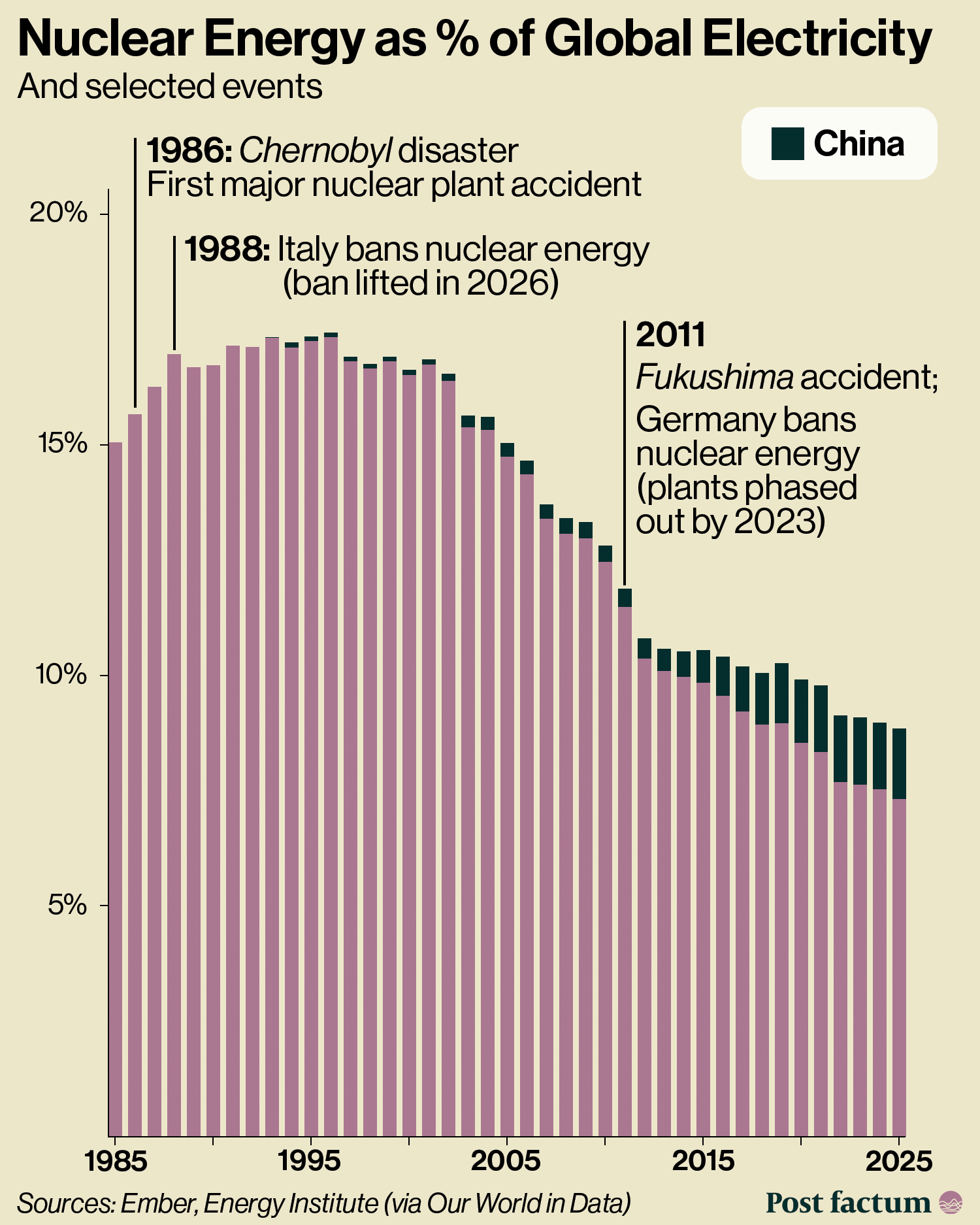
Accidents in the US (Three Mile Island, 1979), the Soviet Union (Chernobyl, 1986) and Japan (Fukushima, 2011), as well as rising construction costs and cheap oil and gas, then slowed the build-out.
In the 2020s, the US, Japan and much of Europe started to turn back to nuclear power, citing energy security, climate change policy and rising energy demand (more below).
China
China has opened 53 reactors since 2006, closed none, and is building half of the world’s new ones.
Its state firms repeat standard designs and borrow cheaply from state banks, finishing a reactor in about 6 years, against 9 worldwide.
- China budgeted $27 billion for 10 reactors approved in 2025, about what France’s newest single reactor cost.
Nuclear power generates around 5% of China’s electricity, up from 1.2% in 2000, and stable since 2020.
China aims to pass the US in total number of reactors by 2030.
Russia
Russia builds most nuclear reactors for export:
- 20 reactors in 8 countries, compared to 4 for all other exporters.
Russia sells reactor construction, nuclear waste management, loans to finance the project and staff training as one package.
This ties the buyer to Russia for decades.
- Egypt took a $25 billion Russian loan for 85% of its plant’s cost, repayable over 22 years, with Russian fuel for 60 years.
Uranium and enrichment
Most reactors run on enriched uranium: the share of its atoms that can split more easily is raised from 0.7% to 5-20%.
- For nuclear weapons, the uranium needs to be enriched to 90% or higher concentration.
Russia has 43% of the world’s uranium enrichment capacity.
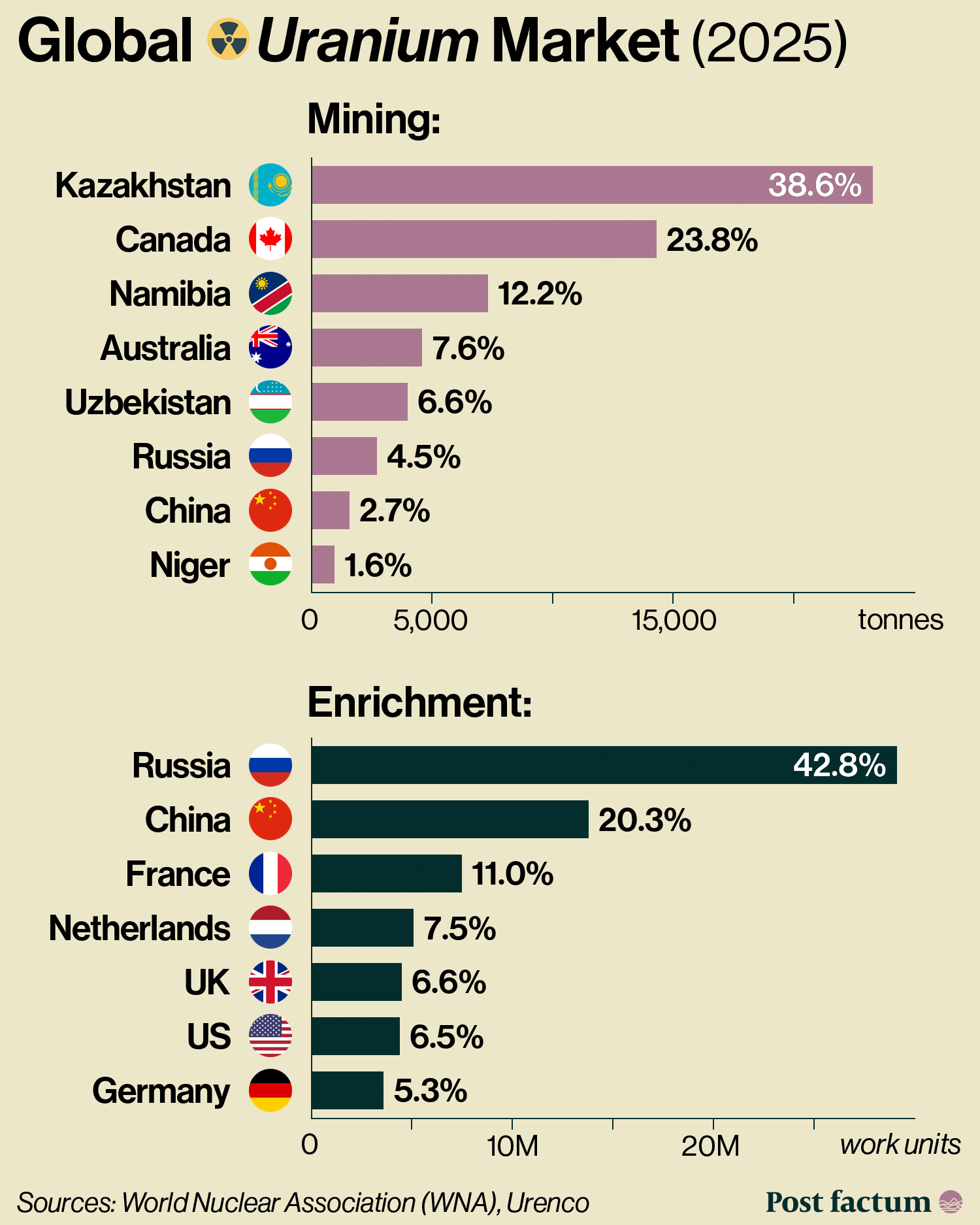
Mines cover about 90% of what reactors use, and supply depends on a few countries:
- Kazakhstan: Russia co-owns several mines; China is the top buyer.
- Namibia: Chinese firms own the mines behind 91% of output.
- Niger: the Sahel state supplied 25% of the EU’s uranium in 2022, then nationalised a French-run mine in 2025 and held sale talks with Russia.
A US ban on Russian enriched uranium takes full effect in 2028.
- The EU has introduced no bans on Russian uranium.
The long-term uranium price hit a record $98 per pound in October 2026, but it accounts for under 3% of the costs for a new US reactor.
Radioactive waste
The most radioactive waste is the used reactor fuel.
- It makes up 3% of the nuclear waste by volume, but 95% of its radioactivity.
It stays highly radioactive for tens of thousands of years.
Nuclear reactors globally have produced 450,000 tonnes of used fuel:
- 72% sits in cooling pools or dry storage.
- 28% has been reprocessed for reuse.
Reprocessing, now done mainly in France and Russia, separates plutonium, which can also be used in nuclear weapons.
No permanent burial site for used fuel is in use yet.
Finland licensed the first, covering 1.5% of existing waste, in October 2026.
- A second site, covering another 3%, has been under construction in Sweden since 2025.
- The US has produced 21% of the world’s used fuel, but suspended licensing of its chosen waste site in 2011.
Taking apart (dismantling) a closed reactor takes 22 years on average: 25 of 224 closed reactors had been dismantled by November 2026.
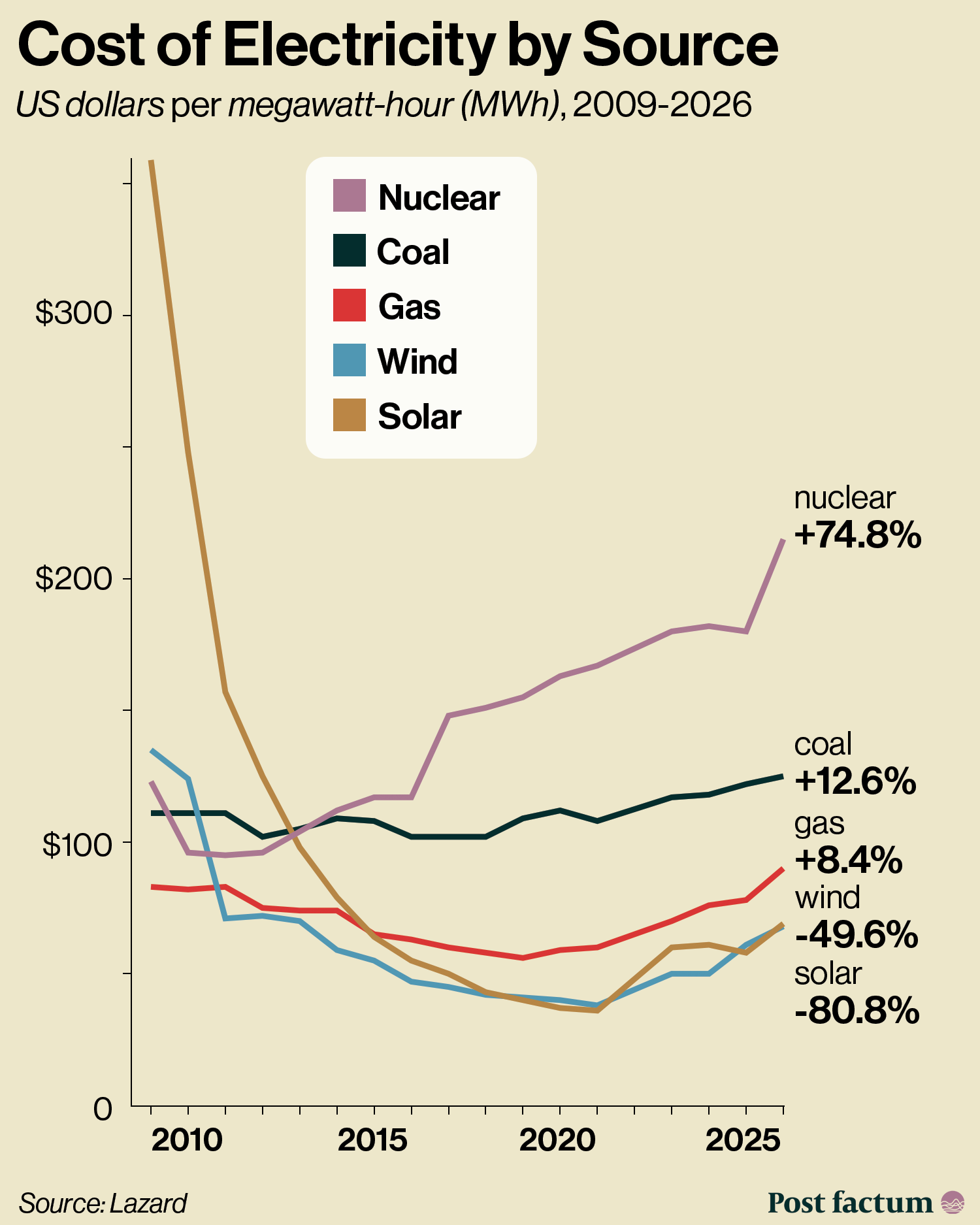
The cost of nuclear power
Most of a reactor’s cost is paid before it makes any electricity, so loan interest sets the price of nuclear power.
Governments that borrow more cheaply finance most of the new reactors.
In 2025, the World Bank ended its ban on lending for nuclear energy projects.
The turn back to nuclear
39 countries have pledged to triple world nuclear capacity by 2050:
- The US aims to quadruple its capacity by 2050 and is restarting 3 closed reactors.
- Japan has restarted 15 reactors.
- France, Poland and the UK plan new nuclear reactors.
- Belgium and Italy reversed existing laws against nuclear power.
- Switzerland votes in February 2027 on lifting its ban.
Staying out: Germany closed its last reactors in 2023, Spain plans to close its own by 2035, and Austria and Australia currently ban nuclear power.
World nuclear energy capacity has grown by under 3% since 2005, as closures of old reactors offset most new openings, re-openings and extensions.
Data centres for AI used under 2% of the world’s electricity in 2025, but the share is growing.
Tech firms have announced nuclear power deals equal to a third of existing US capacity; 3% of it was supplying power by mid-2026.
Small Modular Reactors (SMRs)
SMRs are smaller versions of classic fission reactors.
The parts for them are easier to make and more manageable, and less of the reactor needs to be built on-site.
SMRs are potentially cheaper and quicker to build.
2 SMRs are currently operational, in Russia and China (as of November 2026).
- The West’s first, in Canada, is due in 2030.
Many newer designs, including some SMRs, need more highly enriched fuel, only sold at commercial scale by Russia.
Nuclear fusion
Nuclear fusion joins light atoms instead of splitting heavy ones (fission).
- Its fuel comes from water and lithium.
- It leaves no long-term radioactive waste.
- At its core, the reaction heats up to over 100 million °C, while nearby magnets need to remain at near absolute zero temperature.
No fusion plant has made more electricity than it uses, or supplied any electricity to the grid, as of November 2026.
- The record energy gain (US, 2025) returned 3% of the electricity used.
Fusion firms raised $4.5 billion in the year to July 2026 (a record).
China set up a $2.1 billion state fusion company in 2025.
Microsoft and Google have agreed to buy fusion power from US firms, the first due in 2028.
The largest fusion experiment, built in France by 7 partners including the US, China and Russia, is due to start in 2034, 9 years late.
- It now costs $27 billion, 4 times its original budget.
Accidents, revisited
Three Mile Island (US, 1979): part of a reactor’s core melted after operators misread their gauges when a valve got stuck.
There were 0 deaths or injuries; 140,000 people were evacuated from the area.
The clean-up cost $1 billion by 1993.
- Some analysts link the accident to the slowdown in US reactor building, which had begun earlier.
Chernobyl (Soviet Ukraine, 1986): a safety test went wrong and blew apart a reactor core.
31 people were killed directly.
Estimates of eventual radiation deaths range from 4,000 to 90,000.
- A zone of 2,600 square kilometres is still closed. 350,000 people were resettled.
The reactor was covered with a concrete shell in 1986, but it was never airtight.
A steel dome worth $1.7 billion was put over it in 2016.
In 2025, a Russian drone hit the roof of the steel dome, breaking the seal; the radiation readings are unchanged.
Fukushima (Japan, 2011): 3 reactors melted down in March 2011 after a tsunami wave cut the plant’s power and cooling.
There were no immediate deaths, but 1 later death from lung cancer was linked to the accident.
16 workers were injured by explosions, and 3 more were burned by radioactive water.
164,000 people were evacuated, and over 2,200 deaths were linked to the evacuation (90% of them elderly).
6 emergency response workers received compensation for cancers linked to the accident.
- The tsunami that caused the accident killed 20,000 people in the region.
The melted reactors still contain 880 tonnes of nuclear fuel, with 4 grams recovered by robots.
The reactors were contained by cooling and sealing them off with water.
It is filtered and released into the sea in small batches, tested by a UN agency.
- China banned imports of Japanese seafood over this, lifting the ban in 2025 and re-imposing it within weeks as the China-Japan conflict started.
After the accident, Japan shut every reactor and planned to quit nuclear power.
It has since reversed: current policy calls for using nuclear as much as possible (20% of electricity by 2040), and 15 reactors are running again.
Thank you for reading!
We need your support
Post factum is independent and reader-powered.
Pro subscriptions fund our work, giving you exclusive content, community access and other perks.
We have to reach around 5,000 Pro members to cover our costs and continue publishing, or the funding we have raised so far will run out.
Please help us hit this goal and keep bringing you concise, factual and accessible reporting.
Join as a Founding Member now to lock in a lower lifetime rate.
Your fee will go towards paying our staff, covering our bills and making more content.
Keep exploring:



This week on Post factum Pro:

Join Post factum Pro to access the comment section.