Saudi-UAE Conflict, explained
11 November 2026
- Previously close allies, the two countries split over oil output and the war in Yemen.
- Saudi Arabia and the UAE back opposite sides in conflicts in Sudan, Somalia, Libya.
- The UAE left OPEC in May 2026.
The alliance
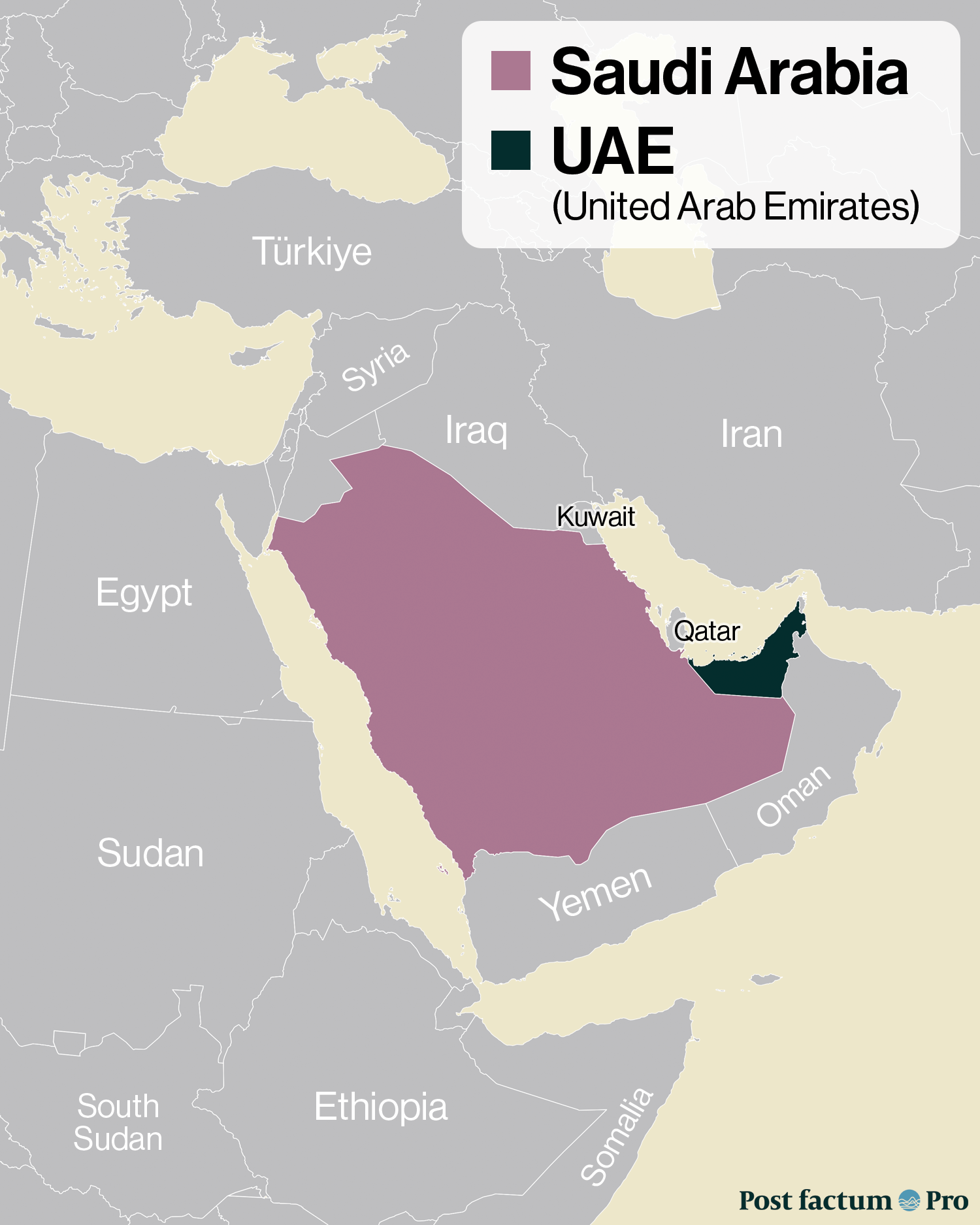
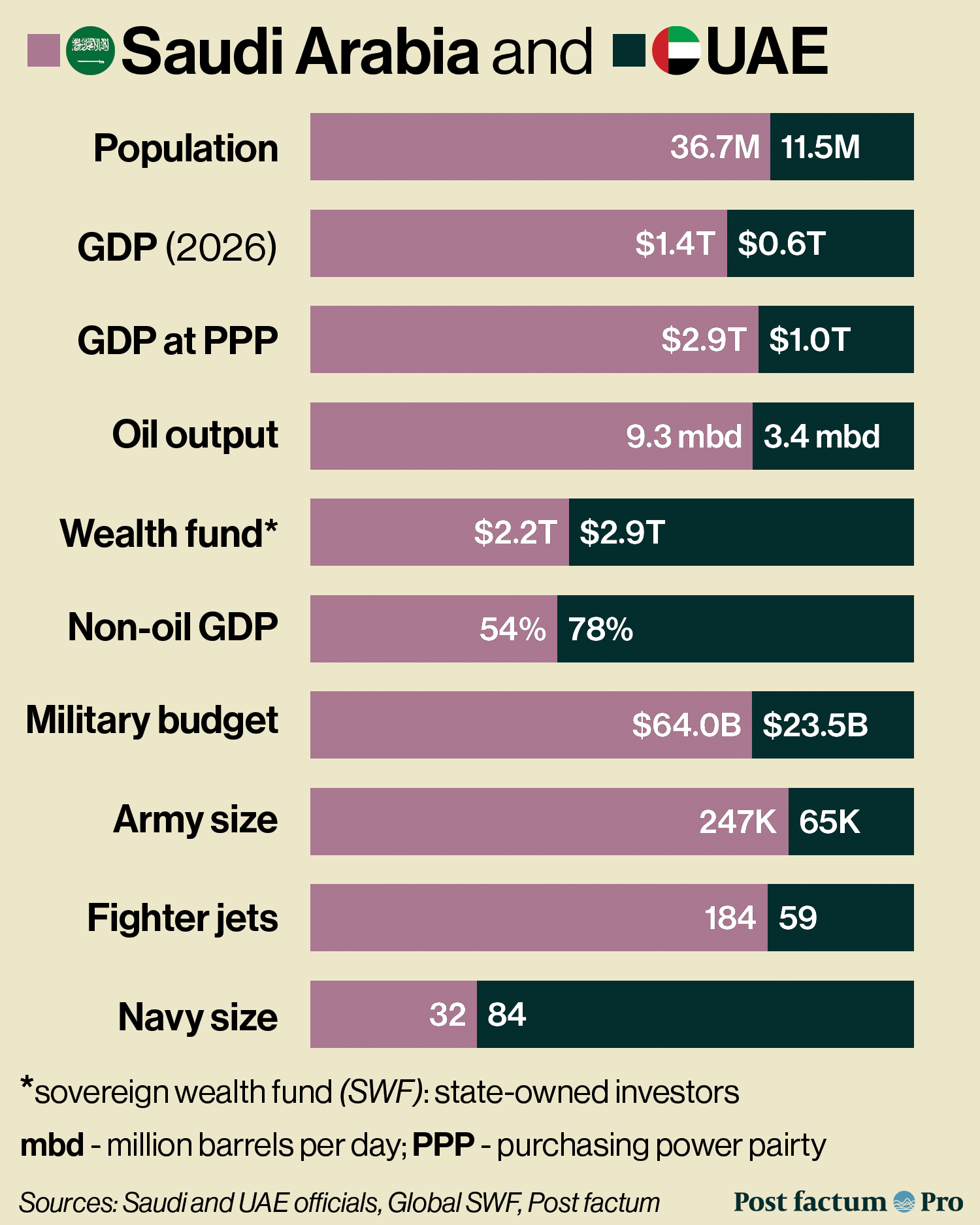
Saudi Arabia and the United Arab Emirates (UAE) are the 2 largest Arab economies, both ruled by royal families and enriched by oil.
Saudi Arabia:
- The largest of the 6 Persian Gulf monarchies
- 2 of the holiest cities in Islam are here
- World’s 2nd largest oil producer and the leader of OPEC, a group of oil exporters that controls output to influence prices
The UAE:
- A union of 7 emirates (small monarchies)
- Abu Dhabi holds most of the oil
- Dubai is the region’s main trade and travel hub
- 78% of GDP is non-oil, after decades of diversification
After the 2011 Arab Spring protests, both worked to block Islamist political movements and Iran’s influence in the region.
The UAE’s leader became a mentor to the younger Saudi crown prince.
In 2015, they entered Yemen’s civil war together against the Houthis, an Iran-backed group that had seized the capital.
- Saudi Arabia led the bombing campaign, while the UAE trained and paid local fighters in southern Yemen.
From 2017 to 2021, Saudi Arabia and the UAE cut all ties with Qatar, accusing it of backing extremists and siding with Iran.
In 2021, Saudi Arabia told foreign firms to base their regional headquarters in the kingdom or lose state contracts.
- Most headquarters were then in Dubai, UAE.
- Few firms moved out of the UAE, instead opening new offices or changing their structure.
The conflict
The tensions surfaced in Yemen:
Saudi Arabia wanted a united country under the existing recognised government.
The UAE backed separatists seeking an independent south.
In December 2025, UAE-backed separatists seized most of southern Yemen, including the country’s largest province, on Saudi Arabia’s border.
On 30 December, Saudi jets bombed cargo shipped from the UAE to a Yemeni port, including over 80 vehicles.
Saudi Arabia called this a threat to its national security, and the Yemeni government requested the UAE to withdraw.
The UAE decided to stop its support for the separatists and pulled its last forces out of Yemen. Why?
- Saudi Arabia had a strategic military advantage in the air
- Yemen’s request to leave meant that staying would legally have been an occupation
- The UAE potentially had more to lose from the conflict than to gain from it
Within 10 days, Saudi-backed forces retook the main southern cities, and the separatist council was declared dissolved.
The conflict between Saudi Arabia and the UAE spilled over into other states, where the two back opposing sides in other wars, especially in the Horn of Africa.
- Proxy war: rival states support opposing factions of a foreign conflict, instead of fighting each other.
International competition
Abroad, Saudi Arabia backs central governments and national armies, while the UAE works with breakaway regions and armed groups, often through port deals.
The two back opposing sides in 3 more conflicts:
- Sudan: Saudi Arabia backs the army, while the UAE reportedly arms the rival paramilitary force.
- Somalia: the UAE supports breakaway region Somaliland (where it has a naval base) and funds autonomous region Puntland’s security force; the Somali government cancelled its deals with the UAE in January 2026 and signed a military pact with Saudi Arabia.
- Libya: the UAE backs the general who controls the east; Saudi Arabia and Egypt reportedly closed their airspace to UAE military flights heading there.
Each has built its own group of partners:
- Saudi Arabia has mutual defence pacts with nuclear-armed Pakistan and Türkiye and works closely with Egypt.
- The UAE has had diplomatic ties with Israel since 2020, unlike Saudi Arabia, is close to Ethiopia, and plans a defence partnership with India.
In December 2025, Israel became the first state to recognise Somaliland; Saudi Arabia joined 20 states in condemning this, and the UAE did not.
Oil and OPEC
The UAE unexpectedly left OPEC in May 2026 after 59 years.
Stated reason: OPEC limits kept the UAE’s oil output 20-30% below its capacity.
Saudi Arabia also has about 20-30% of its capacity idle.
However, Saudi Arabia needed oil at about $92 a barrel to balance its 2025 budget, while the UAE needed about $50.
The UAE, with its economy more diversified away from oil, preferred to sell as much oil as possible to maximise revenue.
Saudi Arabia preferred to keep oil prices high to cover its costs, including ambitious infrastructure projects.
The Iran War
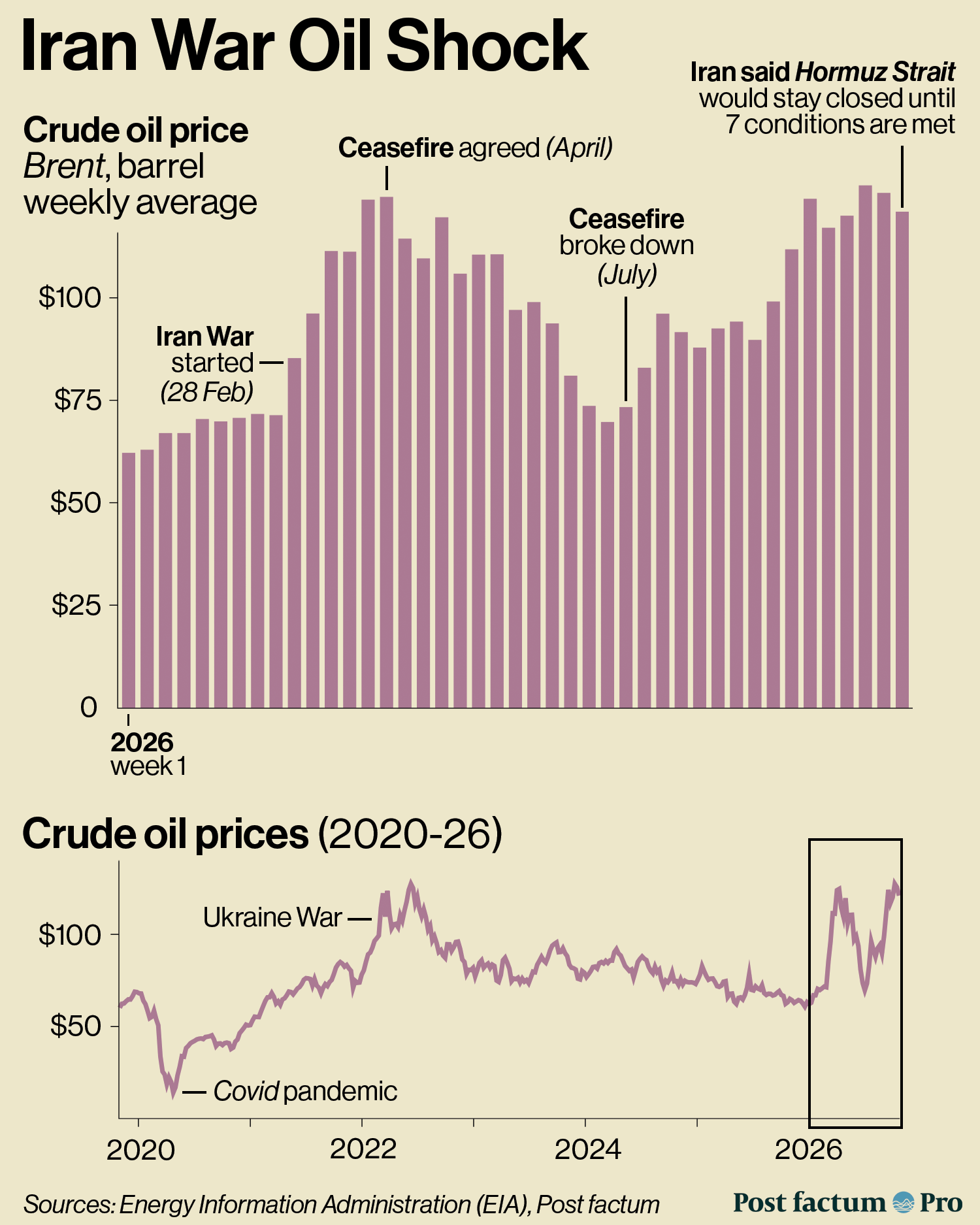
The US-Israeli war on Iran hit both countries: Iran fired over 7,000 missiles and drones at its neighbouring countries in the Middle East.
Iran also closed the Strait of Hormuz, the only sea route out of the Persian Gulf:
Oil output in both countries fell by a third within 2 months as exports stalled.
Both economies are expected to shrink by 3-4% in 2026.
Dubai airport’s passenger traffic fell 31% in the first half of 2026.
In July, the Houthis restarted their war on Saudi Arabia, hitting its capital’s airport and oil infrastructure.
- They also struck the Saudi oil pipeline that bypasses Hormuz, which was paused but later reopened.
The Houthis captured more territory from the Saudi-backed Yemeni government.
This included the Yemeni coast of Bab el-Mandeb, the southern entrance into the Red Sea.
- Shipping through Bab el-Mandeb stayed at pre-war levels as the Houthis did not actively close the strait.
- Shipping traffic here has been lower since 2023, after a wave of Houthi strikes on commercial ships.
During the Houthi attacks, senior royals from Saudi Arabia and the UAE met in September and October, the first high-level meetings since the rupture.
The UAE reportedly agreed to resume paying anti-Houthi fighters in southern Yemen, with Saudi air support, but neither government has confirmed this.
Thank you for reading!
Keep exploring: