
Houthi Attacks on Cargo Ships
Published: July 24, 2025
Important! This report follows the outdated format of Post factum Pro.
Back then, we focused on analysing how other media outlets covered the event.
Let us know if you want to see more of something like this!
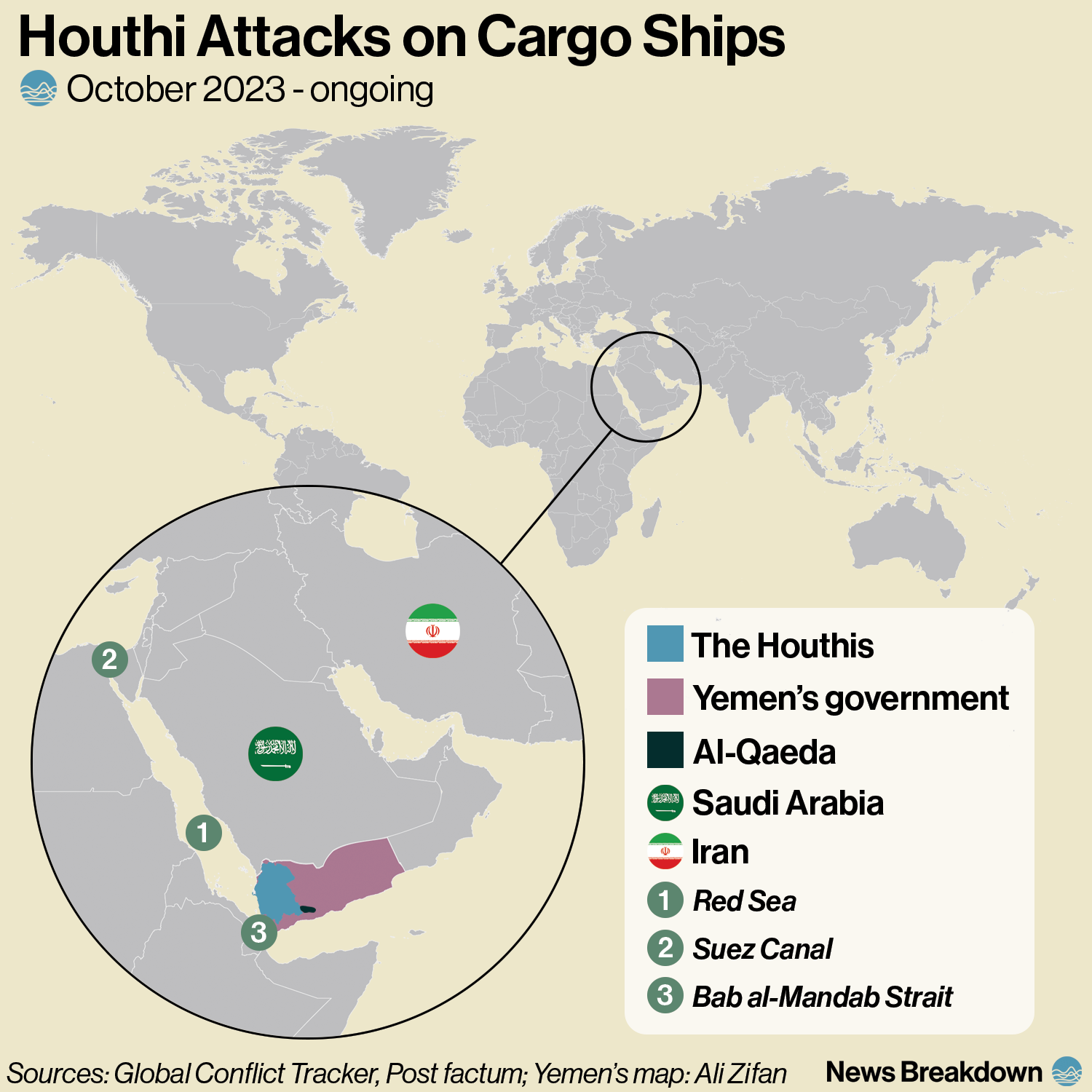
The Houthis are a religious, political and military group in Yemen.
It was formed mostly out of Zaydis, a religious community that was the majority in Northern Yemen but become a minority when the country merged with Southern Yemen in 1990.
The Houthis acted in opposition to the government of united Yemen, seen as corrupt and influenced by the United States.
Houthis are among the militant groups in the Middle East supported by Iran to counter the United States and Israel (the “Axis of Resistance”) alongside Hezbollah in Lebanon and Hamas in Gaza.
A civil war broke out in Yemen in 2014, and the Houthis took control over large parts of Northern Yemen, including the country’s capital.
Saudi Arabia supported the government of Yemen, waging war against the Houthis.
In 2004, the group adopted Hezbollah’s slogan: “God is Great. Death to America. Death to Israel. Curse on the Jews. Victory to Islam”.
After the war in Gaza began in October 2023, the Houthis warned that they will begin attacking commercial ships linked to Israel.
The goal: to threaten the disruption of international trade and to force Israel to stop its campaign in Gaza.
On 19 November 2023, the Houthis attacked and seized (captured) a cargo ship (named Galaxy Leader) rented out by a company part-owned by an Israeli billionaire.
This was the beginning of a series of attacks on commercial vessels in the Red Sea, disrupting the traffic through the Suez Canal and the Bab al-Mandab Strait.
In this report, we review the consequences of the attacks on international trade, and look at media angles on the Galaxy Leader seizure from Iranian (PressTV), Israeli (Times of Israel) and Saudia (Al Arabiya) sources.
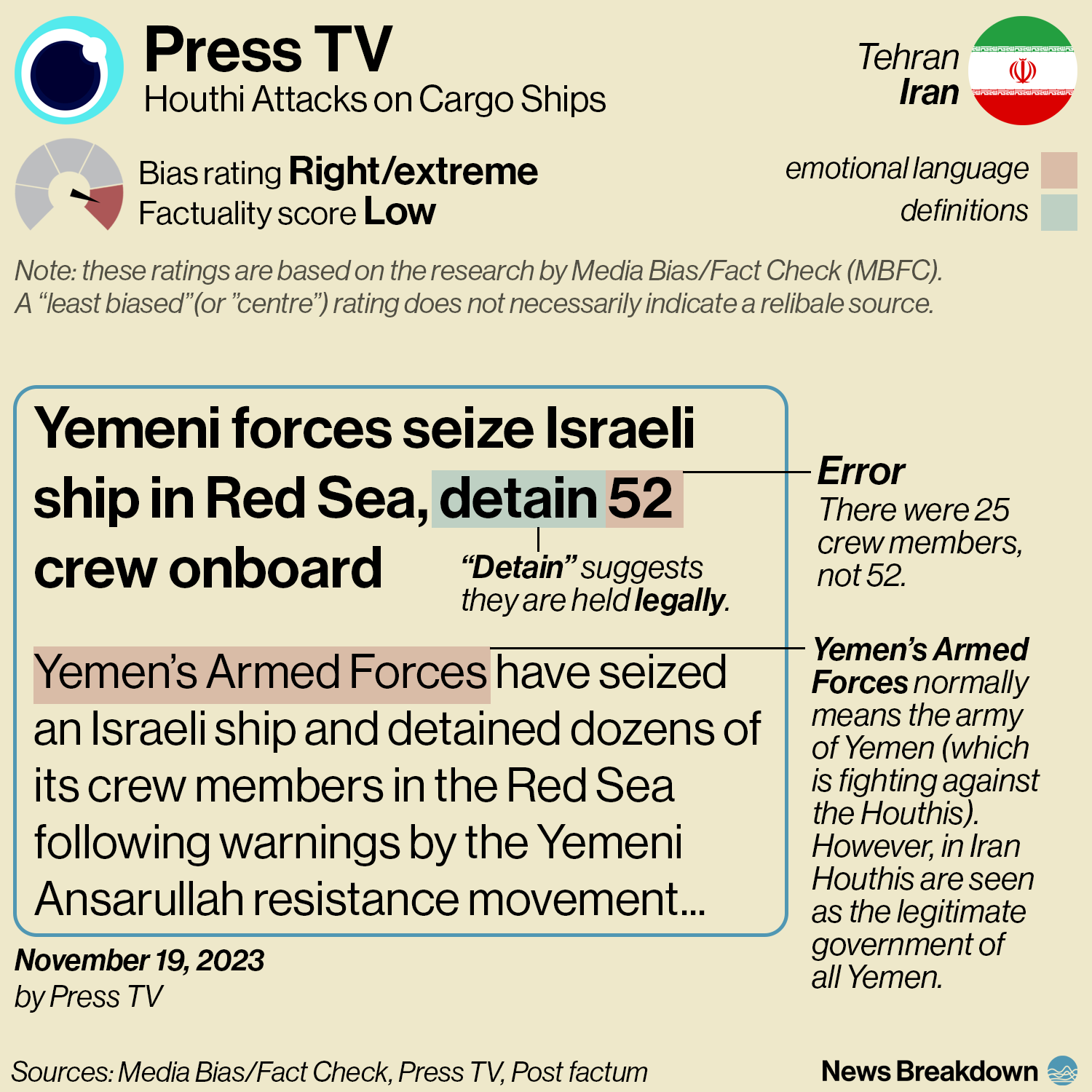
PressTV: Iranian state-owned news media.
The article by PressTV presents the ship’s seizure as a lawful action.
It refers to the ship being “seized” rather than “hijacked” suggesting it was legal.
It mentions that crew members were “detained” which normally means arrested on legal grounds.
PressTV incorrectly reports that 52 members of the crew were arrested. In fact, there were 25 crew members on board.
The crew of Galaxy Leader were taken hostage and released in 2025.
The article refers to the Houthis as “Yemen’s Armed Forces”. This term is normally used to describe the Yemen Armed Forces: the military of Yemen’s internationally recognised government that controls most of the country’s territory, but not the capital.
However, in Iran the Houthis are seen as the legitimate government of Yemen, so they are described as “Yemen’s Armed Forces” to further underline this position.
The article also mentions that the group gave out warnings to Israeli-linked ships previously.
The rest of the article mostly discusses comments made to the press by Houthi representatives:
Israeli-linked ships are considered “legitimate targets” (meaning legal to strike according to the law of war).
Houthis’ actions are in response to Israel’s blockade and bombardment of Gaza that caused thousands of casualties by the time.
Seizing or striking commercial ships in such a way is not legal under international law.
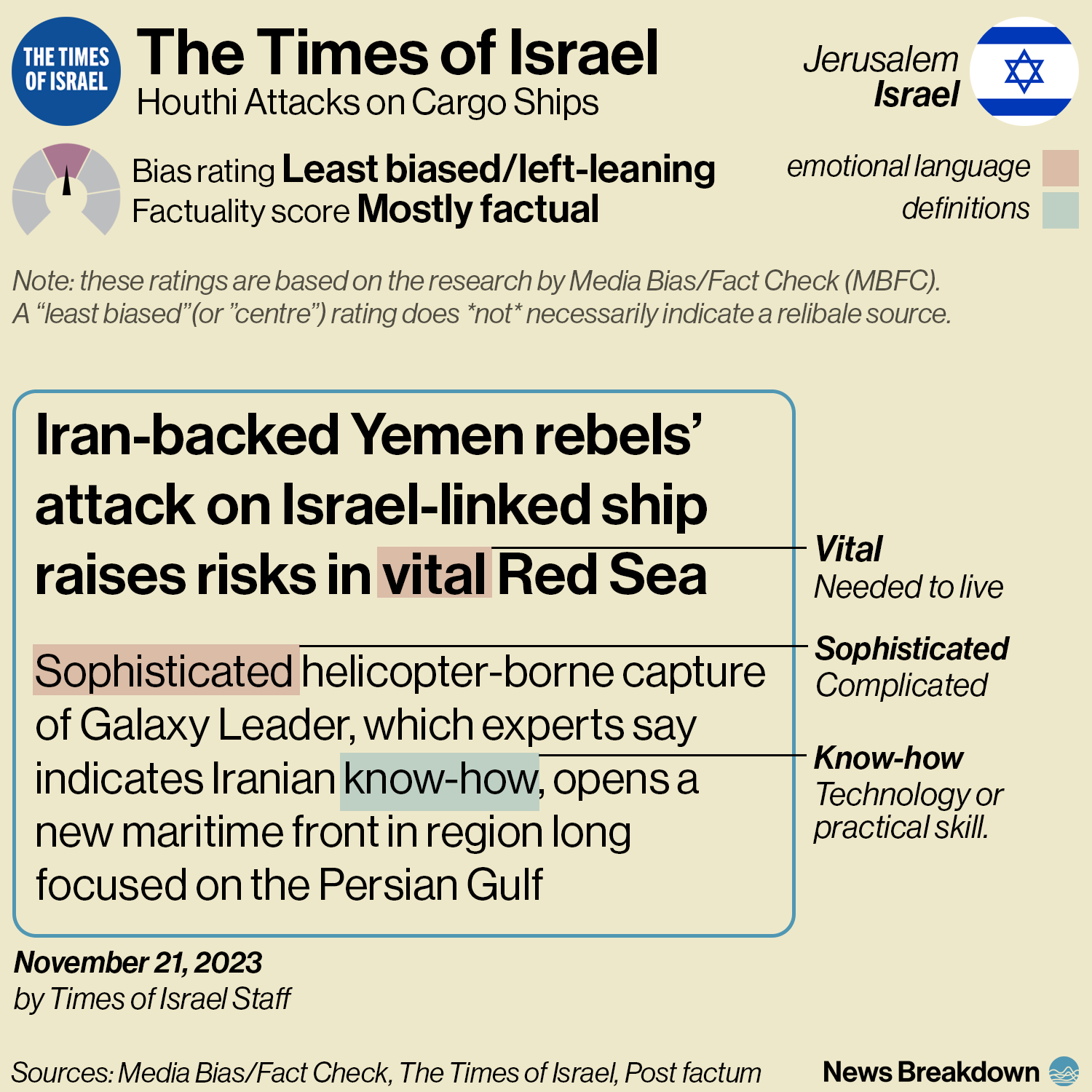
The Times of Israel (ToI): English-language Israeli news-media.
The article by ToI focuses on the potential involvement of Iran by supporting the Houthi’s attack.
There is no proof of Iranian connection to the incident.
However, it is likely that Iran had at least indirectly supported this attack as they supply the Houthis with military and financial resources.
The first words of the headline immediately point out that Iran is a long-term supporter of the Houthis.
The article gives further arguments to support this analysis:
Galaxy Leader passed by an Iranian vessel suspected to be a spy ship before being attacked.
A quote by “an American defense official” who said that “these people were trained by a professional military, which could clearly be Iran”.
An intelligence firm saying that the attack by Houthis is “reminiscent” (producing memories) of the attacks on cargo ships by Iranian military (IRGC).
A security analyst calling the operation “Iranian-style”.
ToI mentions that Iran denies these accusations.
The article points out that the attack is “opening a new maritime [sea] front” in the region. This means that it extends the ongoing conflict to new areas.
ToI downplays the ship’s connection with Israel, pointing out the Israeli “tycoon” is part-owner of a British company that leased the ship to a Japanese firm which sails it under a Bahaman flag.
The article explains that this increases insurance costs for shipping, disrupting it, and could result in the US sending more of its Navy to the region.
It also suggests that “if the next attack sees fatalities – particularly of US or Israeli nationals – that raises the risk of a wider war breaking out in the seas”.
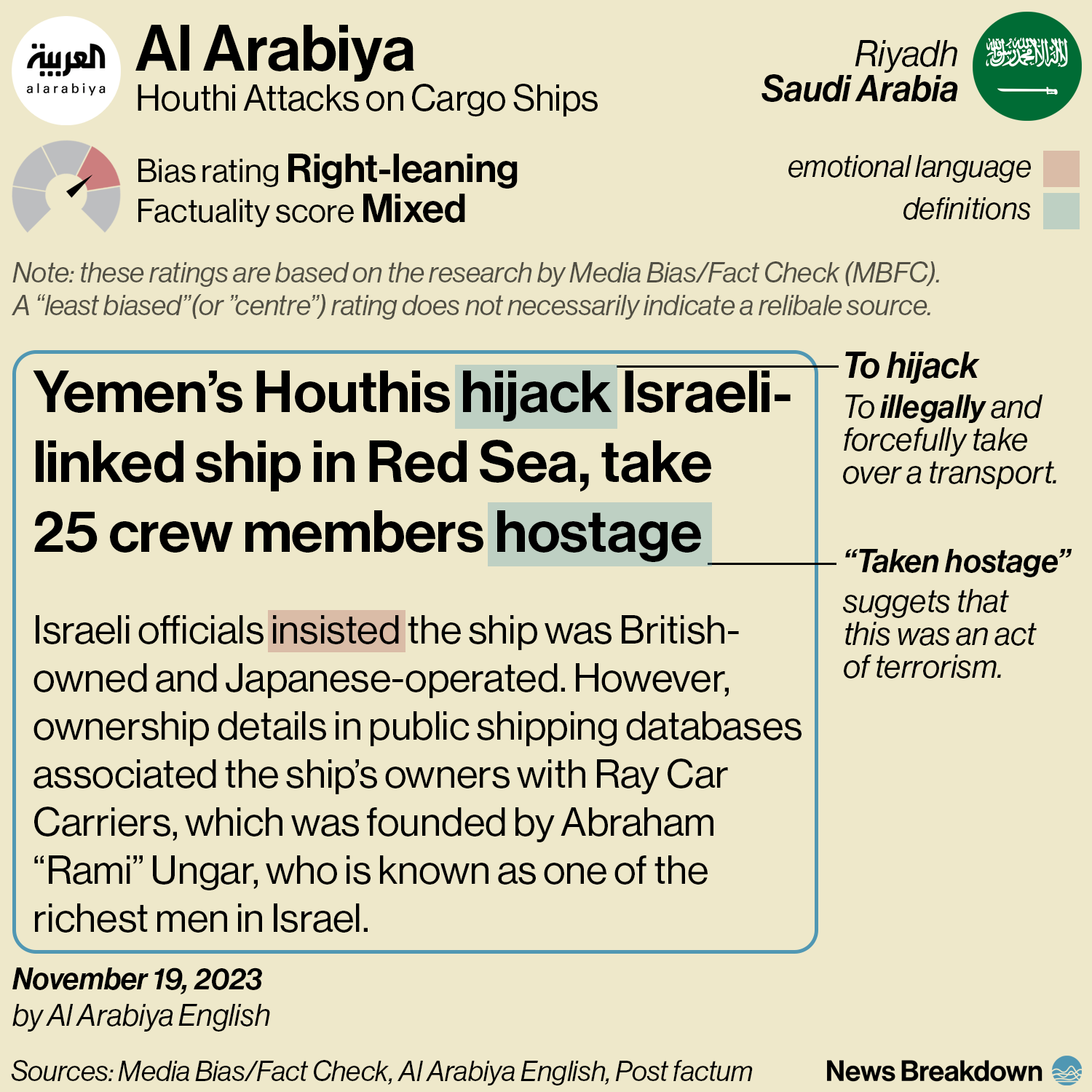
Al Arabiya: Saudi state-owned international news channel.
Al Arabiya maintains a neutral tone but shows a critical stance towards Houthis with its language.
It refers to the ship’s seizure as “hijacking” which underlines (truthfully) that the action is illegal under international maritime law.
It describes the arrest of the crew members as them being “taken hostage” which means that this is an act of terrorism.
Saudi Arabia is effectively at war with the Houthis, as it supported Yemen’s internationally recognised government when a Civil War broke out. There is a ceasefire in place since 2022.
Saudi Arabia and Iran are the two major rivalling powers in the Middle East.
The article by Al Arabiya describes the Houthis as a “militia” which ignores the fact that they control a large part of the country, including its capital, and represent an organised military force.
The article refers to Israel’s actions in Gaza as a “devastating campaign against Hamas” and the Gaza Strip as “besieged” balancing the views of its international and Arab audiences.
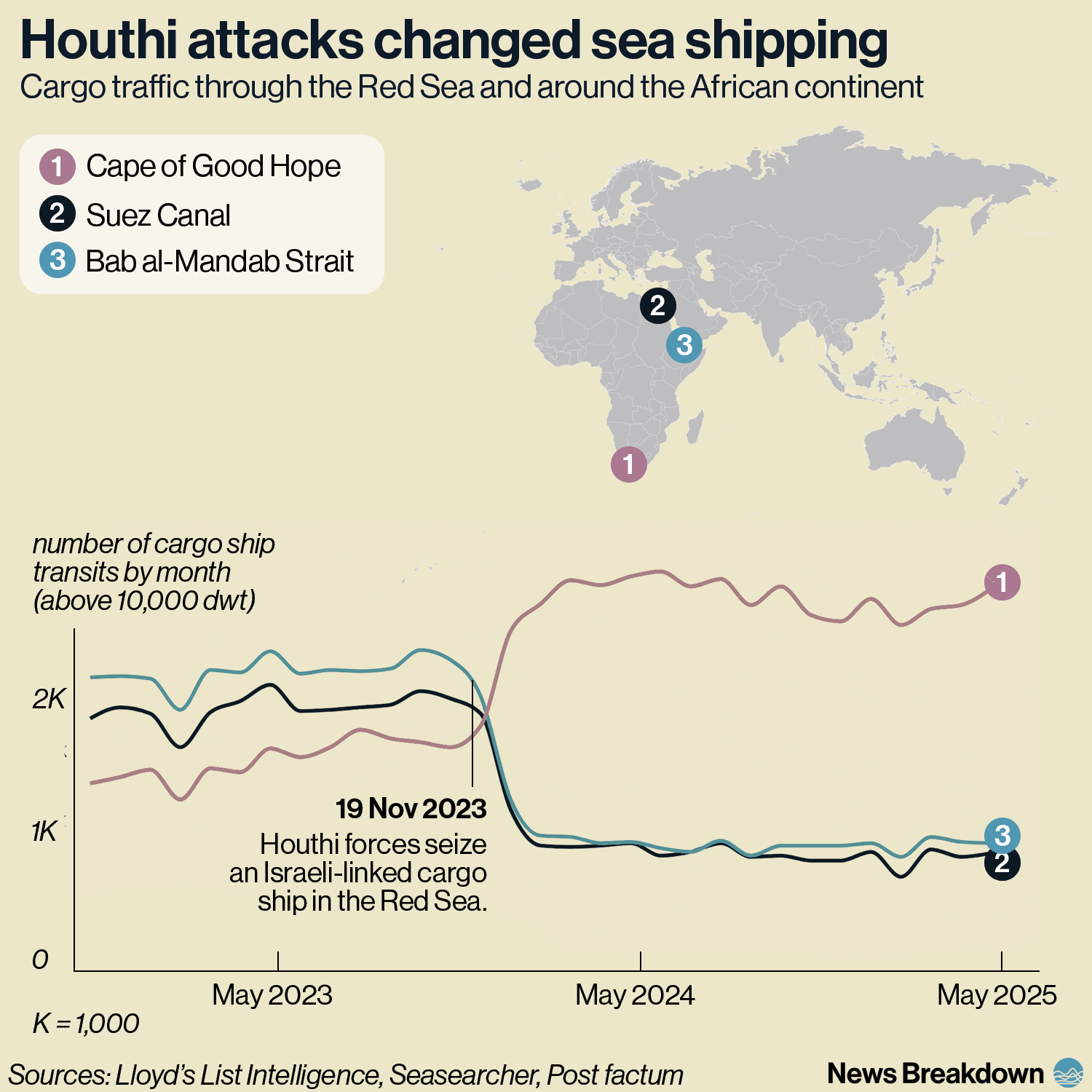
The attacks by the Houthis on international commercial ships in the Red Sea shifted the shipping traffic in the region.
The number of cargo ships sailing through the Suez Canal and the Bab al-Mandab Strait (for example, to get from Asia to Europe) has fallen by around 50%.
Shipping companies are forces to take a longer route around Africa, passing the Cape of Good Hope at its southern end, to avoid the risky areas of the Red Sea.
Multiple ships were attacked by the Houthis in 2024 and 2025, including with drones, missiles, gunfire, and explosive boats, causing multiple fatalities among sailors.
In January 2024, the US and the UK launched airstrikes on Houthi military targets to stop their attacks. This weakened the Houthis’ capabilities but did not put an end to the attacks.
Israel has also launched strikes on the Houthis in response to the drone and missile strikes on its territory, and the attacks on commercial vessels.
Galaxy Leader was taken to Yemen and turned into a political museum.
The 25 crew members were kept hostage for over a year despite none of them being US or Israeli nationals. They were released in January 2025 during a 2-month ceasefire between Israel and Hamas.
In July 2025, the Houthis resumed strikes on commercial ships in the Red Sea after a 7-month pause.
Two Greek-operated ships sank in the Red Sea this month after taking missile and drone fire, with at least 11 sailors reported missing.
Thank you for reading!
Author Anton Kutuzov