
Geopolitics of Poland
NATO’s Eastern Border
December 11, 2025
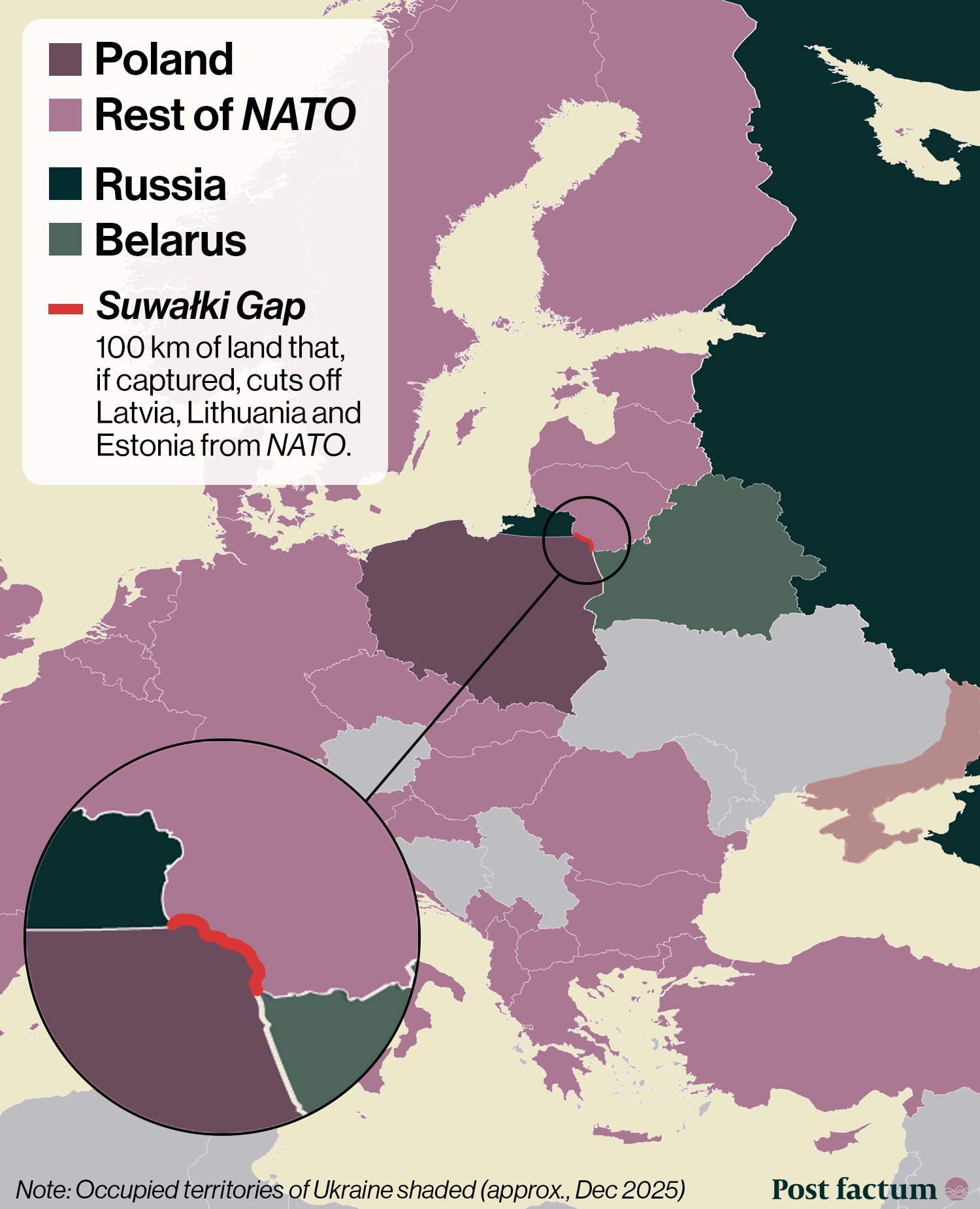
During the Cold War, Poland acted as a Soviet-controlled buffer between the Soviet Union and NATO.
Following the fall of the Soviet Union, Poland has become a democratic republic and shifted towards Western influence.
Poland joined NATO in 1999.
It is located on NATO's Eastern border and hosts its largest battlegroup in Europe: 12,000 troops mostly from the US.
Poland also hosts NATO's air defence systems and other infrastructure.
After Russia's annexation of Crimea in 2014, Poland started growing and modernising its military:
Increased armed forces from 99,000 in 2014 to 216,000 in 2024.
Increased military spending from 1.9% of GDP in 2014 to 4.7% in 2025, highest among NATO members.
Poland's largest weapons suppliers are Bulgaria, South Korea and the US, but detailed figures are secret.
In 2023, Poland and the US signed defence agreements worth $30 billion for Abrams tanks, F-35 fighter jets, and Patriot air defence systems.
In 2022 and 2025, Poland signed $19 billion worth of import deals with South Korea, including for Korean-made tanks, jets and artillery.
Poland's spending on defence and aid to Ukraine have increased its budget deficit to 6.5% in 2024.
In 2025, credit rating agencies lowered Poland's economic outlook, partly due to rising defence spending.
Poland borders Kaliningrad, a Russian exclave.
An exclave is the territory of a country that is geographically separate from it, surrounded by foreign land.
Strategic relevance: Kaliningrad hosts Russian warships, and missile systems capable of carrying conventional or nuclear warheads.
The Polish-Lithuanian border is called the Suwałki Gap, a narrow corridor that is the shortest land route between Belarus and Kaliningrad.
If Russia captures the corridor, it could cut off NATO's land connection to Estonia, Latvia and Lithuania.
Poland borders Belarus, which is involved in hybrid warfare against Poland.
Since 2021, Belarus has directed refugees from the Middle East and North Africa toward its border with Poland, triggering a humanitarian and security crisis along it.
In response, Poland built a 187-kilometre fence equipped with cameras along its 400-kilometre border with Belarus.
As of 2025, 1,900 migrants suffered violence from Polish forces, 1,650 from Belarusian forces, and 90 died.
In 2024, Poland started a $2.5 billion project to build modern fortifications along its borders with Belarus and Kaliningrad, including electronic warfare systems.
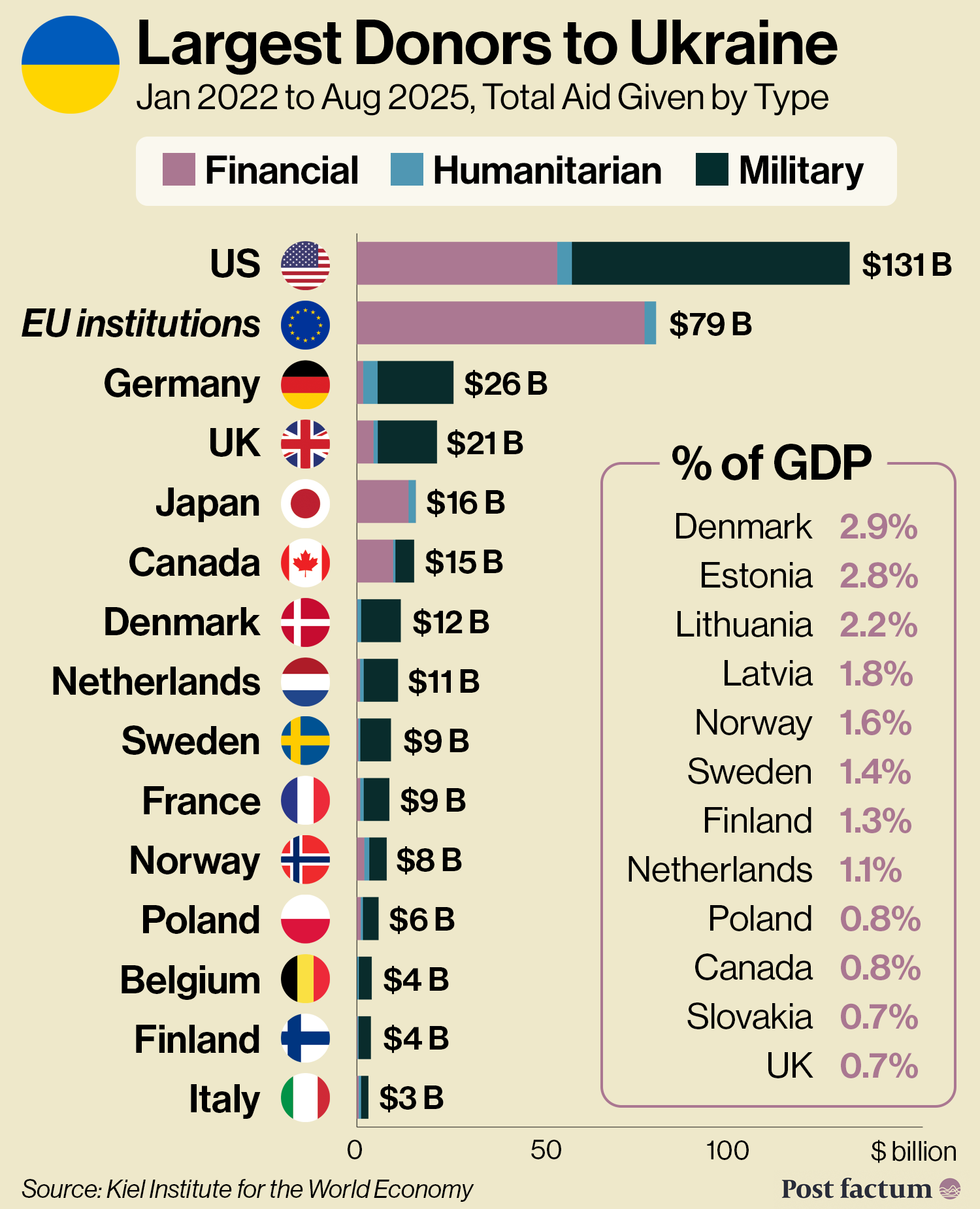
Aid to Ukraine
Poland borders Ukraine and serves as the main transit route for Western weapons and humanitarian aid into the country.
Since 2022, Poland has given Ukraine $6 billion worth of financial, humanitarian and military aid (or 0.8% of its 2021 GDP).
Poland hosts 1 million Ukrainian refugees displaced by Russia's invasion.
In 2024, Ukrainian refugees contributed an estimated 2.7% to Poland's GDP, taking into account both the costs of supporting them and the economic benefits they generated.
Visegrad Group: Geopolitics
Poland, the Czech Republic, Hungary and Slovakia are members of the Visegrad Group (V4).
The V4 was formed in 1991 to move away from communism and pursue reforms required for joining the EU and NATO.
During the 2015 migrant crisis, the V4 states jointly opposed the EU's mandatory relocation policy for asylum seekers.
In later years, the V4 had disagreements over key issues, especially energy and the Russian invasion of Ukraine.
Poland and the Czech Republic support Ukraine's accession to NATO and the EU.
Hungary does not support Ukraine joining either the EU or NATO.
Slovakia supports Ukraine's EU membership but opposes its NATO membership.
Energy Policies
The V4 member states partly relied on Russian energy before the invasion of Ukraine.
In 2025:
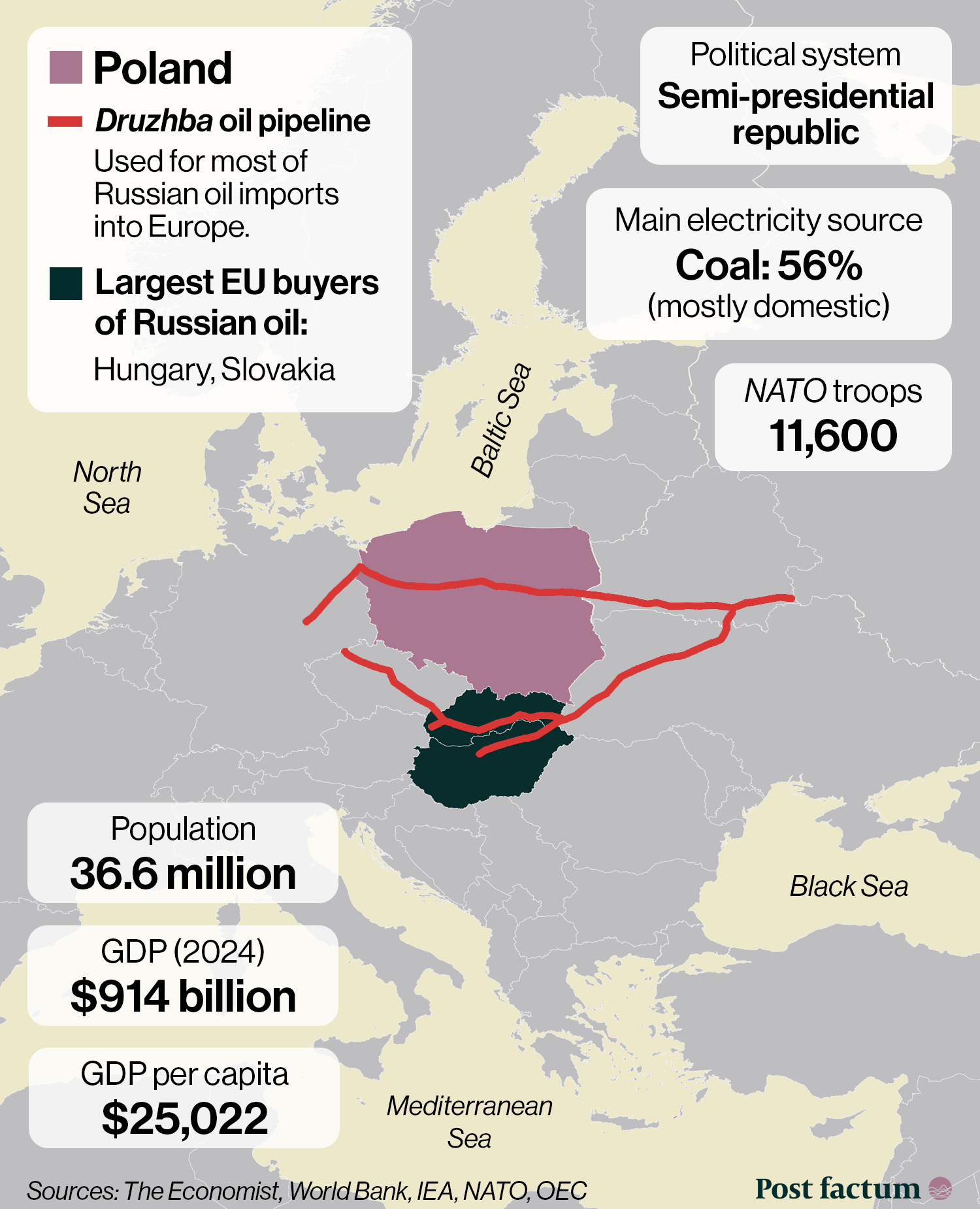
Hungary and Slovakia import over 75% of their oil and gas from Russia
The Czech Republic and Poland have stopped all imports from Russia.
Hungary is also cooperating with Russia to expand its nuclear power plant.
In 2024, Poland generated 54% of its electricity from coal, the highest share among EU countries.
In 2024, about 90% of the coal came from domestic mines.
Poland's coal mines face rising extraction costs, needing state support to remain operational.
Poland imports crude oil and refines it locally, as well as importing petroleum products.
Russia was the main supplier of crude oil to Poland with around $10 billion of imports per year.
By 2023, Poland stopped importing Russian oil in favour of other suppliers.
Poland also stopped Russian gas imports, which had accounted for 57% of its total gas imports in 2021.
In 2022, a major pipeline delivering gas from Norway was opened.
Poland increased the share of renewables in electricity generation, from 21% in 2022 to 30% in 2024.
In 2019, Poland and the US began collaborating to build a nuclear power plant in Poland by 2036.
Domestic Politics
2015-2023: Poland was ruled by the conservative/centre-right PiS party.
PiS expanded government influence over the legal system and news media.
It increased control over the Constitutional Tribunal and Supreme Court.
It gave the government authority to appoint heads of TV broadcasters.
In 2020, a state-controlled energy company bought Poland’s largest regional newspaper group.
Poland’s media freedom index fell from 87/100 in 2015 to 75/100 in 2025.
In 2017, the EU began legal proceedings over judiciary independence, and in 2021 froze Poland’s $42 billion post-COVID recovery fund.
On social policy, PiS introduced a monthly $130 cash transfer per child. Poland’s fertility rate rose from 1.3 to 1.5 children per woman, still below replacement level.
In 2019, about 100 Polish towns adopted anti-LGBT resolutions, covering nearly one-third of the country.
After the EU condemned the resolutions and linked funding with compliance with LGBT rights, all the Polish towns revoked their declarations by 2025.
In 2020, the Constitutional Tribunal practically banned abortion.
The trend: Legal abortions in Poland fell from 1,076 in 2020 to 107 in 2021, but then rose again to 425 in 2023.
In 2023, PiS was replaced by a centrist coalition.
The EU ended its legal actions after the new government promised judiciary reforms. $7 billion of the frozen recovery fund was released.
By 2025, most reforms remained incomplete, though the EU noted slight improvements.
Economy
Poland's real GDP per capita has grown from $1,700 in 1990 (after the communist regime ended) to $25,000 in 2024.
2 major factors behind the economic growth:
Liberalisation, or “free market” reforms
Joining the European Union in 2004
EU membership opened a market with 450 million consumers for Polish firms and products. It also increased foreign investment in Poland.
Between 2004 and 2023, Poland received approximately $265 billion and contributed $90 billion to the EU budget, resulting in a net gain of $175 billion, or 20% of Poland's annual GDP.
Germany is Poland's largest trading partner, with bilateral trade reaching $164 billion in 2023.
German companies account for over 20% of foreign investments in Poland.
Polish factories are part of the German manufacturing sector, particularly in automotive and machinery.
China–Poland trade reached $48 billion in 2023, driven by Polish imports of smartphones, batteries and solar panels.
In 2022, Chinese firms supplied 38% of Poland's 5G network components, but Poland has since started to replace them due to security concerns.
Despite Poland joining China's Belt and Road Initiative in 2016, Chinese investment in Poland remained modest at $2.4 billion in 2022.
Author Elia Preto Martini
Editor Anton Kutuzov
More below:
Join the discussion: