
The Kurds, Explained
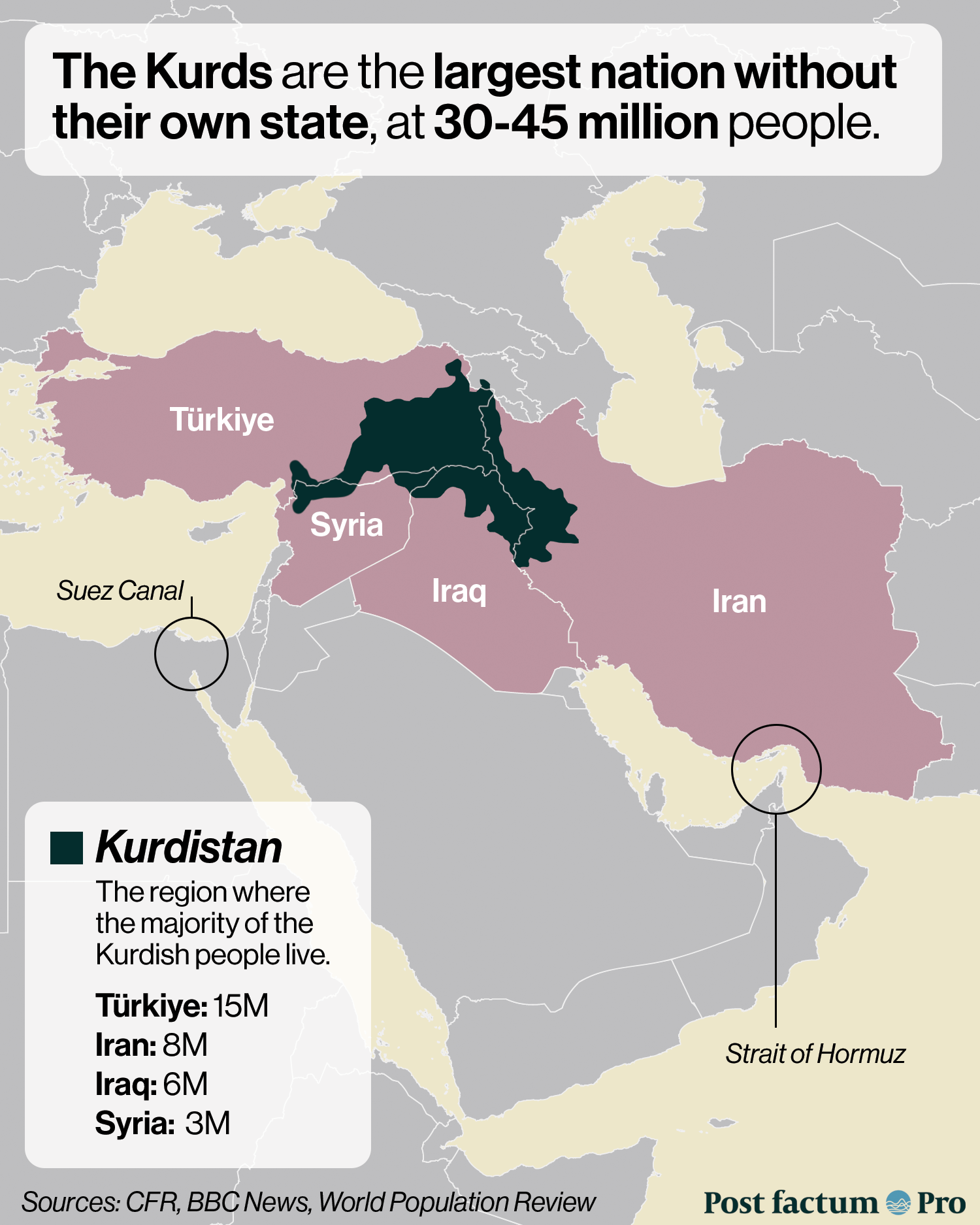
The Largest State-less Nation
March 10, 2026
The Kurds are an ethnic group of 30-40 million people living mostly in Turkiye, Iraq, Iran and Syria.
They speak a language related to Farsi (Persian) and are mostly Sunni Muslims.
International treaties in the 1920s divided Kurdish lands between newly-made countries, leaving the Kurds without a state of their own.
Kurdish groups have fought for autonomy or independence in all 4 countries over the past century.
Turkiye: Kurds make up about 20% of the population; a Kurdish armed group (PKK) has fought the state since 1984 in a conflict killing over 40,000 people.
Iraq: Kurds in the north run a semi-autonomous region with their own government but are in tensions with the government of Iraq, especially over oil profits.
Syria: during the civil war, Kurdish fighters partnered with the US against the Islamic State from 2014, controlling much of the northeast until 2026.
Iran: Kurds make up about 10% of the population and face repression; Kurdish areas were a focal point of mass unrest in 2022 and 2025.
On 28 February 2026, the US and Israel launched a military campaign against Iran, targeting nuclear and military sites.
The US has been in talks with Iranian Kurdish groups about providing military support, but no Kurdish ground operations inside Iran have taken place so far.
Anti-government protests that began in Iran in late 2025 led to thousands of deaths, with Kurdish regions among the hardest hit.
In Syria, the US partnered with the Kurds against ISIS but shifted its support toward the new Syrian government in 2025.
Kurdish forces in Syria signed a ceasefire with the new government in January 2026, ending Kurdish self-rule in the northeast.
In Turkiye, the PKK voted to disband in May 2025 after its imprisoned leader called the armed conflict no longer needed.
President Erdogan needs support from the pro-Kurdish party in parliament to change the constitution and run for a 4th presidential term in 2028.
Turkiye has been the most active foreign power in Kurdish affairs, conducting military operations in both Iraq and Syria and pushing for the end of Kurdish self-rule in Syria.
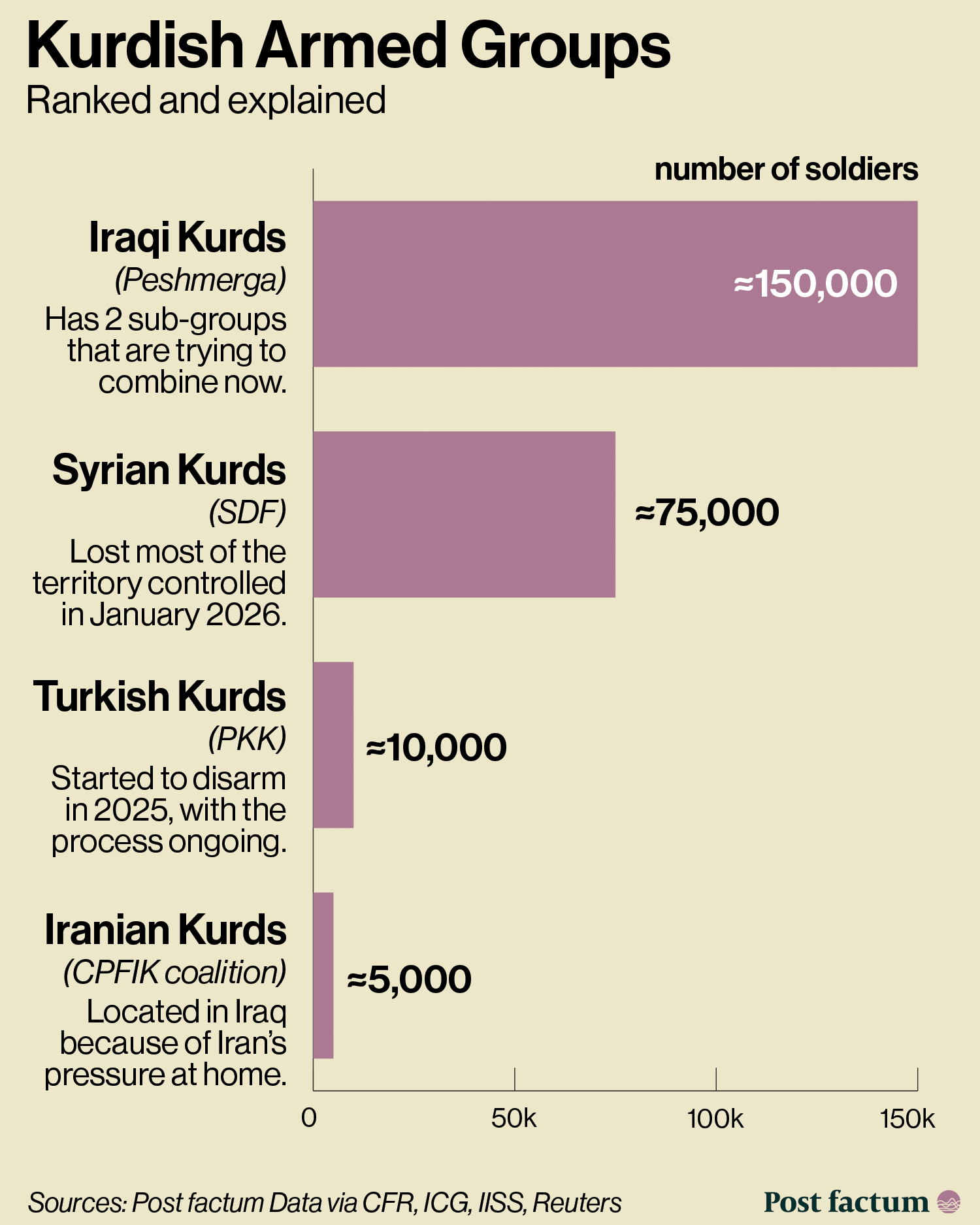
Iran’s Kurdish armed groups are based in Iraq, having been pushed out of Iran over decades of conflict.
Iranian Kurds
2026 war: as the US-Israeli bombing campaign continues, Kurdish fighters are among the few potential land forces than can join the war against Iran on the ground.
2025 unrest: anti-government protests that began in December 2025 led to violence across Iran, with Kurdish armed groups attempting to cross from Iraq into Iran.
Repression: Iran executed over 1,500 people in 2025, at least 231 of them ethnic Kurds, the highest figure in decades.
Lack of rights: Kurdish language is excluded from education in Iran; at least 822 Kurds were arrested in the first half of 2025.
The 2022 killing of an Iranian-Kurdish woman by the police triggered nationwide protests, with Kurdish areas among the hardest hit.
Iraqi Kurds
Iraq's Kurdish region has been semi-autonomous since the early 1990s, when Kurdish parties gained control of three northern provinces.
After the US-led coalition defeated Iraqi dictator’s invading force in Kuwait, he suppressed a rebellion by ethnic groups, including the Kurds, killing around 100,000 people, mostly civilians.
The 2003 US-led invasion of Iraq strengthened Kurdish self-rule, with the country formally recognising the Kurdish regional government and sharing some oil revenue.
The Islamic State swept through northern Iraq in 2014, and Kurdish fighters helped recapture territory, temporarily taking control of the oil city of Kirkuk.
2017 referendum: Kurds in Iraq voted for independence, but the government responded with military and economic retaliation, retaking Kirkuk and other disputed areas.
Oil revenue: sharing between the government and the Kurdish government remains a source of tension, with Iraq reasserting control over Kurdish oil exports.
Foreign presence: about 2,500 US troops remain in Iraq, focused on military training and preventing a return of the Islamic State.
The Iraqi government has reasserted control over the Kurdish region's budget and oil infrastructure since the failed 2017 referendum, limiting Kurdish economic independence.
Turkiye has a network of military bases inside Iraqi territory.
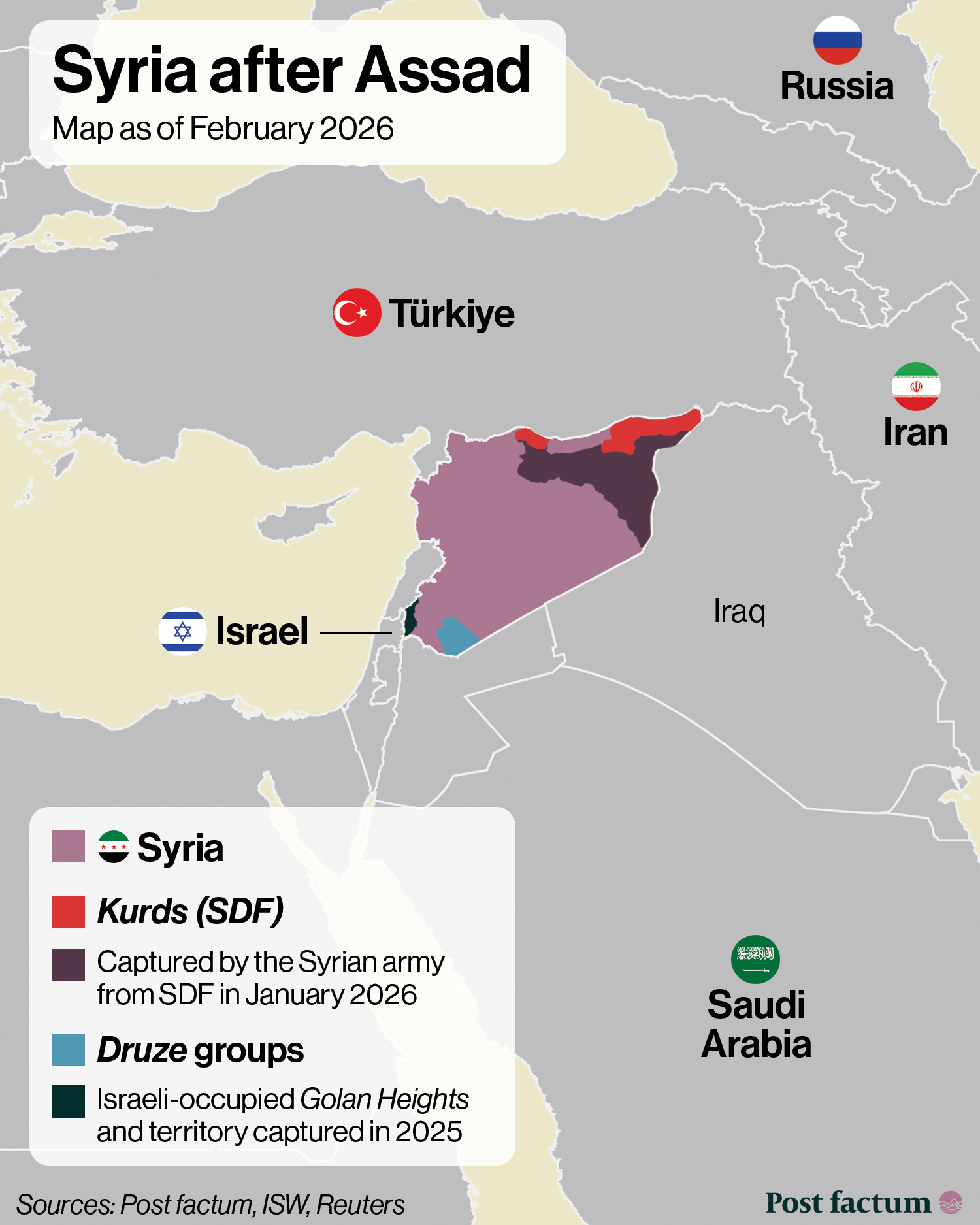
Syria
Kurds form about 10% of Syria's population.
Under the previous government, Kurds were denied citizenship and banned from using their language.
When civil war broke out in 2011, Kurdish groups established self-rule in the northeast while the government fought other rebels.
Kurdish fighters partnered with the US from 2014, later forming the Syrian Democratic Forces (SDF) to fight the Islamic State.
The SDF controlled much of northeast Syria, including most of the country's oil resources.
After the Assad government fell to rebel forces in December 2024, the new authorities pushed to end Kurdish self-rule.
The SDF captured 9,000 ISIS fighters and 30,000 of their family members. Some of the prisoners escaped during the 2026 offensive by the new Syrian government, and some were transferred to Iraq.
In January 2026, the SDF signed a ceasefire agreeing to integrate its forces into the new Syrian military.
The agreement allows small Kurdish security units in some areas but ends the broader autonomous administration.
The new government recognised Kurdish as a national language and declared Newroz, the Kurdish new year, a national holiday.
Turkiye
The PKK is a Kurdish armed group that launched a rebellion in Turkiye in 1984, first asking for independence but later demanding just autonomy and cultural rights.
The conflict: over 40,000 people have been killed; Turkiye, the US and the EU classify the PKK as a terrorist organisation.
Cross-border operations: Turkiye has conducted military strikes in Iraq and Syria against PKK-linked groups, and views the SDF as an extension of the PKK.
Political repression: by February 2025, Erdogan had removed at least 10 pro-Kurdish mayors, replacing them with state-appointed officials.
Imprisoned PKK leader called on the group to disarm in February 2025, saying the armed struggle had become obsolete.
The PKK declared a ceasefire on 1 March 2025 and its leadership voted to disband in May 2025.
On 11 July 2025, 30 PKK fighters burned their weapons at a ceremony in northern Iraq, marking the start of the disarmament.
Erdogan said the agreement between Syria's new government and the SDF eased tensions in Turkiye's own peace process with the PKK.
Erdogan is planning a re-election in 2028, and a constitutional reform is needed to allow another term in office. For that, he may need the support of Kurdish politicians and voters.
The peace process involves 3 parties: the Turkish government, the PKK armed group and the Kurdish political party in parliament, some members of which were charged with terrorism.
The PKK is waiting for a response from the Turkish government, asking for amnesty, prisoner releases and expanded Kurdish-language education.
As of March 2026, Erdogan has not announced amnesty, prisoner releases or constitutional changes in response to the PKK's disarmament.
The leader of the PKK called for new legal reforms in February 2026 to support the disarmament process, a year after first asking the PKK to start disarming.
Thank you for reading!
Join Post factum Pro to access the comments section