
Geopolitics of Venezuela
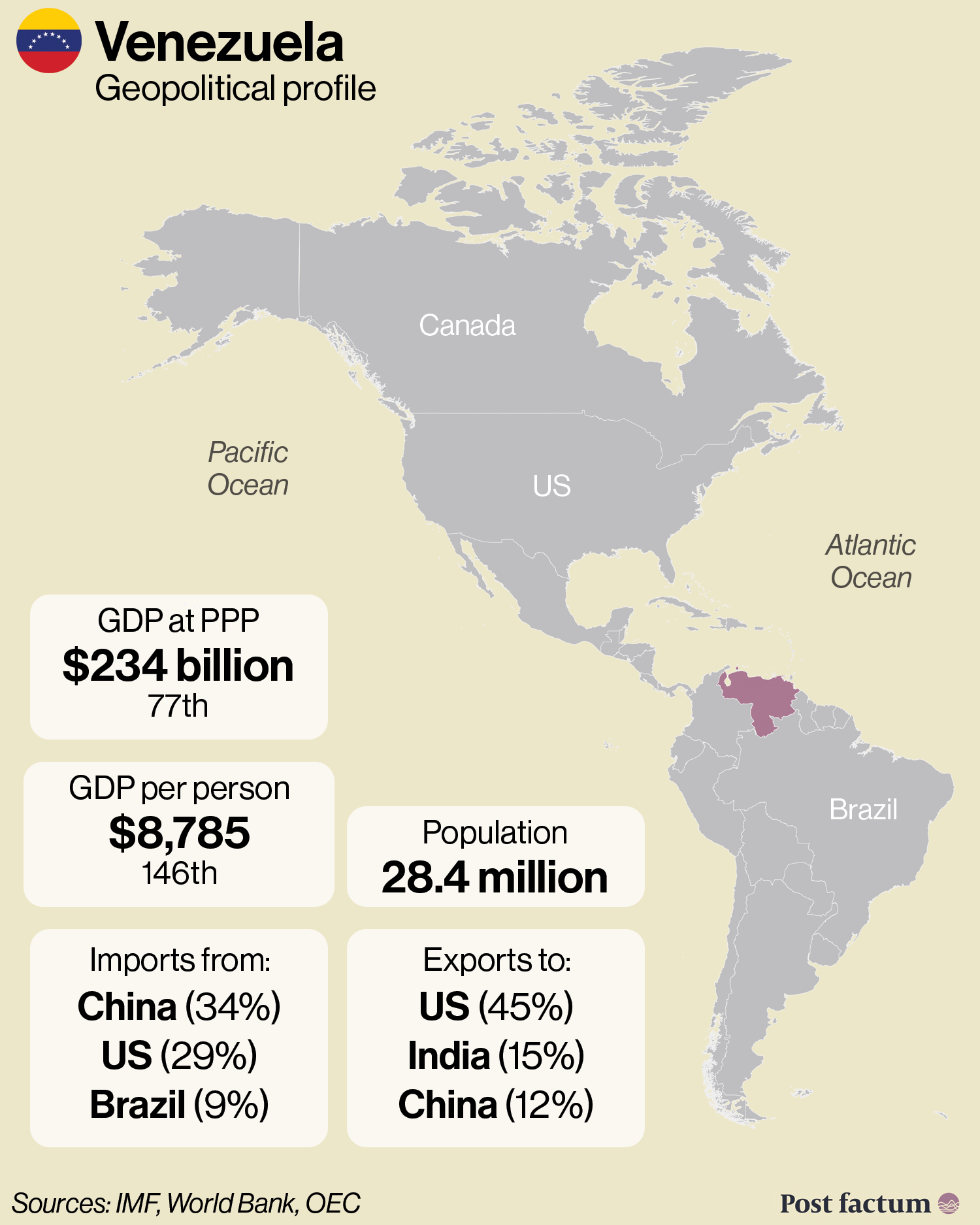
Oil, Drugs and Global Powers
March 15, 2026
Venezuela holds the world's largest oil reserves, around 303 billion barrels, or 17% of the global total.
China, Russia and the US compete for influence in Venezuela.
In January 2026, the US captured President Maduro on drug trafficking charges.
Key background
Between the 1950s and 1980s, Venezuela was one of the wealthiest nations in South America.
Today, over 80% of its population lives in poverty.
The economic crisis began in the 2010s under President Hugo Chavez, who led the country since 1998 as a socialist authoritarian.
Chavez relied on oil revenues to fund social programs and strengthen his political power, as the economy began to struggle.
When oil prices fell in 2014, the government printed money to keep spending, causing price to grow out of control.
At its peak in 2018-2019, (hyper)inflation reached up to 1,000,000%, meaning the prices of goods doubled every week.
Inflation has since declined but remains among the highest in the world, reaching 475% in 2025, up from 48% in 2024.
After Chavez’s death in 2013, his right-hand-man Nicolas Maduro maintained power through control of the military and judiciary.
Security forces arrested several opposition figures, journalists and protesters.
The United States, the EU and several South American countries refused to recognise Maduro's election and re-elections in 2018 and 2024.
To learn more, including the failed attempt to replace Maduro in 2019, read our older report.
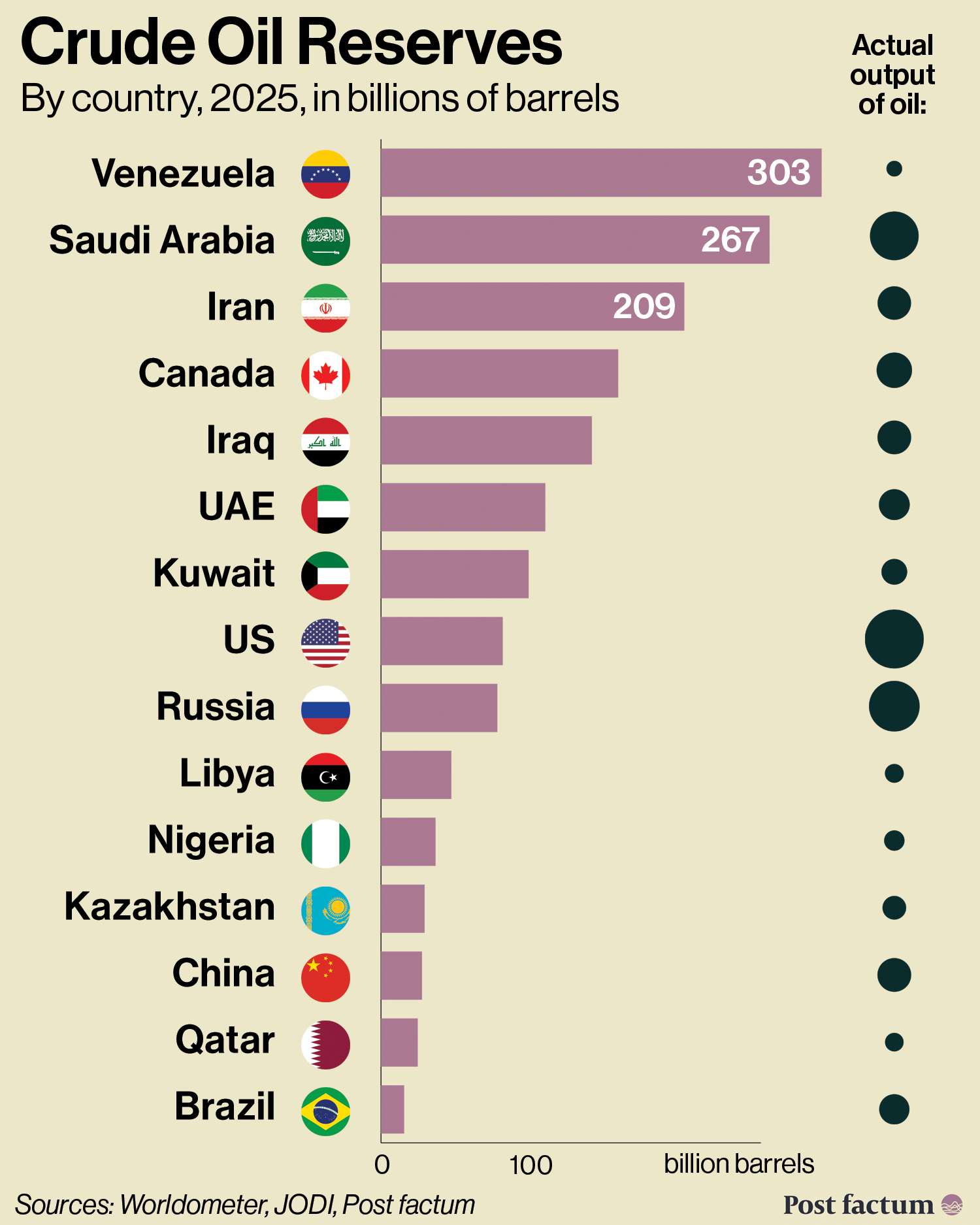
Oil accounts for nearly 90% of Venezuela's exports and pays for 60% of the national budget.
Venezuela's oil is mostly “extra-heavy” crude.
“Extra-heavy” crude: a type of oil that is thicker, it is costly to extract and requires foreign technical expertise to process.
Despite large reserves, oil production has declined by over 70% from 1998 to 2025.
The main reasons include:
Mismanagement and corruption: thousands of qualified engineers and workers at the state oil company were replaced by supporters of Chavez.
Under-investment: oil revenues were redirected into ineffective social programs and not enough was spent on the oil infrastructure.
US sanctions: sanctions prohibited Venezuela's access to US financial markets, beginning in 2017. Some sanctions are now being reviewed.
In January 2019, the US sanctioned the Venezuelan state oil company.
To avoid US sanctions and export its oil, Venezuela uses the "shadow fleet", a network of tankers that hide the origin of the oil, or the shipment itself.
Venezuela sells crude oil at a discount compared to international benchmarks like Brent.
Main reasons:
Quality: refiners pay less because extraction and refining costs are higher.
Sanctions: the US threatened "secondary sanctions" on companies that trade Venezuelan oil, so buyers have extra risks.
As of late 2025, Venezuelan crude traded at a discount of about $15 per barrel below Brent.
China
China's interest in Venezuela is primarily economic.
China is Venezuela's largest oil buyer, accounting for around 65% of Venezuela's total oil exports in 2024.
Venezuelan oil represents around 4% of China's total oil imports.
Selling oil to China helps Venezuela get foreign currency, as US sanctions restrict the country's access to international financial markets.
Between 2000 and 2023, China loaned about $100 billion to Venezuela, making it the 4th largest recipient of Chinese lending.
Loans are mostly repaid through crude oil shipments.
Venezuela's current debt to China is about $10-15 billion.
China controls most of the mining for critical minerals in Venezuela, including rare earths.
Russia
Russia's main interests in Venezuela are (1) to expand its influence in the region and (2) challenge US interests there and globally.
Venezuela is Russia's main military ally in South America and the largest buyer of Russian weapons in the region.
Between 2004 and 2018, Russia loaned Venezuela an estimated $34 billion.
Russia helped Venezuela avoid US sanctions by providing shadow fleet tankers and helping oil sales to China and India.
Russian oil companies collaborated with Venezuela on oil extraction and infrastructure maintenance, especially before 2020.
Russia and China have both used their positions on the UN Security Council to block resolutions against the Maduro government.
US
Under President Trump in particular, the US aims to expand its global influence, countering the presence of China and Russia, especially in South America.
Before 2017 sanctions, the US was Venezuela's largest buyer of oil.
At its peak in 2008, the US imported about $51 billion worth of Venezuelan crude.
The US did not buy any Venezuelan oil between 2019 and 2023, when it began negotiating with Maduro’s government using oil imports under President Biden.
The US has a set of oil refineries that are specialised on extra-heavy crude oil.
After the arrest of Maduro, the US started to increase its imports of Venezuelan oil.
Drug trafficking
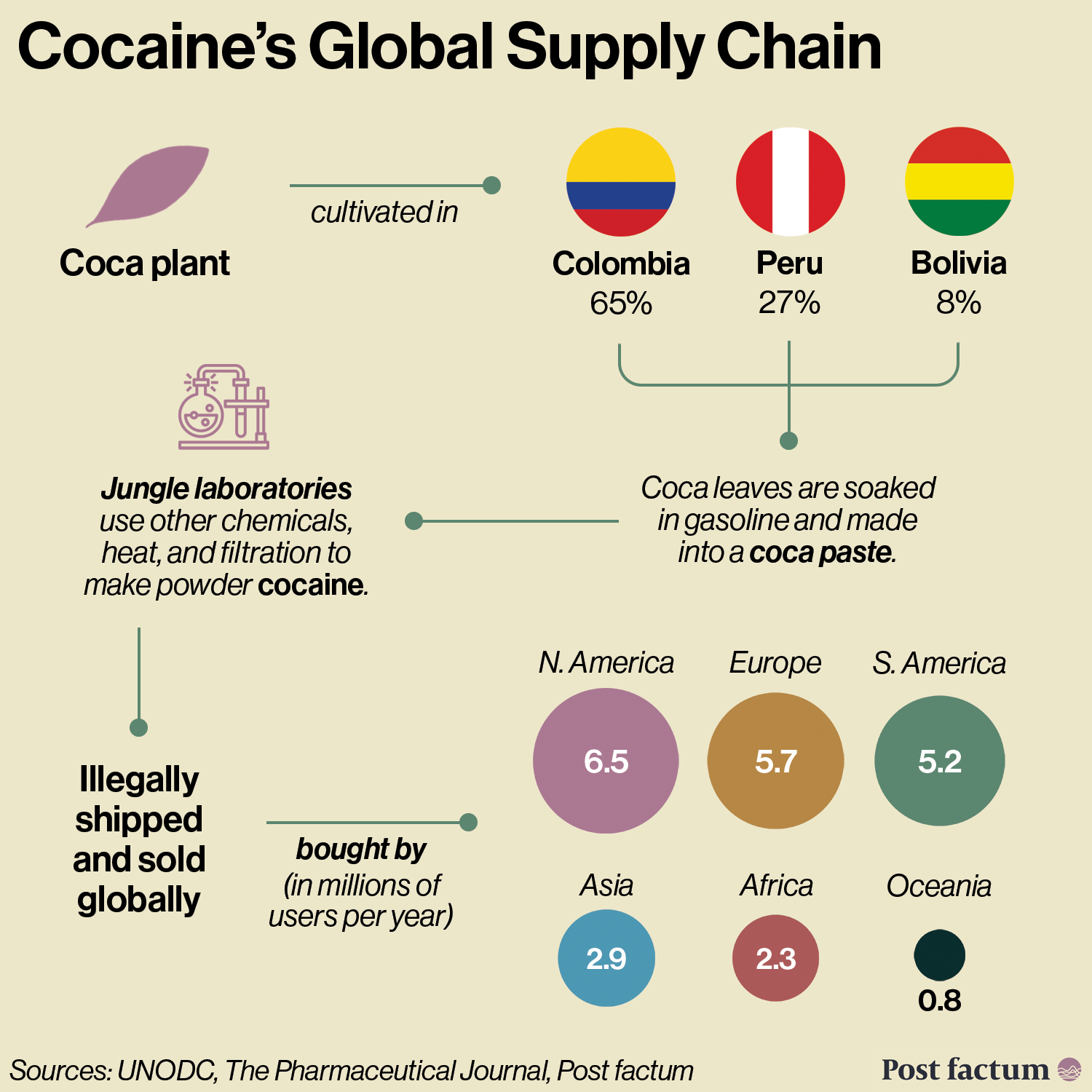
Venezuela is not a cocaine-producing country.
Venezuela is a transit corridor for cocaine.
Most cocaine that transits through Venezuela to the US arrives from Colombia.
About 250 tonnes of cocaine transit through Venezuela every year, accounting for about 10% of global production.
Only 8% of cocaine going to the United States transits through Venezuela, while around 90% is trafficked through other Caribbean and Pacific routes.
Some Venezuelan officials are involved in the smuggling of cocaine through Venezuela. They are called the Cartel de los Soles by the media and some academics.
In March 2020, the US accused Maduro and some other Venezuelan officials of narco-terrorism and cocaine trafficking.
Narco-terrorism: using drug money to pay for activities that go against the US national security, especially terror acts.
In 2025, the US listed the Cartel de los Soles as a terrorist organisation, identifying Maduro as its leader.
Soles means “suns” in Spanish, referring to the sun symbol on Venezuelan military uniforms.
Maduro has denied the cartel's existence as a made-up reason for a US intervention.
In August 2025, the US deployed ships to the southern Caribbean as part of a counter-narcotics operation.
US forces conducted strikes on vessels claimed to be transporting drugs, killing more than 150 people.
In January 2026, US special forces captured Maduro during a military operation in Venezuela.
Maduro was transported to the US where he faces criminal charges.
After the capture of Maduro, the vice president assumed the role of acting president, with the support of the United States.
She is known as a more moderate politician, open to more US influence.
Author Simone Chiusa
Editor Anton Kutuzov
Thank you for reading!
Join Post factum Pro to access the comments section