
Syria since the fall of assad
Democracy, Ethnic Violence and Geopolitics
Published: February 20, 2026
In December 2024, the Assad dictatorship in Syria fell, ending a 12-year civil war.
Bashar Assad fled to Moscow, Russia, where he now lives with his family.
The decisive attack was supported by Türkiye and led by the Islamist group HTS (Hayat Tahrir al-Sham).
HTS established a transitional government to rule the country for the next 4-5 years.
In this report, we analyse the first year of the new Syria: democratic progress, ethnic tensions and geopolitics.
Syria’s geopolitical context
Large crude oil reserves, economic and energy potential
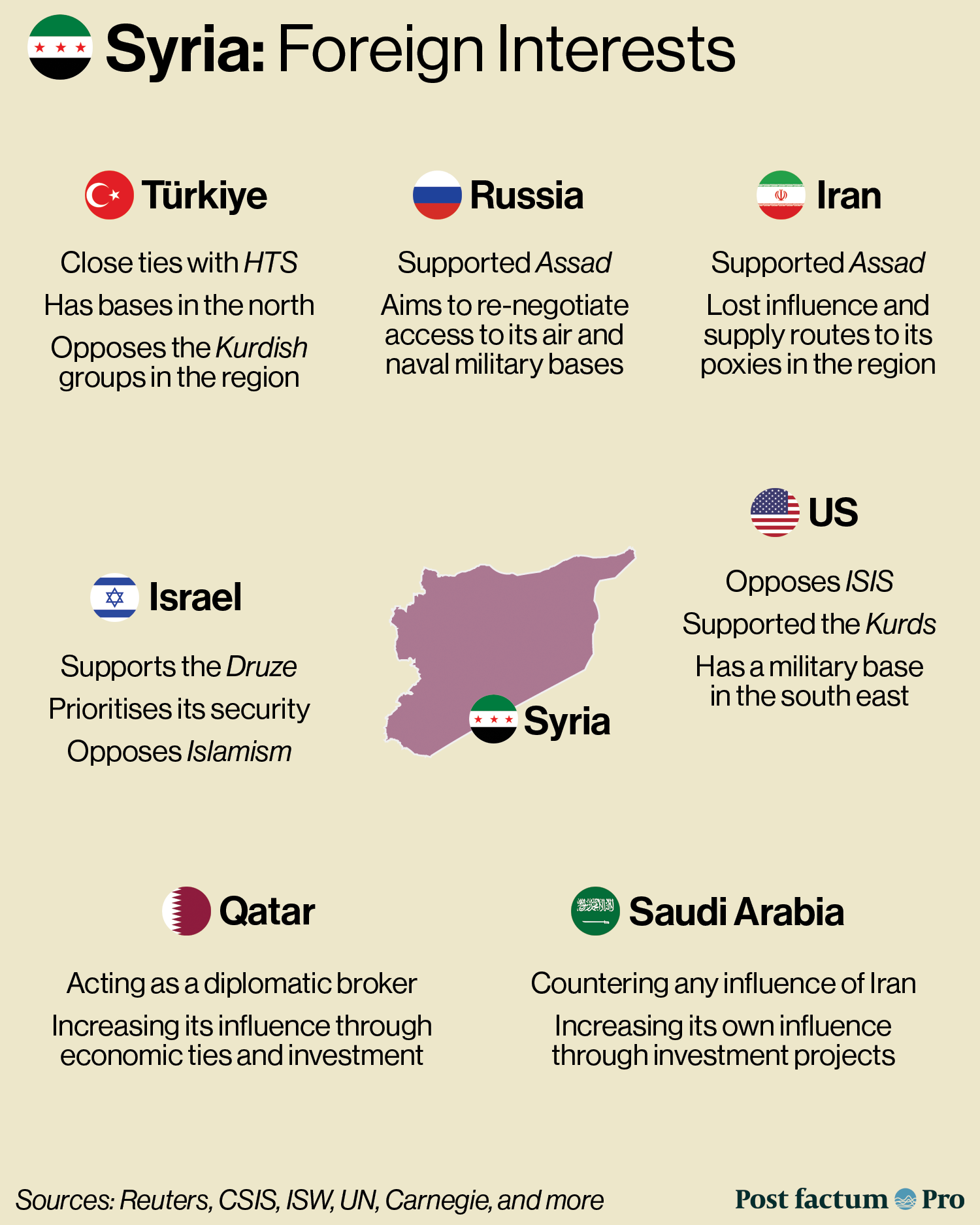
Competing interests of Iran, Israel, Russia, Türkiye and the US
Land route from Iran to its anti-Israeli allied militant groups
Kurdish minority population wanting more independence
The Kurds are a state-less ethnic group of 30 million people living mostly in Türkiye, Syria, Iraq and Iran.
During the civil war, the Kurds (SDF) established an independent government in northeast Syria.
In 2019, backed by the US, Kurdish-led coalition defeated ISIS militants in the region.
Türkiye sees the Kurdish groups as terrorists, and had attacked them during the civil war.
Why did Russia and Iran not support Assad?
Iran and Russia were the 2 main allies of Bashar Assad.
During the civil war, Russian military intervention on the side of Assad kept him in power.
Russia bombed the opposition forces, including the HTS, and provided financial support.
Since the invasion of Ukraine in 2022, Russia has directed more of its military and financial resources to the war effort, reducing their ability to support Assad.
Iran has also been an ally of the Assad regime, and the pro-Iranian Hezbollah has been fighting on its side (and also against pro-Israeli groups in Syria such as the Druze).
Since October 2023, Israel weakened Iranian proxy groups in the region, especially Hezbollah, reducing their ability to support Assad.
After the fall of the Assad regime, Israel bombed Syrian military infrastructure and equipment to decrease the country’s military potential.
Is Syria moving towards a democracy?
In short, it is impossible to tell yet.
There is some formal progress towards democracy but the new president is in the process of securing control over the country first anyway.
The President Ahmed al-Sharaa (leader of HTS) and some of his closest ministers hold most of the power in Syria today.
There is no current trend for Islamisation or the introduction of Islamic law on a legal level.
HTS follows Sunni Islam, and so does 70% Syria.
The government set up 2 committees to investigate human rights violations during the Assad rule. This does not include crimes committed by other groups, such as HTS.
Syria adopted a temporary constitution for 2025-2030.
A temporary parliament of 210 members was set up.
One-third were appointed by the president directly. Two-thirds were selected by electoral colleges (local representatives).
The election process was not completely transparent and involved only 6,000 voters directly.
One reason is the inability to carry out mass elections due to the destruction of a decade of war.
Sunni Muslims hold 92% of seats in the new parliament.
Alawite Muslims hold 3% despite being 12% of the population.
The Assad family was part of the Alawite community.
Kurds hold 3% of the seats, below their 10% share of the population.
Ethnic tensions
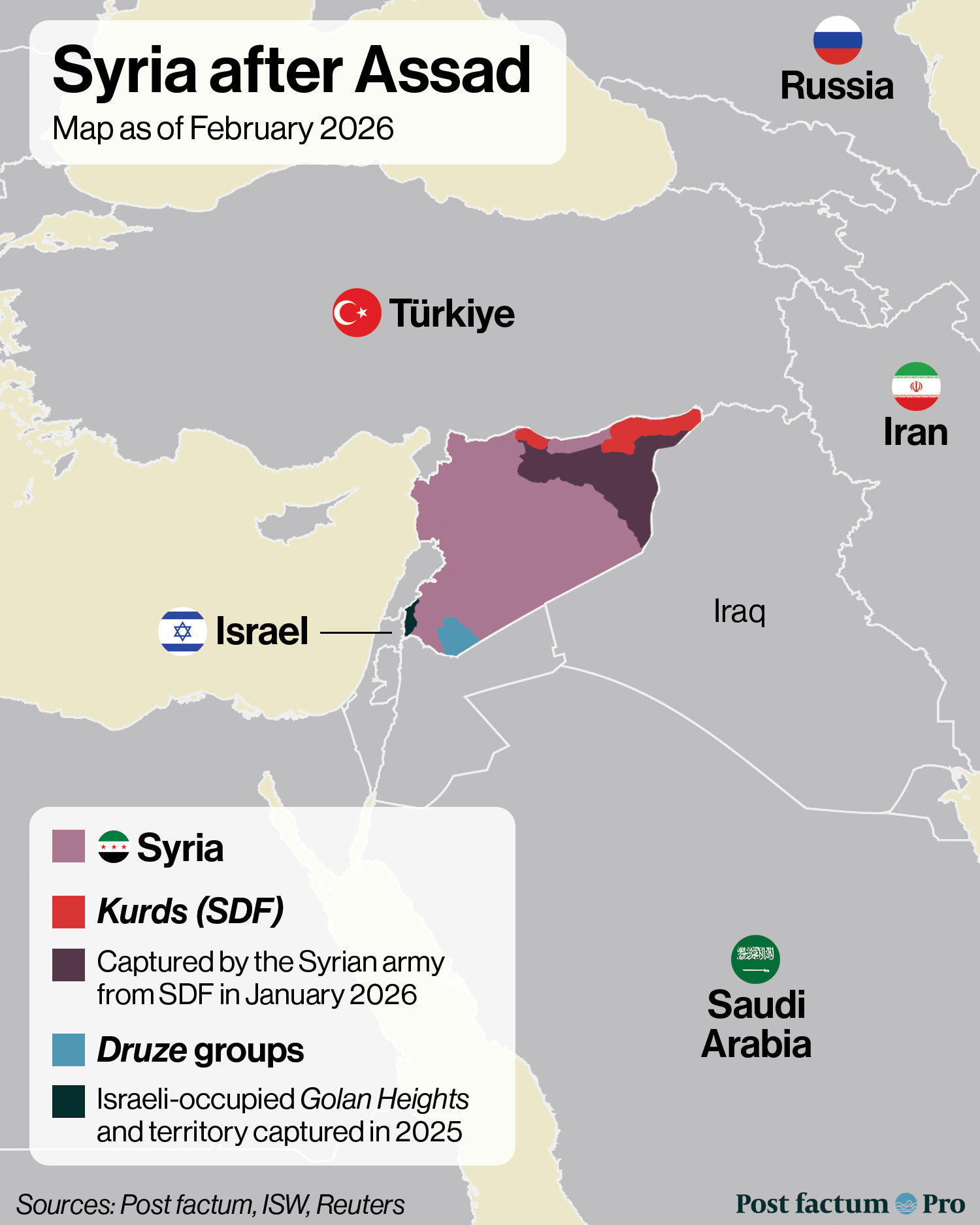
Most of Syria’s territory is controlled by the government but some is held by Kurdish, Druze and other militant groups.
In 2025, 3,400 people were killed in religious conflicts.
Despite this sectarian violence, 1.2 million international refugees and 1.9 million internally displaced Syrians returned home in 2025.
Alawites
Alawism is a type of Shia Islam.
After the fall of Assad’s regime, some Alawites lost their jobs, social status or were punished for supporting Assad.
In March 2025, pro-Assad Alawite militants launched a coordinated attack on the government (insurgency).
Pro-government forces responded and 1,400 Alawites were killed in the fighting and resulting religious violence, mostly civilians.
The government is making a complicated effort to re-integrate some ex-Assad supporters:
For example, it is giving pardons to militants willing to disarm and help disarm others, even if they may have committed serious crimes.
Druze
Druze faith originates from Shia Islam, but its followers do not identify as Muslims.
Druze represent around 1% of the population of Israel.
Israel supports Druze populations in Syria and Lebanon and uses this alliance to improve its influence and security.
In July 2025, Syrian army clashed with Druze and Bedouin groups, with mass displacement and over 1,400 deaths.
Druze groups control a part of Syrian territory in the south-west.
Israel occupies the Golan Heights since 1967. It captured some more territory after the fall of Assad.
It also bombed some Syrian military assets, reducing its offensive and defensive potential.
Kurds
After HTS took power, the Kurdish-led SDF (Syrian Democratic Forces) kept control of their territories in the northeast.
However, HTS-led government pushes for control over Syria’s whole official territory.
The SDF and the Syrian government signed a deal in March 2025 to integrate their military and political structures.
The deal was not realised: the SDF wanted to stay unified within the Syrian army, but HTS wanted the SDF mixed in with the rest of the military.
Clashes continued between the Syrian government forces and the SDF in 2025.
In January 2026, the government captured half of SDF’s territory in a major offensive.
The government then announced a ceasefire that included the SDF's full integration into the Syrian army (individually, not as a group).
The Syrian government also gave Kurds formal language rights, identity recognition, and restored their right to Syrian citizenship, stripped in 1962.
Economy and lifting sanctions
The new Syrian President made 21 state visits since February 2025 (including with Donald Trump), to gain more international legitimacy.
Ahmed al-Sharaa is the military leader of the Sunni Islamist group HTS who now heads the transitional government as President.
In July 2025, the US removed the HTS from its list of recognised terror groups, and in November the UN Security Council lifted personal sanctions off al-Sharaa
Syria attracted $28 billion in foreign investment since the fall of the Assad regime, to October 2025.
The cost of rebuilding Syria after the war is at least $216 billion, which includes mostly the cost of the destroyed infrastructure and housing.
Thank you for reading!
Authors Elia Preto Martini
Editor Anton Kutuzov
Leave a comment below: