
Arctic Geopolitics, explained
6 September 2026
- Falling summer ice cover is opening new Arctic shipping lanes.
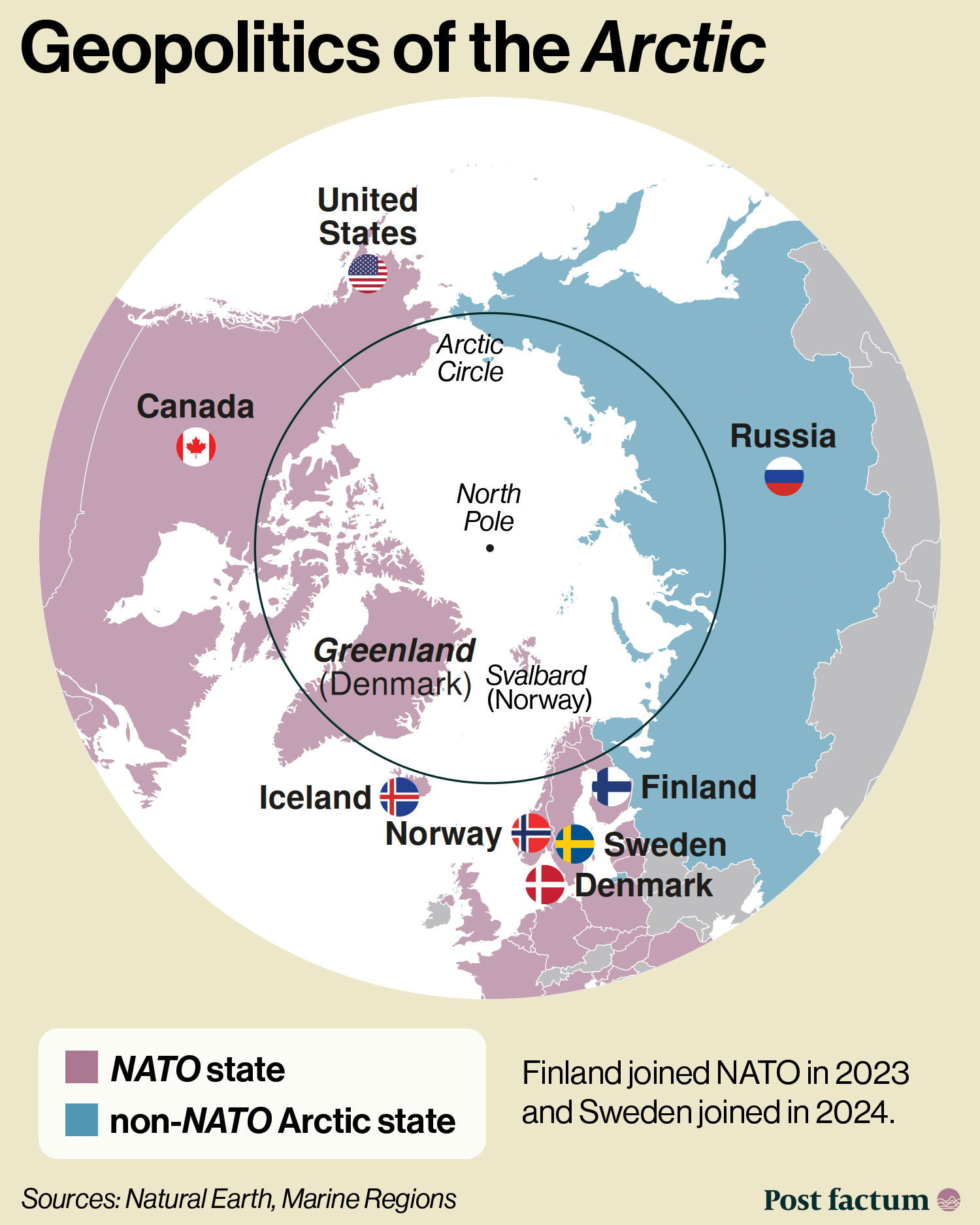
- 7 of the 8 Arctic states are in NATO; Russia holds over half of the Arctic coastline.
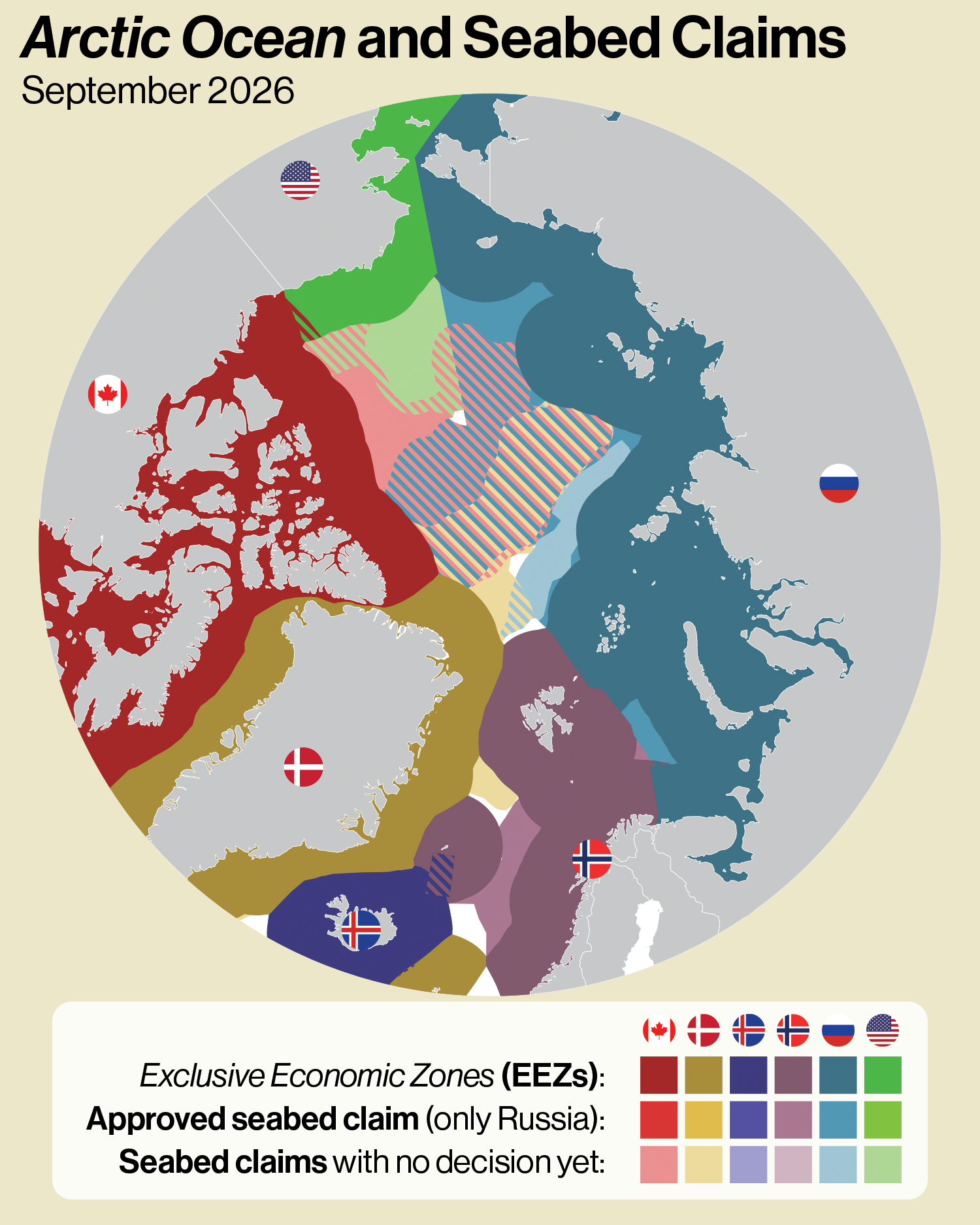
- Seabed claims overlap in the Arctic Ocean.
Why is the Arctic important?
- Resources: the Arctic produces about 12% of the world’s natural gas and 4% of its crude oil, over 90% of it in Russia.
- Defence: the shortest path for missiles between Russia and the US crosses the Arctic, and Russia’s most powerful fleet deploys into the Arctic Ocean.
- Shipping: summer routes between Asia and Europe through the Arctic are 30% shorter than going through the Suez Canal.
- Climate: the Arctic has warmed 4 times faster than the rest of the world since 1979, with lower ice cover opening new shipping lanes.
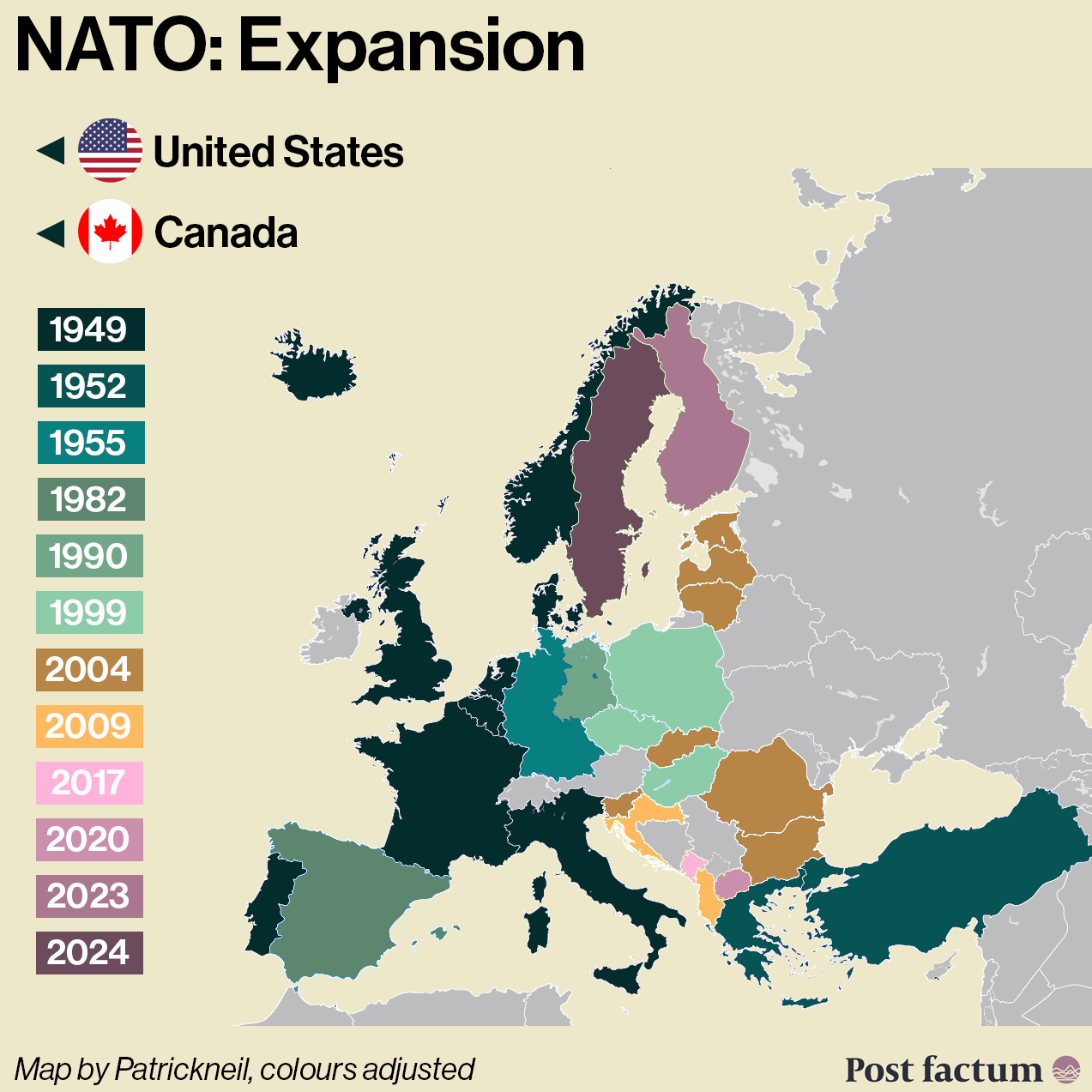
All Arctic states except Russia are NATO members since Finland joined in 2023 and Sweden in 2024.
Russia has 32 military bases in the Arctic, against 37 for NATO.
In October 2025, Russia test-flew a nuclear-powered cruise missile 14,000 km from its Arctic test site.
In March 2026, NATO launched Arctic military exercises with 30,000 troops in northern Norway.
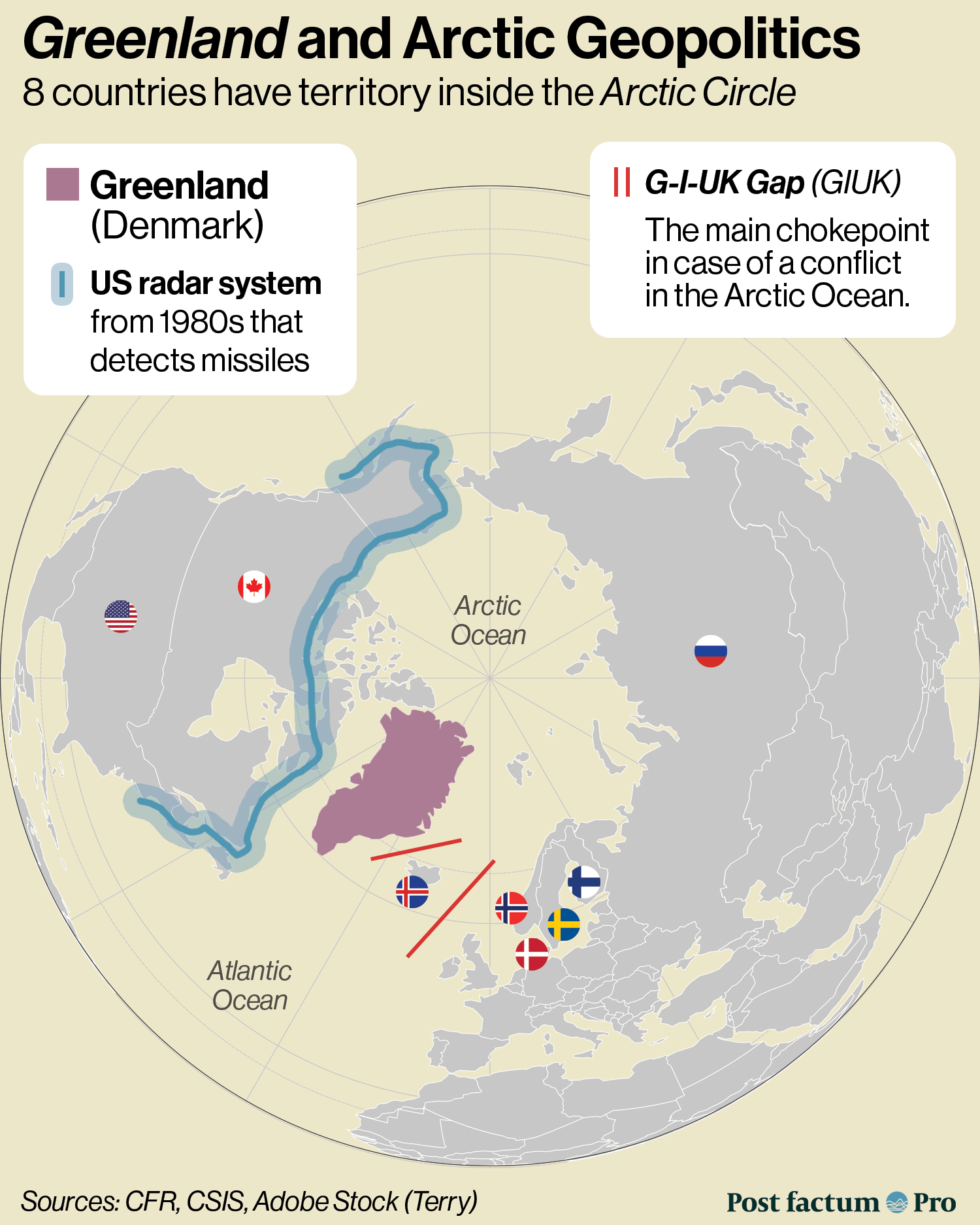
Since December 2024, the US has pushed to take control of Greenland, a self-governing territory of Denmark that hosts a US missile-warning base.
- Read more in our Pro report: US Push for Greenland, revisited.
Melting ice and shipping routes
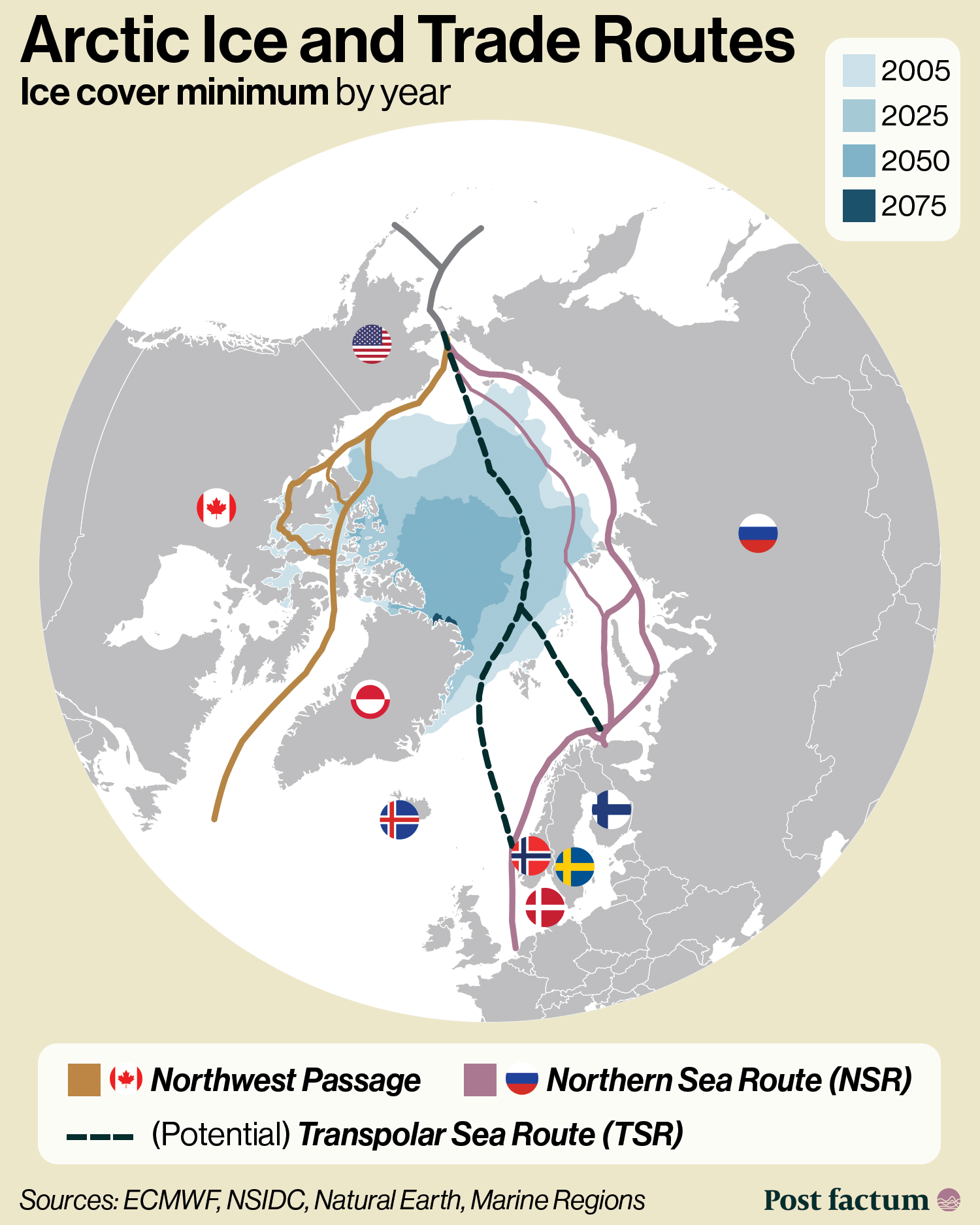
The year’s lowest level of ice cover (ice minimum) has been falling by about 12% per decade, especially quickly between 1995 and 2012.
The lower ice levels in the summer open new shipping routes for global trade.
Russia’s route: Russia issues a permit for every ship, and foreign warships need permission 90 days in advance.
- 37 million tonnes of cargo in 2025 (about 0.3% of global sea trade), mostly oil and gas
- 103 full transits in 2025, thousands of authorised voyages
- Lower summer ice cover opens new route options and lengthens the shipping season
Canada’s route: Canada treats it as internal waters, the US as an international strait; under a 1988 deal, US icebreakers need Canada’s consent to pass.
- 16 voyages in 2025, mostly cruise ships
- Sits closer to the core cluster of ice that does not melt through the summer
- Drifting ice made navigation more difficult in 2007-2021
Transpolar route: a potential route across the central Arctic; models show it opening in September around 2050; no commercial use so far
Existing models project at least 1 ice-free September before 2050.
- Ice-free: under 1 million km² of ice.
- The 2025 ice minimum was 4.6 million km², and the maximum was 14.3 million km².
Icebreaker fleets, 2026
Icebreakers are ships designed to navigate through ice-covered waters and cut lanes for other ships.
- Russia: about 40 icebreakers, 8 of them nuclear-powered (the only such fleet in the world).
- US: 3 working polar icebreakers, with 14 more ordered (4 being built in Finland).
China
China calls itself a “near-Arctic state”, runs 4 polar research ships (none nuclear-powered) and holds stakes in Russia’s Arctic gas projects.
China buys sanctioned Russian Arctic gas: 41 cargoes from a US- and EU-sanctioned project reached China between August 2025 and June 2026.
In 2025-26, the first scheduled China-Europe container voyages through the Arctic reached the UK in about 21 days.
China and Russia are planning to increase their bilateral trade through Russia’s Arctic shipping route to 20 million tonnes by 2030.
The struggle for the Arctic seabed
No treaty covers the Arctic as a whole: the UN law of the sea governs its waters, and national laws cover the land.
Under the UN law of the sea, each coastal state controls 3 zones measured from its coast.
- Territorial sea: up to 12 nautical miles (22 km), with full sovereignty.
- Exclusive Economic Zone (EEZ): up to 200 nautical miles (370 km), with rights to fish, oil, gas and minerals.
- Continental shelf: countries can make claims beyond 370 km for the seabed if it is a natural extension of the state’s land.
A UN commission checks the science behind shelf claims, but overlaps must be settled between the states themselves.
Russia, Denmark and Canada have filed overlapping claims for the seabed around the North Pole, along an underwater mountain range.
- The commission accepted most of Russia’s data in 2023, covering about 1.8 million km²; the Danish (2014) and Canadian (2019) claims are still unreviewed.
The US has not joined the UN sea convention (UNCLOS) and cannot file a claim.
The US declared its own shelf limits in December 2023, which Russia rejected despite having no overlaps with its own claim.
Norway and Russia settled their sea border in 2010, and Canada and Denmark split a disputed island in 2022.
Commercial fishing in the central Arctic high seas is banned until at least 2037 under a 2021 agreement signed by the coastal states, China, Japan, South Korea and the EU.
The Arctic Council brings together the 8 Arctic states, 6 Indigenous organisations and 13 observer states (including China).
- Its decisions are not binding and exclude military matters.
After Russia’s invasion of Ukraine in 2022, the other 7 states paused most cooperation with Russia; expert-level meetings re-started online in 2024, but no ministerial meeting has been held since 2021.
The Arctic Council marks its 30th anniversary on 19 September 2026.
Thank you for reading!

Hey, curious mind! Hope you enjoyed this report.
I started this project out of frustration with biased, opinionated, attention-grabbing news media filled with ads and placements.
Post factum alone cannot change the world; but we can share concise, factual, neutral, systematic, accessible and visual reporting, ad-free.
We need your help: memberships fund our work, and we need more readers to sign up to survive and continue our mission.
Please consider buying a Post factum Pro subscription:
On top of all the exclusive content, you get to support an independent, reader-powered outlet against the mainstream media juggernaut.
Keep exploring:



This week on Post factum Pro:

Join Post factum Pro to access the comment section.