
Space Geopolitics, explained
Weapons, Satellites and Strategy
June 11, 2026
We built a live-updated Space Geopolitics Data Board for this edition. It is free for everyone for 48 hours after this goes live.
Why is space important?
Critical infrastructure: satellites provide navigation, communications and other services used by billions of people daily.
Military use: most space tech is dual-use, serving both civilian and military needs. For example, Starlink provides frontline internet to Ukraine's military.
Space economy: the global space industry grew by about 86% between 2014 and 2024. There are plans for new satellite constellations and space data centres.
Lunar resources: the US and China both have programmes to build bases on the Moon for resource extraction and further space exploration.
Prestige: space programmes are a measure of a country's technological and military strength, and major achievements can build international status.
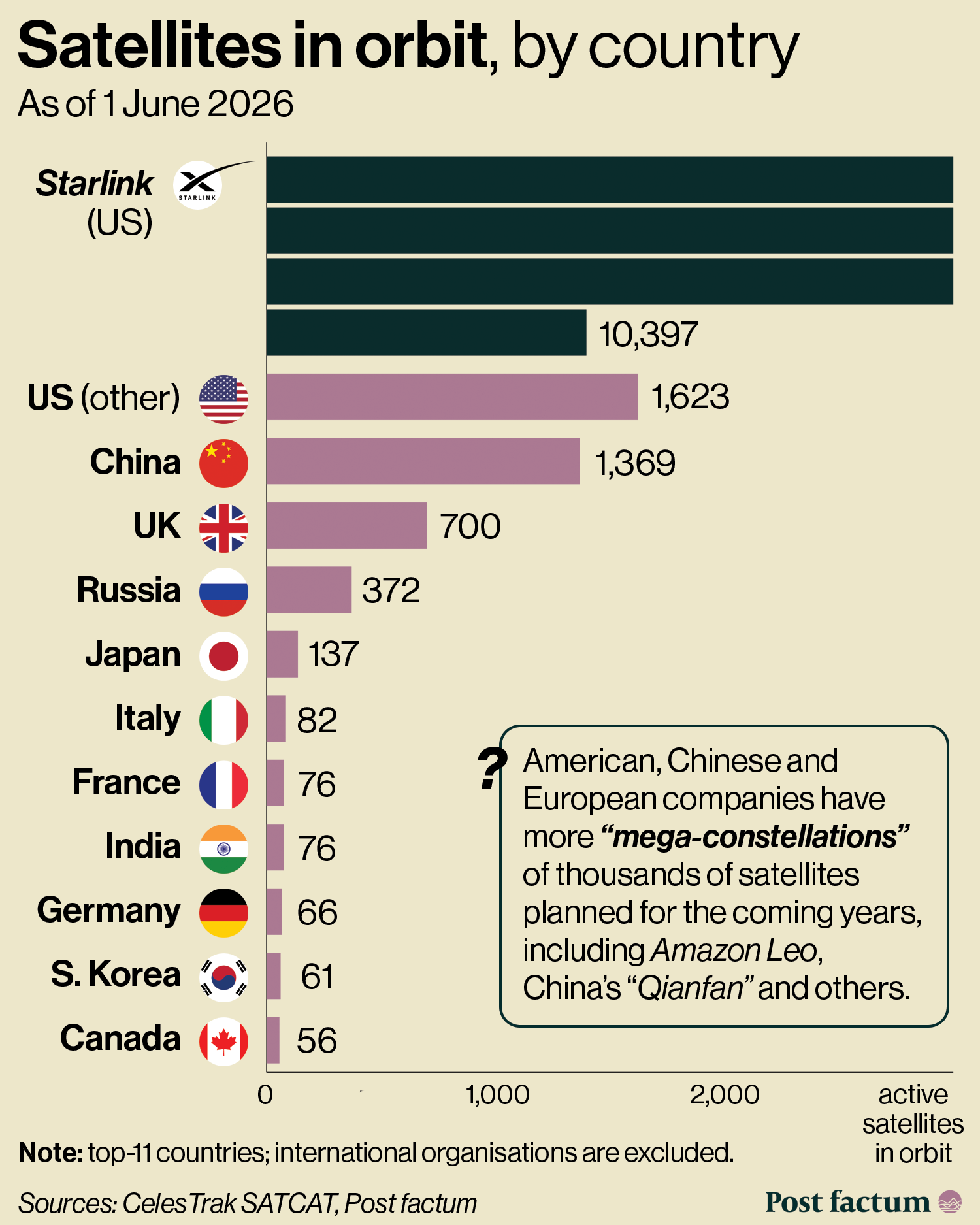
About 16,000 satellites are in orbit as of June 2026, and 65% of them belong to Starlink, the internet constellation run by SpaceX.
For decades, only governments were able to reach space.
Since the 2010s, private companies led by SpaceX have taken over the market and the company now launches more rockets and operates more satellites than any country.
China has also started using partly private companies for its space programme (with state support and oversight).
China plans to put over 37,000 new satellites in orbit by the 2030s.
An international treaty signed in 1967 banned weapons of mass destruction in orbit and territorial claims in space, forming the basis of space law.
Loophole: the treaty did not ban the claiming of resources in space without owning territory.
Context: A 2011 US law mostly bans its space agency (NASA) from cooperating with China.
This led to two international Moon exploration programmes competing today:
Artemis Accords: led by the US, an agreement that sets out principles for space exploration and international cooperation. (67 countries)
International Lunar Research Station: a programme led by China and Russia to build a base at the Moon’s south pole in the 2030s. (15 countries)
Why are satellites important?
Communications: especially in harder-to-reach areas, satellites are the only option; Starlink-style internet is bringing satellite comms into the mainstream.
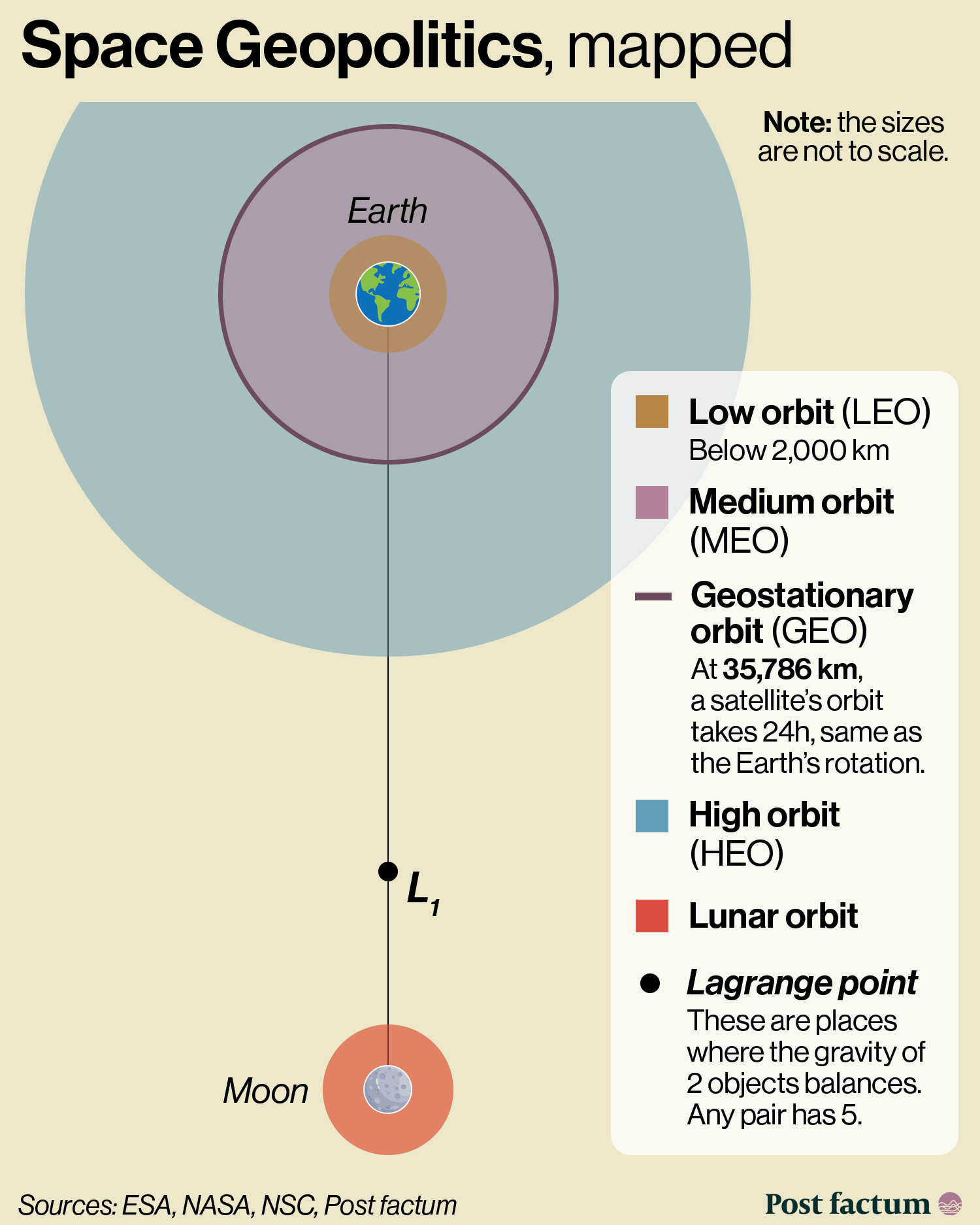
These satellites are in Low Earth Orbit (LEO), less than 2,000 km above ground.
As more satellites enter LEO, there is a growing risk that some will crash, and potentially start a chain-reaction mass collision of satellites in orbit, called the Kessler Effect.
Navigation:GPS and its alternatives are used globally to check position and time or to find directions, for example with Google Maps.
Navigation satellites are mostly in Medium Earth Orbit (MEO) or in Geosynchronous(GEO) orbits where their movement is in sync with the Earth's rotation, allowing them to almost stay over one spot.
Alternatives to US-made GPS exist: China's BeiDou, Russia's GLONASS, and the joint European system Galileo.
Earth observation: satellites allow regular images of the Earth's surface to be taken.
This is important for many reasons, from predicting weather and scientific research to finding military targets or spying.
Like much space tech, imaging is dual-use: needed both for civilian and military purposes.

Check out the Space Geopolitics Data Board
Free for the next 48 hours
Countries have developed weapons to destroy or damage satellites in space:
Direct-ascent weapons: missiles fired from the ground, sea or air that strike a satellite without entering orbit themselves.
Co-orbital weapons: satellites that move up to and attack a target, including by pushing it out of orbit.
Electronic warfare: the jamming or spoofing of transmissions to or from a satellite, blocking or faking communications.
Other counterspace tools include ground-based lasers designed to blind satellite sensors, and cyberattacks targeting the software systems that run satellites.
The US, China and Russia are the countries with the most advanced counterspace capabilities.
For a full breakdown of space weapons across 13 countries, see the Space Geopolitics Data Board.
In 2025, the US started the Golden Dome programme: a plan to place sensors and missile interceptors in space, creating a new layer of missile defence above the Earth.
In February 2022, a cyberattack disrupted a commercial satellite internet service across parts of Europe and Ukraine on the day Russia's full-scale invasion began.
In 2019, India tested its own anti-satellite missile, becoming the 4th country to destroy a satellite in orbit after the US, Russia and China.
Russia is developing a nuclear-armed anti-satellite weapon: designed to destroy many satellites in orbit with a nuclear explosion.
No country has so far used a destructive anti-satellite weapon in a military conflict.
Some missiles can enter space, travel on an orbit and then re-enter the atmosphere for a strike. China tested a nuclear-armed version of a hypersonic missile with this capability in 2021.