
Taiwan, explained
Chips, Ships and US vs China
May 3, 2026
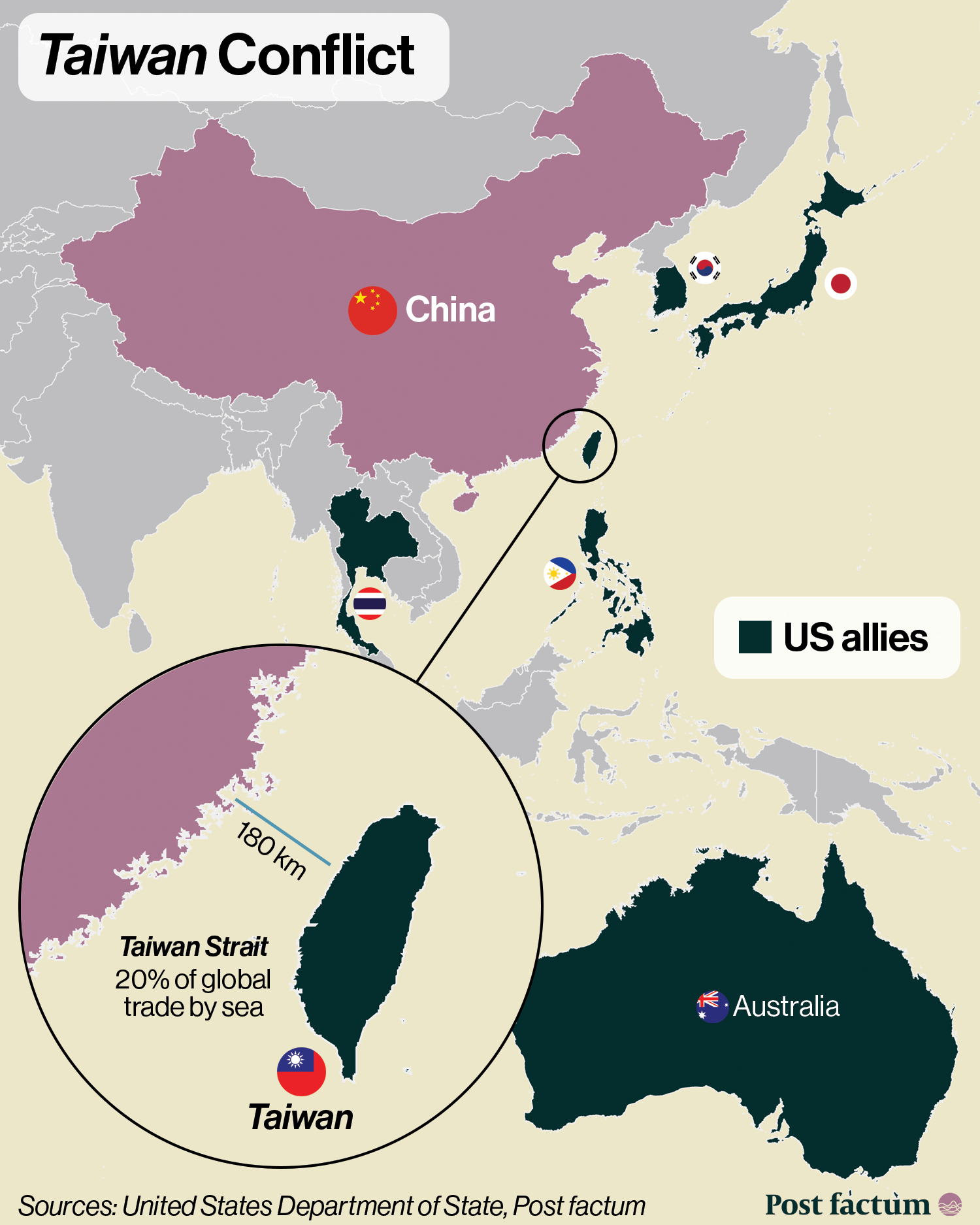
Taiwan is a self-governing democracy of 23 million people that China considers a part of its territory.
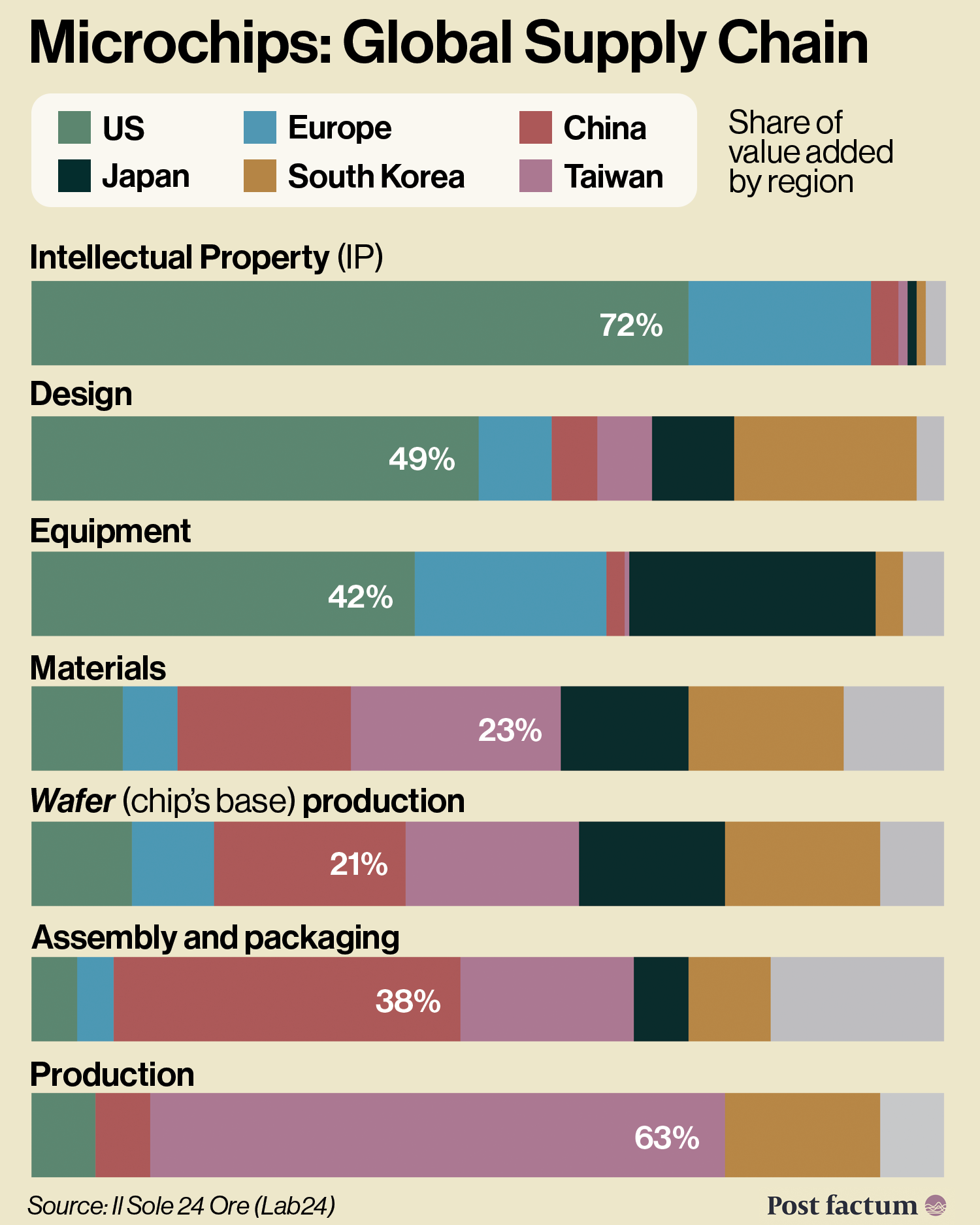
Taiwan produces 92% of the most advanced microchips, making it important for almost any technology, including advanced weapons or AI.
180 km of the Taiwan Strait separate China and Taiwan. Around 20% of global sea trade is shipped here.
Taiwan has existed independently since 1949 when the Communists defeated the Nationalists in the Chinese Civil War.
The Nationalist government retreated to the island of Taiwan but still claimed to rule all of China.
In 1971, the United Nations transferred China’s seat from Taiwan to mainland China.
The US:
Does not formally recognise Taiwan
Sells Taiwan weapons
Says it may or may not defend Taiwan from a potential attack
In December 2025, the US approved an $11 billion arms sale to Taiwan, the largest in the history of the relationship.
63% of the population identify as Taiwanese, 3% as Chinese, and the rest as both.
China's stated goal is to unify with Taiwan: ideally by agreement, but by force if necessary.
China’s tools for unification range from cultural and economic ties or diplomatic pressure to the threat of a naval blockade or a full-scale invasion.
Taiwan imports 97% of its energy. It holds an oil reserve enough for around 100 days, and a liquefied gas reserve for 12 days’ demand.
A potential blockade of Taiwan would cause $2.7 trillion in global economic damage.
In 2025, China conducted its largest military exercises near Taiwan since 2022, with over 2,000 ships detected around the island.
Around 900 short-range ballistic missiles are stationed opposite Taiwan.
In an academic wargame modelof a Chinese invasion, Taiwan is defeated in all scenarios without US military intervention.
The use of US airbases in Japan and the Pacific region, as well as a large stock of anti-ship missiles were found to be important.
As of 2026, China has no active plans for an invasion of Taiwan by 2027 and wants to achieve unification without the use of force.
Since 2023, 50% of China’s top military command has been removed or replaced, likely due to corruption concerns.
China's Navy Modernisation
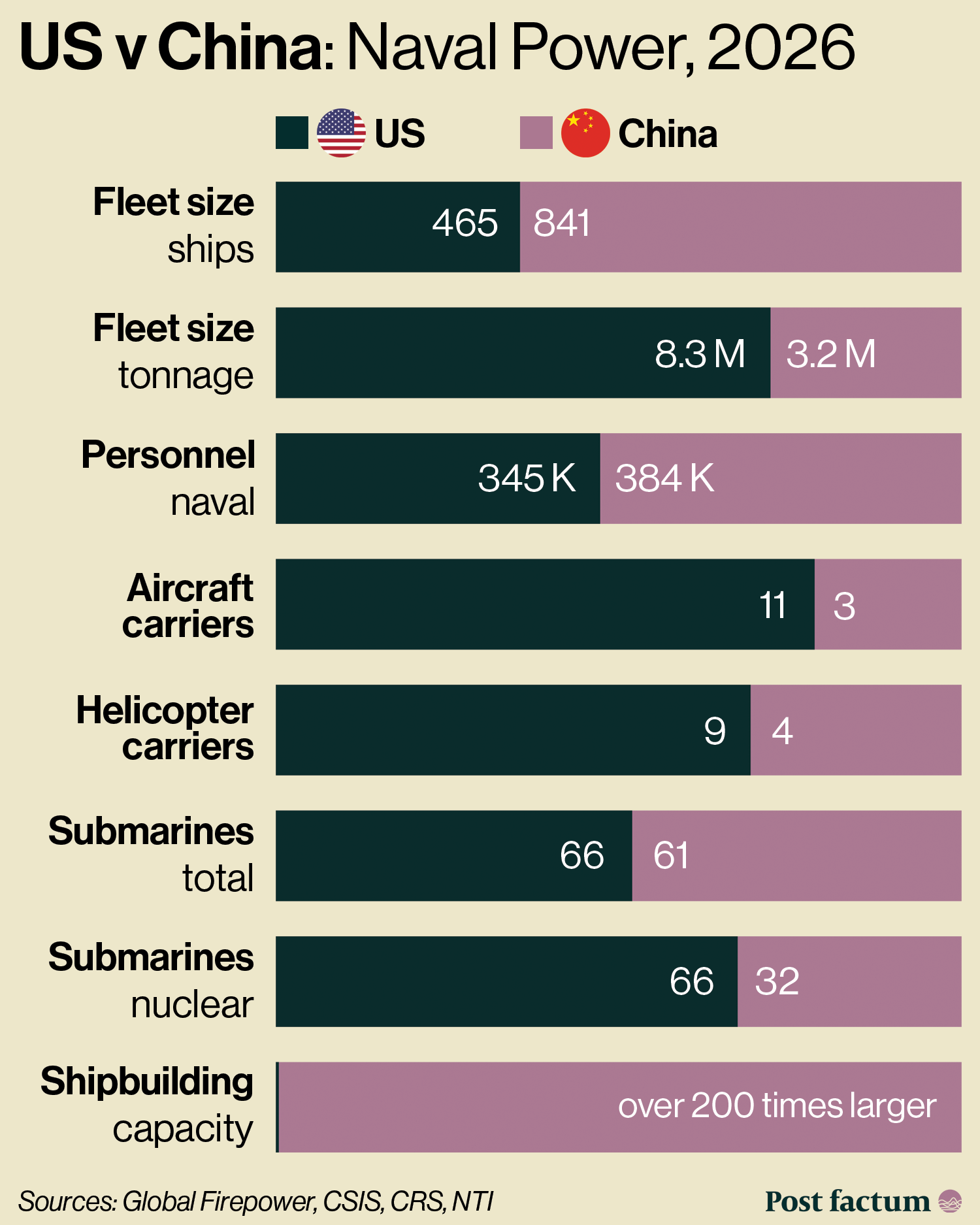
China built the world's largest navy, with 841 warships in 2026 compared to 465 for the US:
Shipbuilding capacity: China can build or repair 200 times more ships than the US by tonnage. This includes commercial capacity, which can legally be used for military purposes in China.
Average age: 70% of China's ships are younger than 15 years old; 25% of US ships are.
Total tonnage: the US fleet is at 8.3 million tons, China's is at 3.2 million.
Submarines: the US has 66 nuclear-powered submarines; China has 32, with new subs added yearly. China also has diesel-electric submarines.
Aircraft carriers: the US has 11, all nuclear-powered; China has 3, planning to add a new one every 2 years.
The US has started testing repairs at shipyards in Japan and South Korea to boost its capacity.
US submarine fleet is expected to shrink to 46 by 2035 because of slow shipbuilding and repairs.
Power Balance in the Pacific
Taiwan's defence budget is at least 9 times smaller than China’s:
Silicon Shield: Taiwan's chip industry acts as a deterrent, since a full conflict over the island would cost the world economy over $10 trillion.
Porcupine Doctrine: Taiwan is building a defence system based on less expensive weapons, with 1,400 anti-ship missiles planned by the end of 2026.
Drones: Taiwan ordered 48,750 military drones in 2025-27, all domestically produced, worth about $1.6 billion.
Navy: Taiwan launched its first domestically built submarine in 2024, with a target of 8 boats in the programme.
Air force: Taiwan operates 139 upgraded F-16V jets, with 66 more on order for delivery by 2028.
In the Pacific region, the US has military alliances with Australia, Japan, the Philippines, South Korea and Thailand.
375,000 US military personnel serve in the region, including about 53,000 in Japan and 24,000 in South Korea.
In November 2025, Japan's Prime Minister called a Chinese attack on Taiwan a threat to Japan's survival, a phrase that under Japanese law allows military action.
China responded by cancelling flights, banning Japanese seafood and sending more military patrols near disputed islands.
South Korea has not publicly committed to defending Taiwan.
Geopolitics of Microchips
Advanced microchips are needed to train and run AI systems, and a secured supply of the best chips gives a technological advantage in both military and civilian industries.
The Taiwanese company TSMC produces over 60% of the world's microchips, including 92% of the most advanced ones.
TSMC's chip-making machines have a remote shutdown feature, so they can potentially be disabled from afar if taken over by China.
TSMC’s equipment, in turn, relies on unique electrical circuit printing machines, produced only by the company ASML in the Netherlands.
Under US pressure, ASML banned the sales of these advanced machines to China.
Since 2022, the US has restricted sales of chips, equipment and intellectual property to China to slow their advance in chipmaking.
In March 2025, TSMC agreed to invest $100 billion in new chip factories in the US, after Trump threatened tariffs of up to 100% on chip imports.
Chinese companies produce ever more advanced chips, and are supported by the state to supply local tech industries.
After President Trump announced major tariff increases in April 2025, China responded with its own tariffs and rare earths export restrictions.
Exports of the most advanced microchips to China were also a part of the dealmaking process.
In November 2025, both sides suspended some restrictions for one year, including China's rare earth export controls and the US's highest tariff rates.
The suspended controls expire in November 2026, and Taiwan's chip industry is at the centre of ongoing US-China trade negotiations.
President Trump is planning a meeting with President Xi Jinping of China in its capital Beijing on 14 and 15 May 2026.
Thank you for reading!
Join Post factum Pro to see the comment section below.