
Meta-modernism, explained
The 21st Century Culture Trend
May 17, 2026
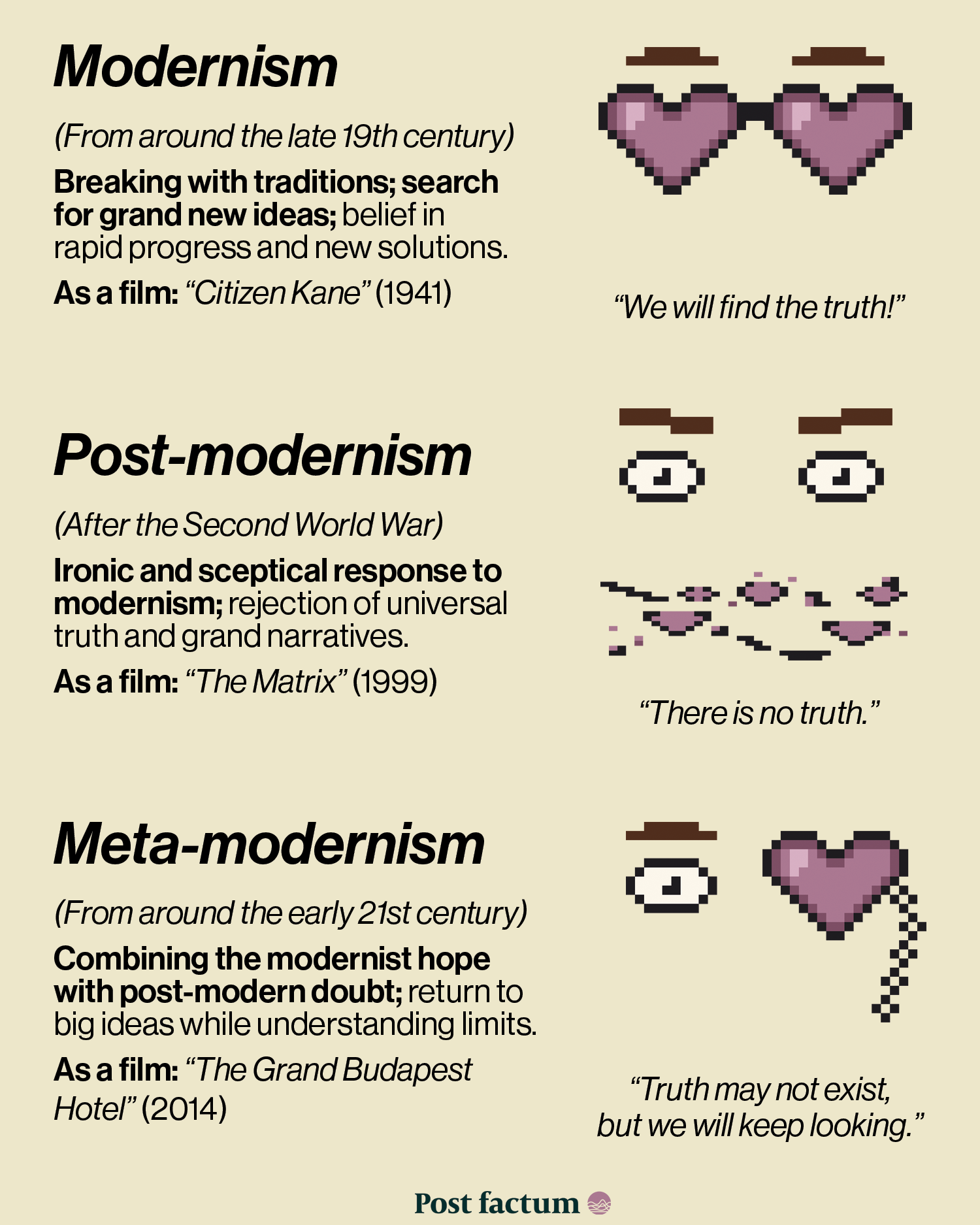
Modernism, post-modernism and meta-modernism are not completely separate.
However, this cultural evolution can be seen in any form of art, including news journalism (more on that below).
Modernism: breaking with traditions; looking for grand new ideas, order and purpose; belief in rapid progress and the power of an individual; the re-making of old systems, and experimentation. [Around the late 19th century]
Post-modernism: the sceptical response to modernism; critique of grand ideas and narratives; irony; rejection of universal truth; focus on power structures and context. [After the Second World War]
Meta-modernism: both (or switching between) modernist hope and post-modernist doubt; looking for authentic meaning while understanding the limitations of this approach. [In the early 21st century]
These concepts are the core of meta-modernism:
New sincerity: accepting real emotions, rejecting cynicism towards art and life in favour of genuine joy or sadness.
Informed naivety: allowing yourself to believe and create freely, while understanding the complex reality.
Pragmatic idealism: taking on big projects, knowing the limitations of grand narratives.
Meta-modern News Journalism
The news journalism of today (especially “mainstream”) is largely stuck in the post-modernist era.
Sceptical about truth: a range of opinions on a topic is often preferred to looking for some underlying “reality”.
Narratives over facts: media outlets focus on building strong stories instead of finding a neutral view.
De-construction: journalists have become good at criticising facts and worse at finding or constructing them.
There is a clear conflict here:
News journalism has a deeply “modernist” purpose — to look for the truth and to share it.
However, the journalism of today almost rejects the possibility of finding this truth.
Around the 1970s, news media went through this Revolution of Subjectivity, and mostly accepted that an author is a human with emotions and bias who thinks in stories. (Thank you, Hunter S. Thompson.)
It is time to make the next, meta-modernist, step forward and finally accept that biased humans can still look for truth, and maybe even find it.
If you want to take this step forward together with the industry, you are in the right place.
Post factum’s mission is to return to the truth-seeking roots of news journalism, bringing you content that is factual, neutral, concise, accessible, systematic and visual.
If you want to support us, please have a look at Post factum Pro: this membership gives you weekly reviews of pivotal geopolitical events, full access to our Data Boards, and more.
Your support is the only reason we exist.
Author Anton Kutuzov
Thank you for reading!