
Drone Warfare: Evolution
Fibre Optics, AI, Jet-drones and Interceptors
Updated: 27 September 2026
How did drones change war?
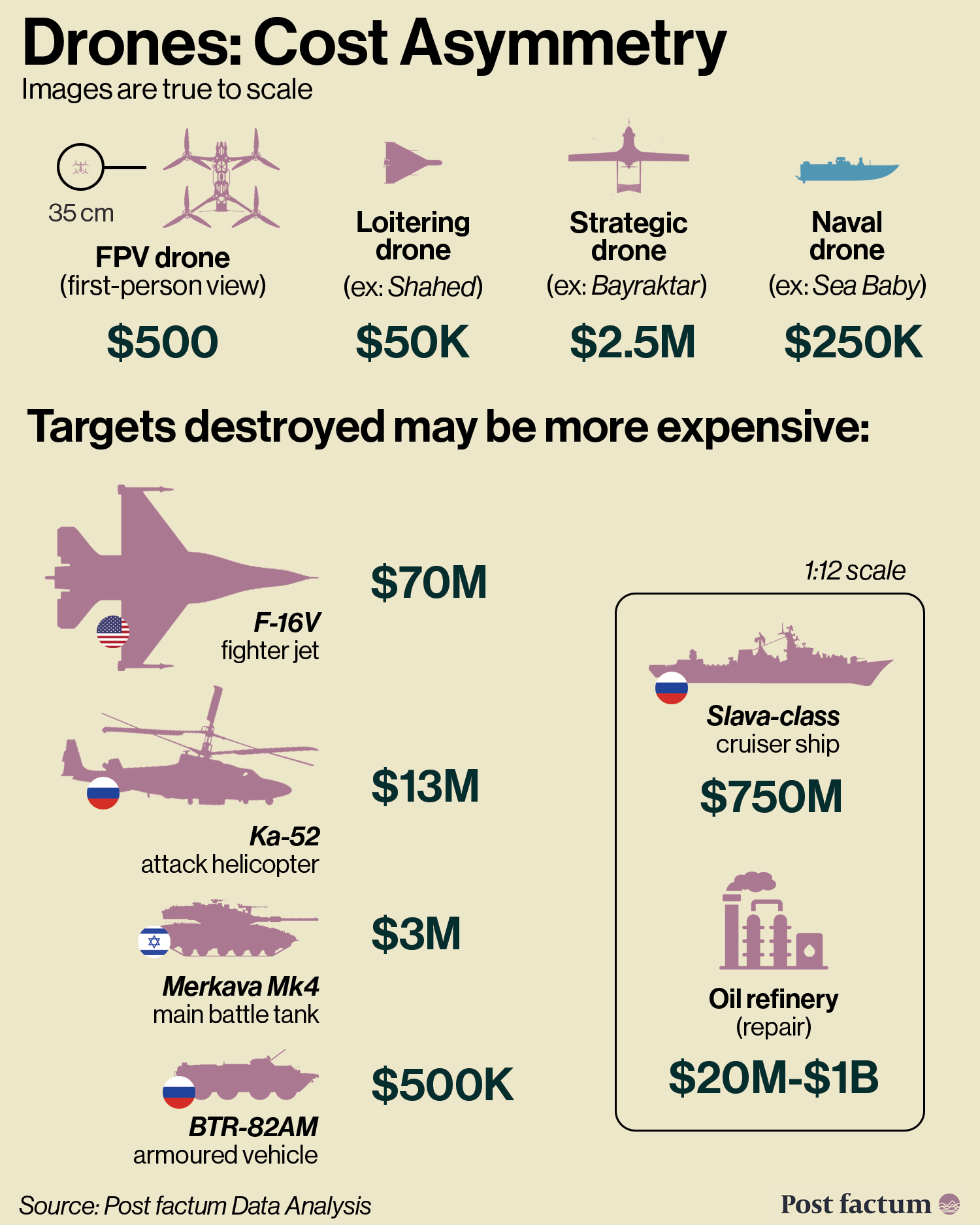
- Cheap precision airstrikes: a $500 drone piloted remotely through a camera can now do what required a $50 million fighter jet with a highly skilled human on board.
- Constant monitoring: drones watch over large areas constantly, making it difficult to move around undetected, on the battlefield and beyond.
- Air, land and sea: unmanned robots are used for rescue, de-mining and now even attacking enemy positions; drone-boats and drone-missiles are also used.
China makes about 70-80% of components for the world’s commercial drones.
For more context, see our earlier report on drone warfare.
Advancements by Russia and Ukraine
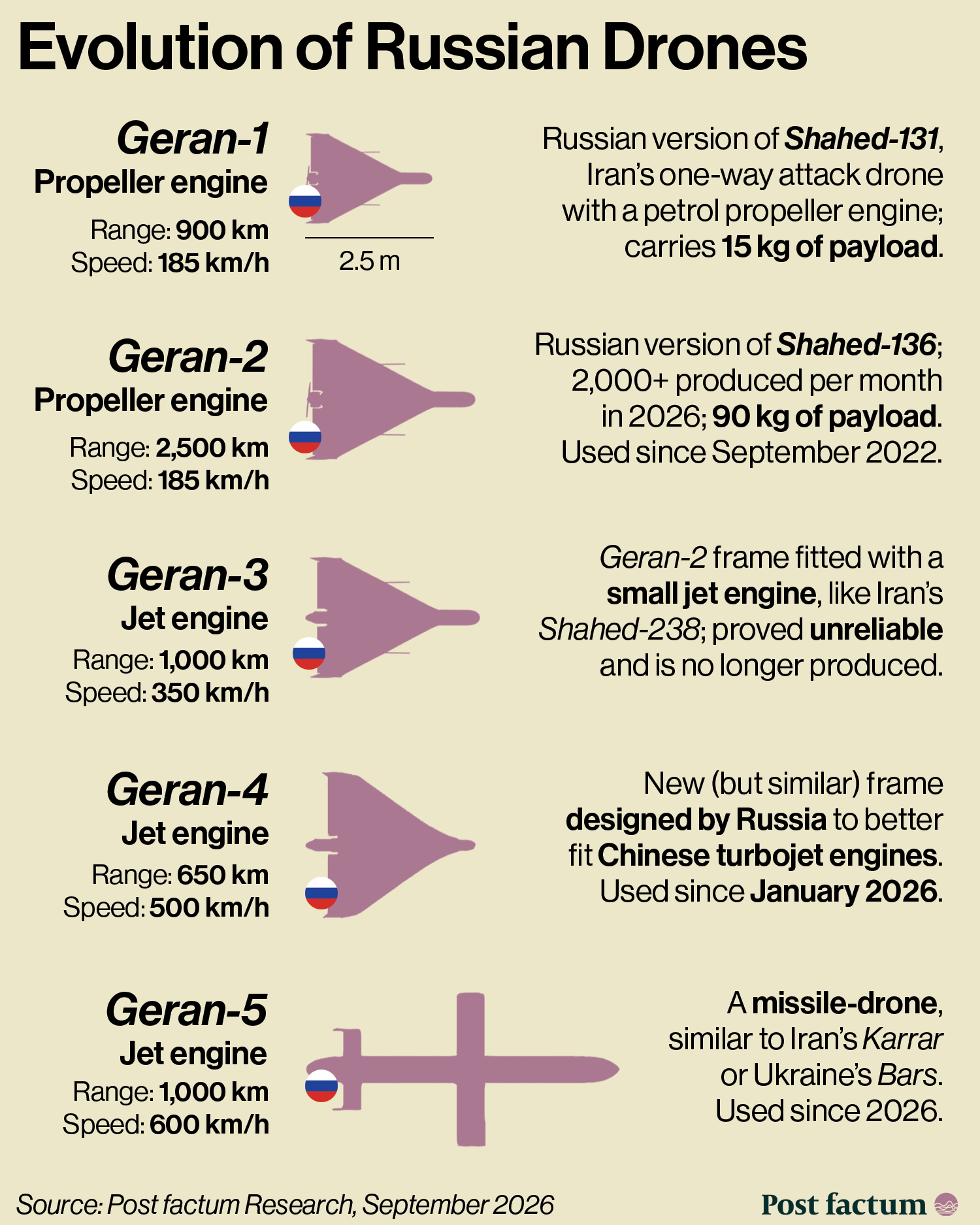
In 2023, Iran showed a jet-powered version of its Shahed drone (Shahed-238).
Russia was already using its versions of earlier Shahed models, powered by propeller engines, and produced them locally.
Jet drones fly quicker but have a shorter range.
In 2024, Ukraine began to develop its own jet-powered missile-drones to make up for a lack of cruise missiles.
- In 2022, Ukraine used Soviet jet-powered spy drones re-made into attack munitions.
In 2025, Russia tried fitting small Chinese jet engines onto the Shahed-136 (Geran-2) frame, already mass-produced locally at around $30,000.
This experiment failed, as the model proved unreliable, occasionally breaking apart in flight.
In 2026, Russia started successfully using the jet-powered Geran-4, a new (but similar-looking) frame designed to better fit the Chinese engines.
At the same time, Russia deployed the Geran-5 missile-drone, a full re-design, looking more like the Ukrainian models or Iran’s Karrar.
- Both models cost around $100,000.
- Both models include European and US-made components, supplied through third countries to avoid sanctions.
Russia launched 2,850 jet drones in August 2026, up from 350 in June.
- This was on par with the number of propeller drone strikes in the same period.
Ukraine intercepts up to 95% of propeller drones but up to 60% of jet drones.
Its interceptor drones are slower than jet drones and less effective at taking them down.
Ukraine uses fighter jets to take down jet drones, while some interceptor drones can also occasionally hit them.
- Ukraine is racing to mass-produce jet-powered interceptor drones.
Both countries depend on imported engines: Russia on Chinese models made by civilian firms, Ukraine on a few European makers.
- Small turbojet engines were initially made for model planes and research but are now beginning to face tighter controls.
A shortage of these small jet engines limits how many missile-drones (or jet-powered interceptors) can be made.
Russia makes 3,000+ jet drones per month (and 2,000+ propeller drones) as of September 2026.
Ukraine makes 200-500 jet drones per month and 5,000+ propeller drones.
The Drone Arms Race
Missile-drones can strike far behind the front lines, but the most used drones on the battlefield are small quad-copters and FPVs.
FPVs, first-person view drones, are cheap (around $500) and account for most of the casualties on the battlefield.
Both Russia and Ukraine produce hundreds of thousands of FPVs per month.
This fuels a competition to intercept the drones and then to overcome these new methods of interception.
Signal Jamming
A drone’s radio signal link to its pilot or its satellite navigation can be jammed with interference noise, sending the drone off course.

Fibre Optic Drones
A drone can be controlled through a thin fibre optic cable of up to 50 kilometres in length.
This makes it immune to regular jamming by avoiding the need for a radio signal or GPS.

AI Navigation
Clip-on modules with AI vision, costing about $100, fly the final 500 metres to the target by camera alone, with no signal left to jam.
Taking Down Drones
Shooting down a $50,000 Shahed drone could cost up to $4 million, as producers race to make cheaper tools at scale.
- Missiles: a traditional air defence interceptor is fired at the drone as it would be at an enemy missile; this costs from $100k per shot to over $12m for advanced systems like US THAAD.
- Guided rockets: older and cheaper rockets are upgraded with laser guidance kits to be used accurately against drones at around $30,000 per shot.
- Regular guns: in practice, soldiers with machine guns and rifles, or anti-aircraft cannons, are used against slower drones; this is cheap but has minimal range.
- Interceptor drones: small and fast specialised drones are now used to take down attackers, mass-produced by Ukraine at $1,000-2,500; the most notable advancement of 2025-26.
- Lasers and microwaves: burning the drones out of the sky for the cost of the electricity used; Israel deployed the first laser air defence systems in 2025.
- Radars and scanners: to take down a drone, it must first be detected and identified, with defenders often facing combined drones+missiles attacks.
- Electronic warfare: this includes jamming and other ways of altering the drone’s control signals, affecting its electronic equipment or hacking it.
- Nets and roofs: the cheapest defence of all, physical covers over equipment, vehicles, trenches or entire roads, from metal roofing to anti-drone nets; effective against smaller drones.
During the 2026 Iran War, the US and its allies fired 943 Patriot missiles in 4 days, around 18 months of production.
Interceptor drones destroyed about 70% of the 1,704 long-range drones downed over Ukraine in January 2026.
Naval Drones
Ukrainian naval drones (unmanned boats armed with explosives or missiles) have damaged or sunk over 10 Russian warships.
- Because of drone and missile attacks, Russia moved some of its Black Sea fleet from Crimea to ports 300 km further east.
Sea drones also shoot down aircraft: a Russian helicopter in December 2024, then 2 fighter jets in May 2025, all hit with air-to-air missiles.
Geopolitics
In September 2025, NATO jets shot down Russian drones that crossed into Poland, the alliance’s first direct engagement with Russian weapons.
The EU is building a ‘drone wall’ of sensors and interceptors along its eastern border and across the bloc, planned for end-2027.
The US ordered every squad to be equipped with drones by the end of 2026 and requested $74 billion for drones and counter-drone tools in 2027.
48 countries now have strategic drones, up from 8 in 2014, as drones and cheap weapons become central to military modernisation plans globally.
Türkiye supplied 23 of the 48 countries with their first strategic drone system, and its arms exports more than doubled in 2021-25.
Thank you for reading!
We need your help to survive
Post factum is independent and reader-powered.
We have to reach 5,000 Pro members to cover our costs and continue publishing, or the funding we have raised so far will run out.
Please help us hit this goal and keep bringing you data-driven, retrospective reporting.
Join as a Founding Member and get all our past and future content at the best rate.
Your fee will go towards paying our staff and running our digital systems.
Keep exploring:


This week on Post factum Pro:

Join Post factum Pro to access the comment section.