
Iran War, analysed
Economic Effects and Military Results
May 31, 2026
On 28 February 2026, the US and Israel started a bombing campaign against Iran.
Iran responded by closing the Strait of Hormuz to all shipping, including 20% of the world's oil supply. It also attacked US allies in the region.
In this report, we analyse the effects of the Iran War on the global economy and energy markets, as well as the results of the military campaign so far.
Key context
Why did the US and Israel attack?
The stated goal was to damage Iran's missile and nuclear programme, as well as to replace the existing regime by killing its leaders.
We discuss the results in section 2.
See our reports on Iran's nuclear programme and the Gaza War, and our Pro report on the US's earlier strikes on Iran's nuclear sites for more context.
Global effects
Closing the strait removed about 20% of the world's oil from the market.
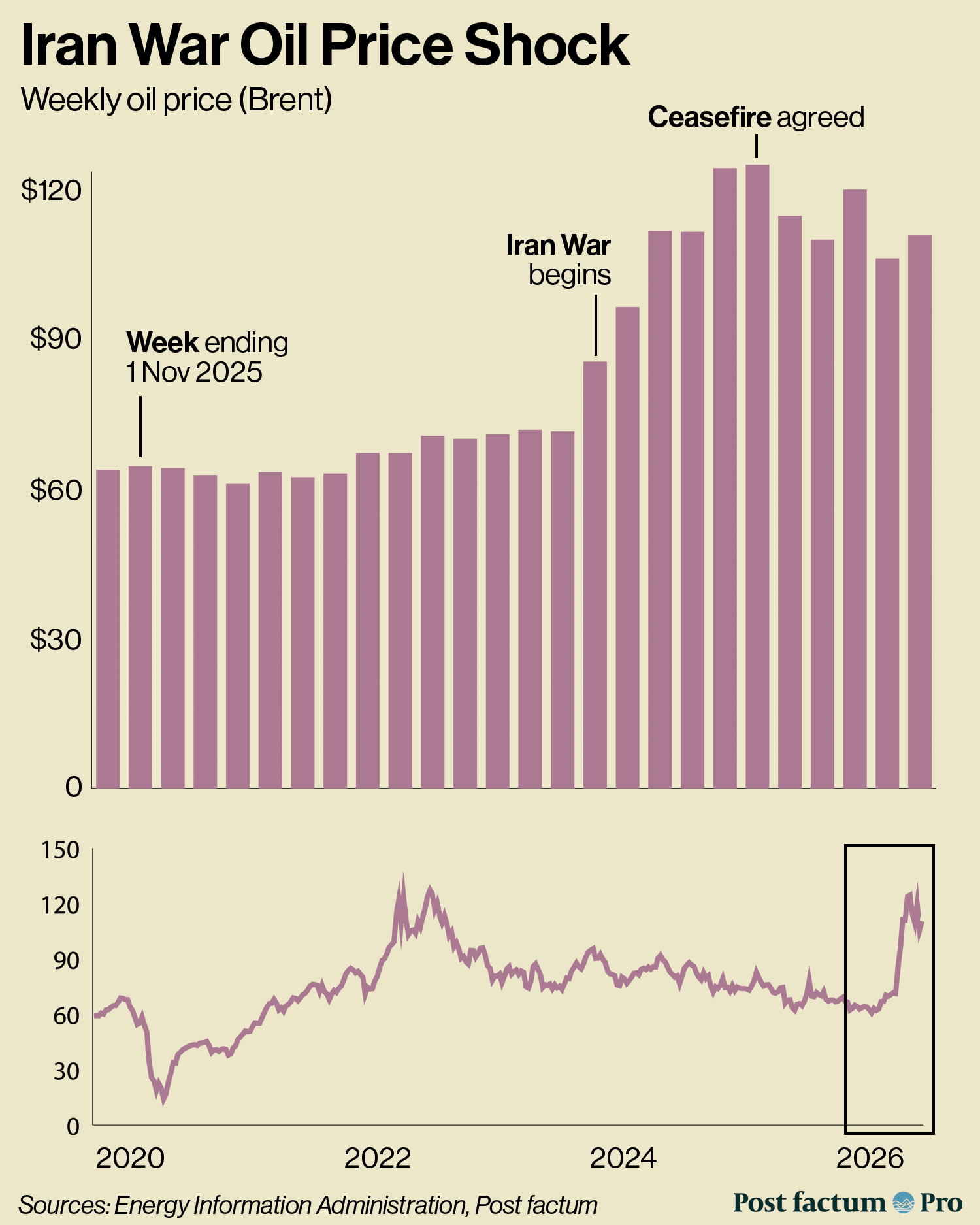
Oil prices rose by about 40%, to $100+ per barrel. At the peak in April, the price was over $120.
Daily ship crossings through the strait fell by 90%, from around 70-100 pre-war.
About 80% of the oil shipped here went to Asia.
At first, the markets expected the conflict to be short-lived; the prices climbed as the conflict and negotiations dragged out.
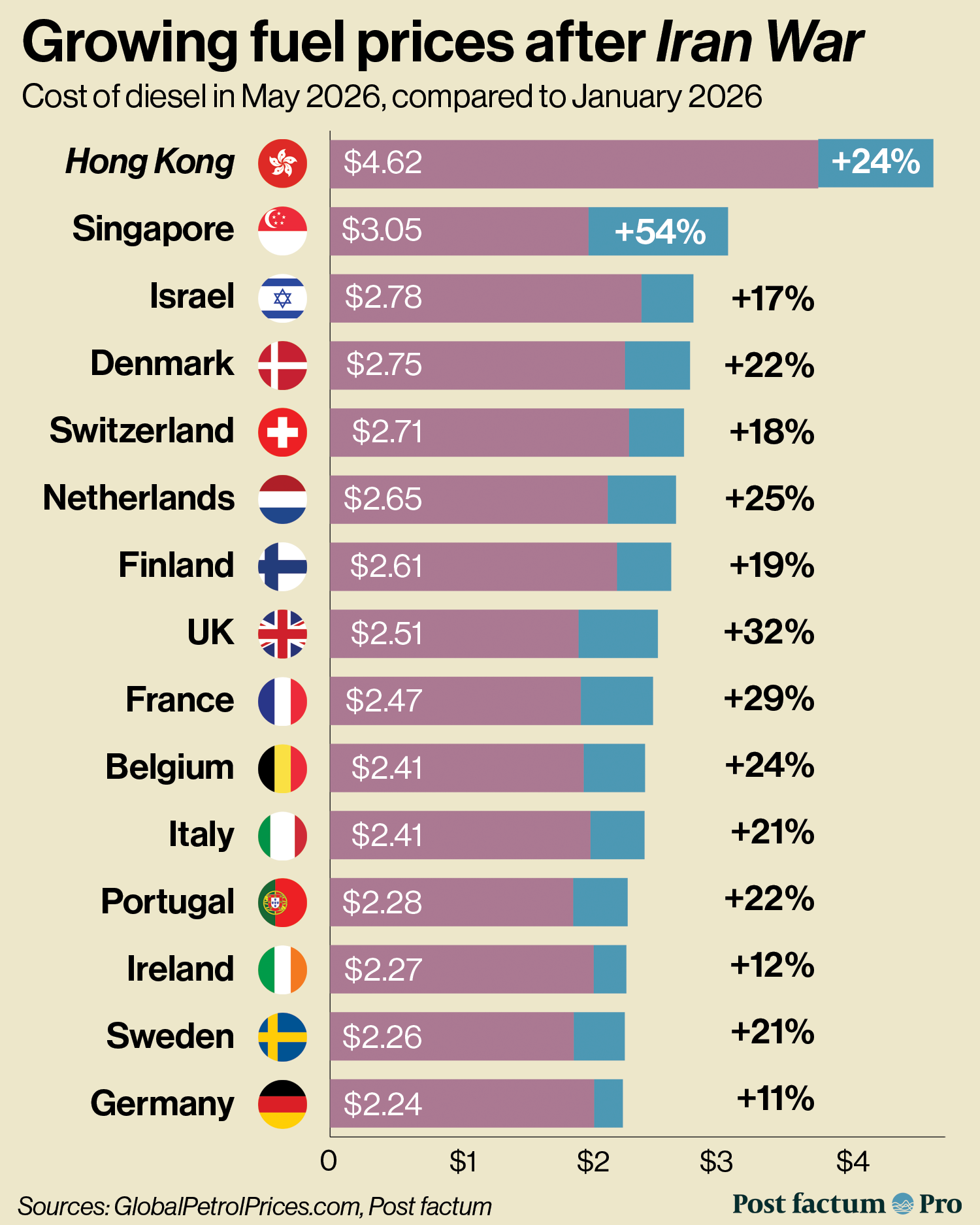
Higher oil prices added to inflation around the world, because energy costs feed into most goods and services.
See our report on Oil Geopolitics for more on how this works.
Governments tried to reduce the damage by finding more oil to be sold on the global market:
Reserves: major economies released a record 400 million barrels of oil from their strategic stocks.
Extra supply: the US and other producers raised oil production and exports to record highs.
Avoiding Hormuz: Saudi Arabia is making maximum use of its pipeline and ports made for exporting oil through the Red Sea, now covering about 50% of Saudi Arabia’s oil production.
In general, oil-exporting countries and oil producers earned more from the higher prices.
Oil producers outside the Middle East have improved their positions because oil buyers switched to them as a safer long-term source.
In particular, the US now produces and exports more, increasing its influence on the global energy markets.
However, US consumers and transport-heavy industries are hit with higher prices.
Russia, a major oil exporter, gained $150 million per day in extra oil revenue in March.
Ukrainian attacks on Russia's oil refining reduced its export capacity and forced it to sell more crude oil instead of refined products, but the profit from higher prices is greater in the short term.
Brazil is another major oil producer that improved its market positions while seeing a relatively small increase in fuel prices locally.
While oil producers are able to sell more of it, most consumers globally see higher prices for fuel and products in general.
In free-market economies, like Canada or the US, oil-producing companies benefit the most from higher prices.
Even if the producers were to cut back on profit, other companies downstream, like refiners or fuel stations, would keep the profit.
A more realistic option is directly covering some of the final price for consumers (subsidies).
In the US, higher fuel prices correlate with lower chances of a presidential re-election.
In November 2026, the US has its midterm election for the House of Representatives and a third of the Senate.
Military results
The US-Israeli campaign since February weakened Iran's military and defences and killed some of its leaders, including its Supreme Leader, Ali Khamenei.
But it did not remove Iran's ability to carry out drone attacks, close the Strait of Hormuz or create a nuclear weapon within a few years.
The opening strikes hit Iran's missiles, air defences and military industry, with nearly 900 strikes in the first 12 hours.
The war killed thousands of people in Iran and displaced many more across the region.
In one attack, a school was hit, killing 120 students and 36 other civilians.
The US intelligence services still believe that Iran can make a basic nuclear bomb in about a year, unchanged since the 2025 US strikes on Iran’s nuclear sites.
Iran’s ability to enrich uranium is likely more damaged, but it is also likely to still have potential access to existing enriched uranium, enough for about 10 bombs.
The 2026 campaign damaged Iran's air defences, reducing its ability to protect military and strategic sites.
The weapons used against Iran cost the US about $17 billion, and the total military cost reached about $29 billion.
Costs fell after Iran's air defences were destroyed, dropping to around $0.5 billion for each day of active bombing since around day 6.
Businesses worldwide have faced at least $25 billion in costs from the war, close to the $35 billion linked to Trump's 2025 tariffs.
Many airlines were among those hit hardest, with about $15 billion in extra costs as jet fuel prices nearly doubled.
On 8 April, a temporary ceasefire was agreed and the conflict became less intense, but it remains unresolved, while the Strait of Hormuz is still closed to most ships.
Negotiations between Iran and the US continue, especially around the future of Iran’s nuclear programme.
Thank you for reading!
Log in to Pf Community to access the comments below.