
US Strike on Iran’s Nuclear Sites
Published: October 16, 2025
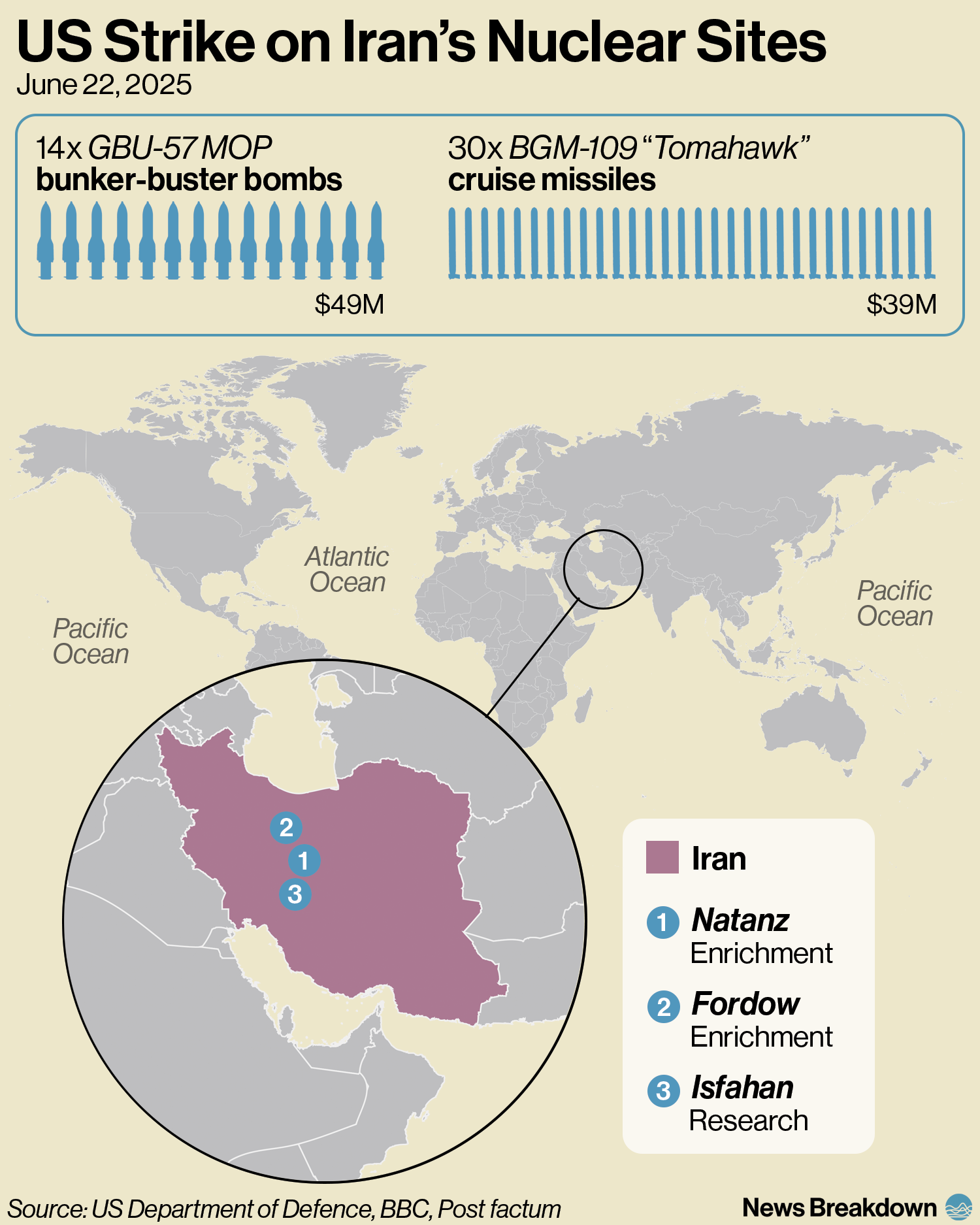
On 22 June 2025, the United States bombed Iran’s nuclear facilities: 3 major locations where Iran was known to work on nuclear weapons.
7 US B-2 bombers dropped 14 “bunker-buster” bombs on the targets.
In addition, a US submarine in the Persian Gulf launched 30 Tomahawk cruise missiles at the 3 sites.
The previous day, the US openly sent another group of B-2 bombers westward to the Pacific.
While the public attention was on those, the actual attack group was flying to the Middle East.
The B-2s flew nonstop for over 36 hours during the mission, refuelling mid-air.
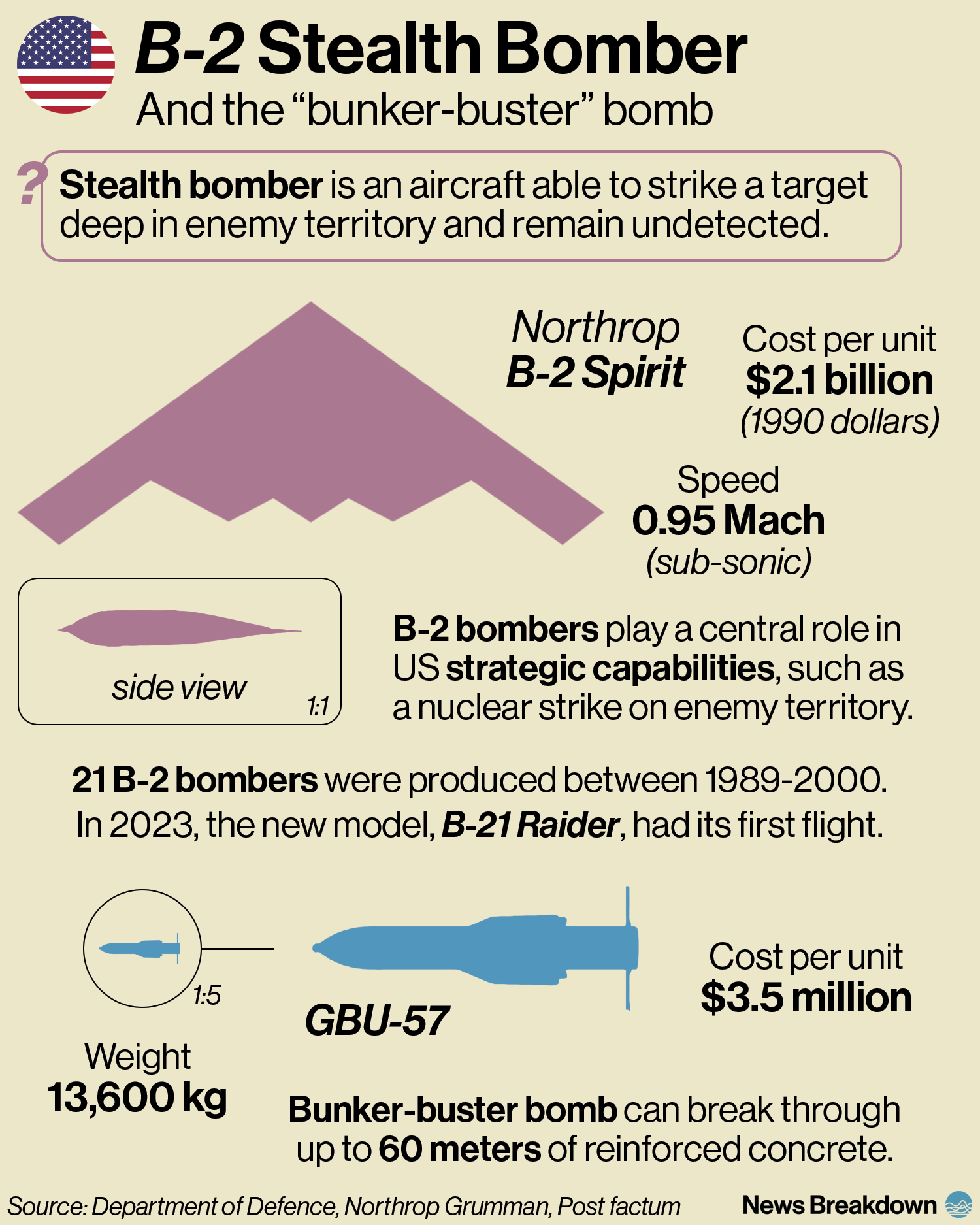
The B-2 bomber is the crown jewel of the US Air Force, costing over $2 billion per unit in the 1990s, or over $4 billion in 2024 dollars.
It is the only operational strategic stealth bomber, capable of striking targets almost anywhere in the world undetected.
The strike on Iran’s nuclear sites was the largest deployment of stealth bombers ever.
Each B-2 carried 2 GBU-57 bunker-buster bombs.
Bunker-buster bombs can break through up to 60 meters of reinforced concrete.
The strike was also the first known combat use of the “bunker-busters”.
Iran did not try to defend against this attack.
Operation Midnight Hammer was one of the most complex long-range strike missions in US history.
Context:
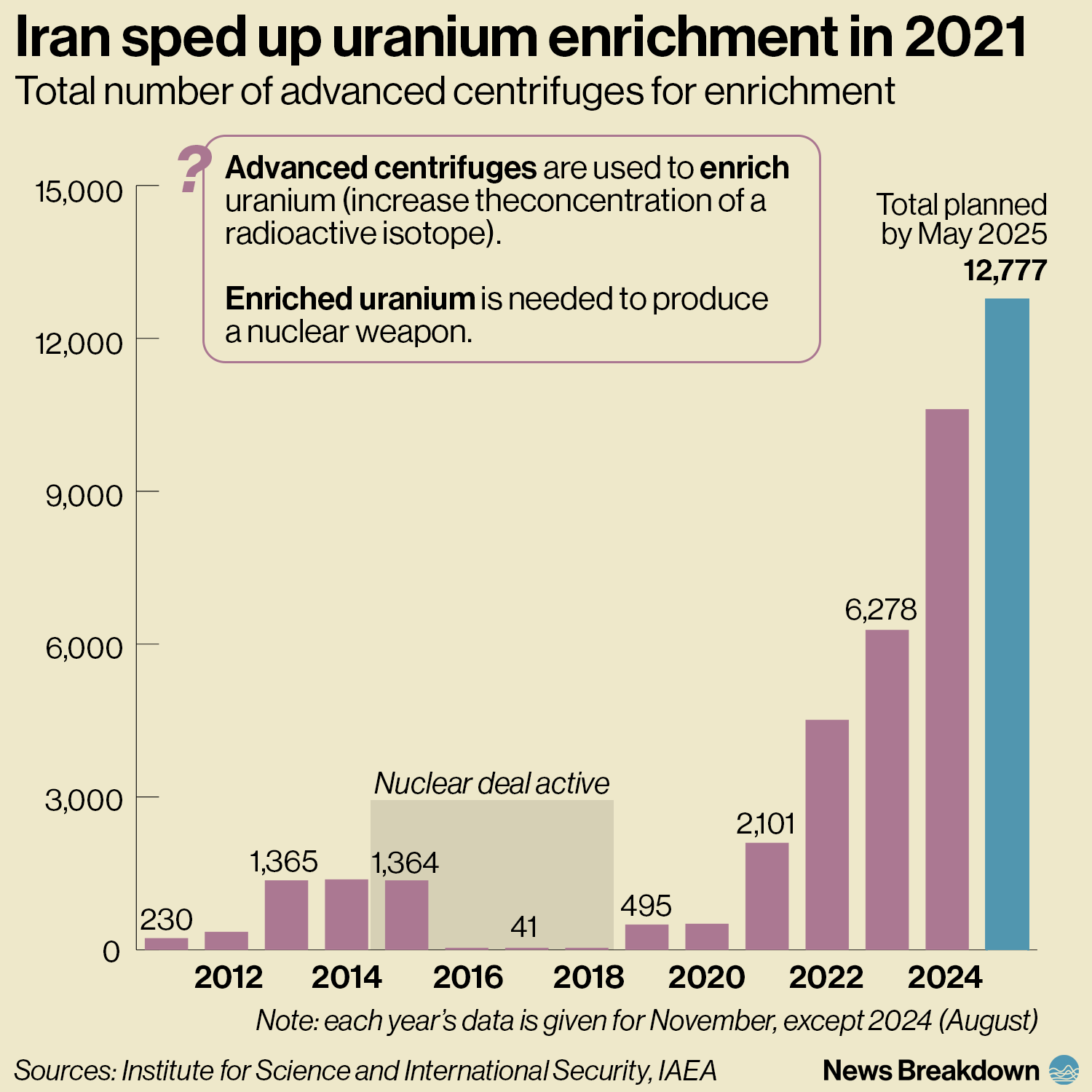
The acceleration of Iran’s nuclear program.
The escalating Israel-Iran conflict.
The threat of Iran’s nuclear program
In May 2025, the International Atomic Energy Agency (IAEA) reported that Iran holds 9 tonnes of enriched uranium.
Of that, over 400 kg was close to nuclear weapons-grade.
The stockpile of enriched uranium had grownby 50% since February.
According to the IAEA, Iran’s stockpile was enough for around 9 nuclear warheads.
Iran claimed that its nuclear program was civilian and focused only on nuclear energy, not weapons.
For US and Israel, Iran creating a nuclear bomb is a diplomatic red line (meaning they are openly ready to take extreme actions to prevent this, or to counter this).
In the last decade, Israel repeatedly tried to stop Iran’s nuclear program with covert operations and attacks on the nuclear facilities.
In 2010, Israel and the US deployed a virus against the Natanz nuclear facility in the first known cyberattack to cause physical destruction.
In 2020, Israel’s secret services killed a top Iranian nuclear scientist.
In April 2025, the Trump administration, with Oman’s mediation, tried to reach a new deal with Iran.
The US offered sanctions relief in exchange for Iran stopping uranium enrichment and allowing independent inspections.
The talks failed in June, with Iran repeatedly rejecting the US proposal and announcing the launch of a new uranium enrichment centre.
Israel-Iran rivalry
The rivalry between Israel and Iran escalated when Iran-backed Hamas attacked Israel on 7 October 2023.
Iran funds armed groups (proxies) that wage war against Israel including Hamas, Hezbollah, the Houthis.
In 2024, a series of strikes and counterstrikes led Iran and Israel into an open war.
What happened?
1 April: Israel bombed Iran’s consulate in Syria, killing Iranian military officials, including a top hybrid warfare commander.
13 April: Iran responded, launching 140 drones, 120 ballistic missiles, and 30 cruise missiles at Israel, killing 1 civilian and injuring 31.
July 31: Israel assassinated Hamas’ political leader in Tehran (Iran) with a hidden bomb.
September 27: Israeli jets struck Beirut (Lebanon), killing the leader of Hezbollah and an Iranian military commander
October 1: Iran retaliated, launching around 200 ballistic missiles at Israel, with no reported casualties.
October 26: Israel responded with strikes on Iran, destroying air defence systems. By late 2024, most of Iran’s air defence was destroyed.
The Twelve-Day war
On June 13, 2025 (9 days before US strikes), Israel launched a coordinated air campaign against Iran.
Israeli jets struck missile sites, radar systems, and nuclear facilities.
Secret service agents in Iran’s territory set up a hidden drone launch location near Tehran. These drones neutralised what remained of Iran’s air defences.
Iran responded with mass missile attacks successfully overloading Israeli air defence systems. 32 people were killed and over 3000 injured.
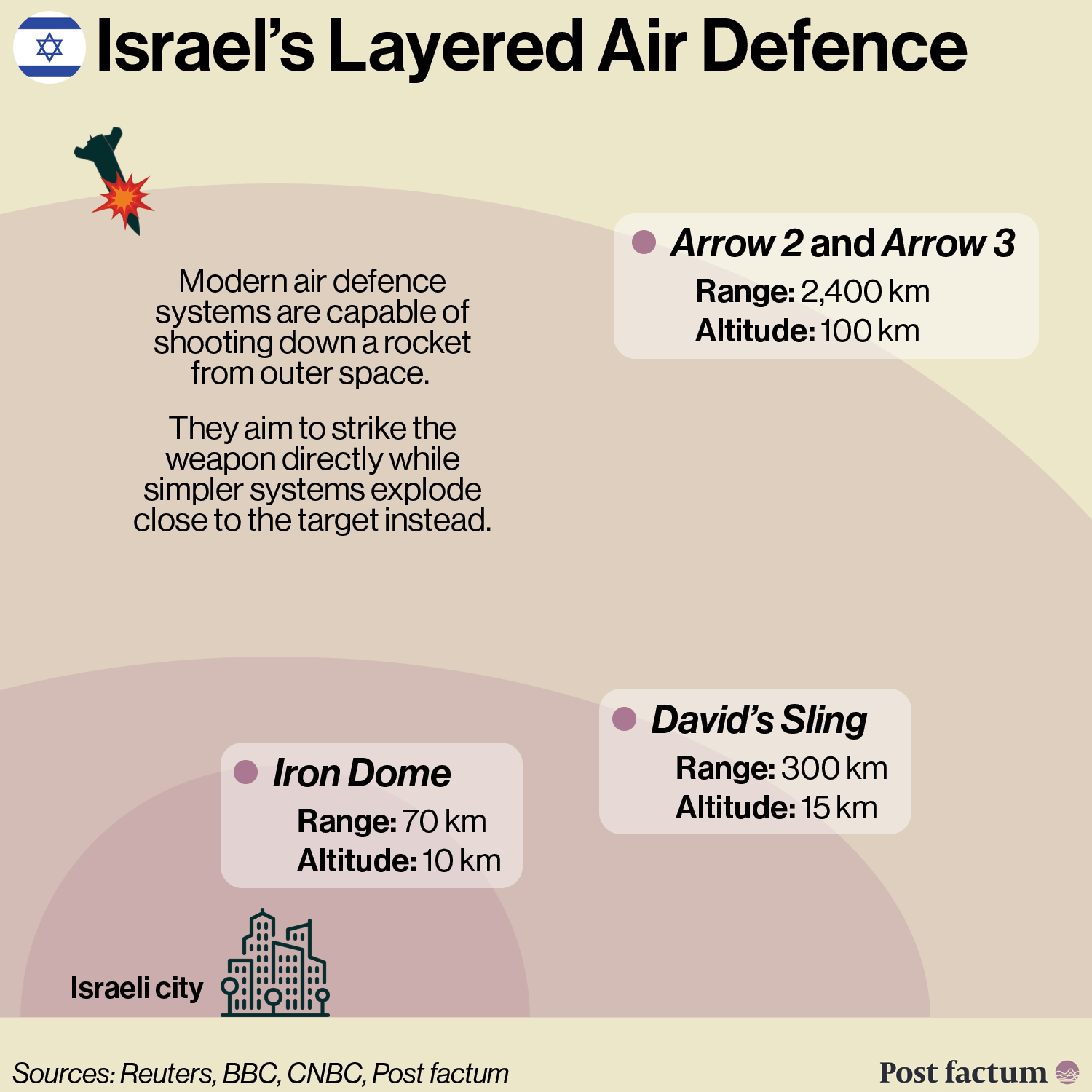
By the time of US strikes, Iran’s nuclear facilities were vulnerable:
The air defences were mostly destroyed
The military was focused on retaliating against Israel
Did the strikes stop Iran’s nuclear program?
The scale of the damage remains unclear.
No people reportedly died in the strike.
President Trump claimed that the strike “completely and totally obliterated” Iran’s nuclear facilities.
However, US military official claimed the strikes set back the program by up to 2 years.
A leaked report by US military intelligence claims Iran’s nuclear program has been set back by a few months.
Israeli intelligence claims that the program was damaged but not destroyed.
It is unclear whether Iran may have relocated sensitive materials and machines to secret locations before the strike.
Also, it is important to highlight that Iran’s nuclear infrastructure extends beyond the 3 sites hit during the strikes.
Iranian officials initially denied major losses but later admitted that several facilities had beendamaged.
On June 23, Iran launched a limited missile attack on a US base in Qatar.
All missiles were intercepted, causing no casualties.
The following day, the United States, with Qatar's mediation, brokered a ceasefire between Israel and Iran.
Both Iran and Israel claimed victory, while US President Trump took credit for the deal.
President Trump re-stated the US pledge to stop Iran’s uranium enrichment program, reaffirming the red line.
Overall, the Twelve-Day war left 32 Israelis and over 1,000 Iranians dead.
Israel killed at least 14 Iranian nuclear scientists.
In the days after the strike, Iran threatened to close the Strait of Hormuz, the world’s most critical chokepoint for oil exports.
However, Chinese diplomatic mediation helped de-escalate the tensions, and global oil prices stabilised.
Recently, President Trump threatened new strikes if Iran’s nuclear program resumed.
In response, Iran’s Foreign Ministry spokesman accused the US of violating international law, adding that Iran has no interest in entering new negotiations.
Thank you for reading!
Author Simone Chiusa
Editor Anton Kutuzov