
Horn of Africa, explained
11 October 2026
- Region on the coast of the Red Sea which hosts 10% of global trade.
- Foreign powers exploit tensions over 10+ disputed borders and areas.
- Ethiopia pushes for sea access and control over the Nile, as economy booms.
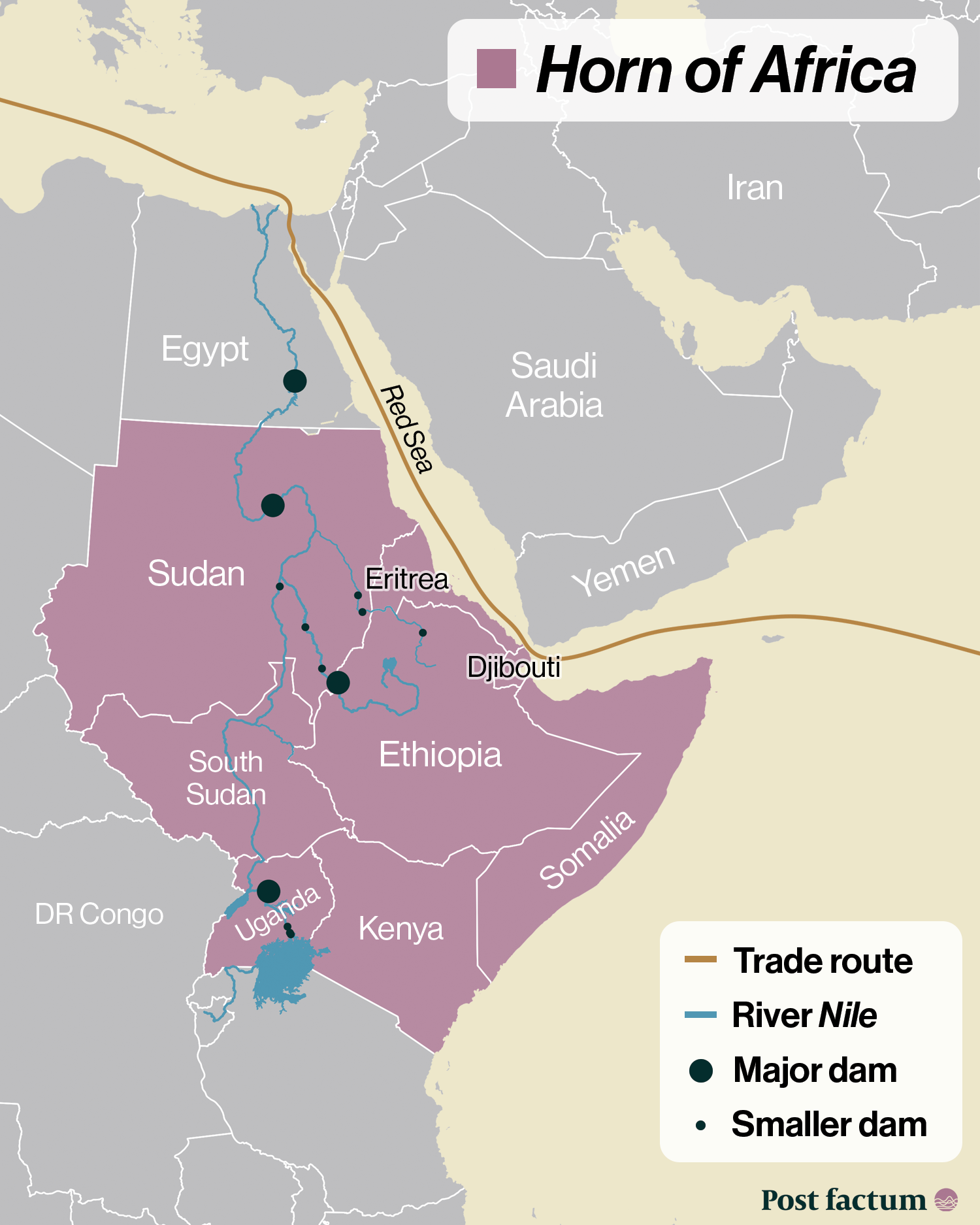
Why is the Horn of Africa important?
10-15% of the world’s trade normally flows past the Horn of Africa, including 12% of seaborne trade in oil and 25% of all container shipping.
- The Bab el-Mandeb strait is the southern entrance into the Red Sea, with the Suez Canal in the north.
Red Sea traffic fell by 50% between 2023 and 2025, after attacks on ships by Yemen’s Houthi rebels.
When the war in Iran disrupted the Strait of Hormuz, the Red Sea became Saudi Arabia’s main alternative route for oil exports.
Key themes:
- Nile River: Ethiopia controls the source of most of the Nile’s water, which Egypt and Sudan depend on downstream.
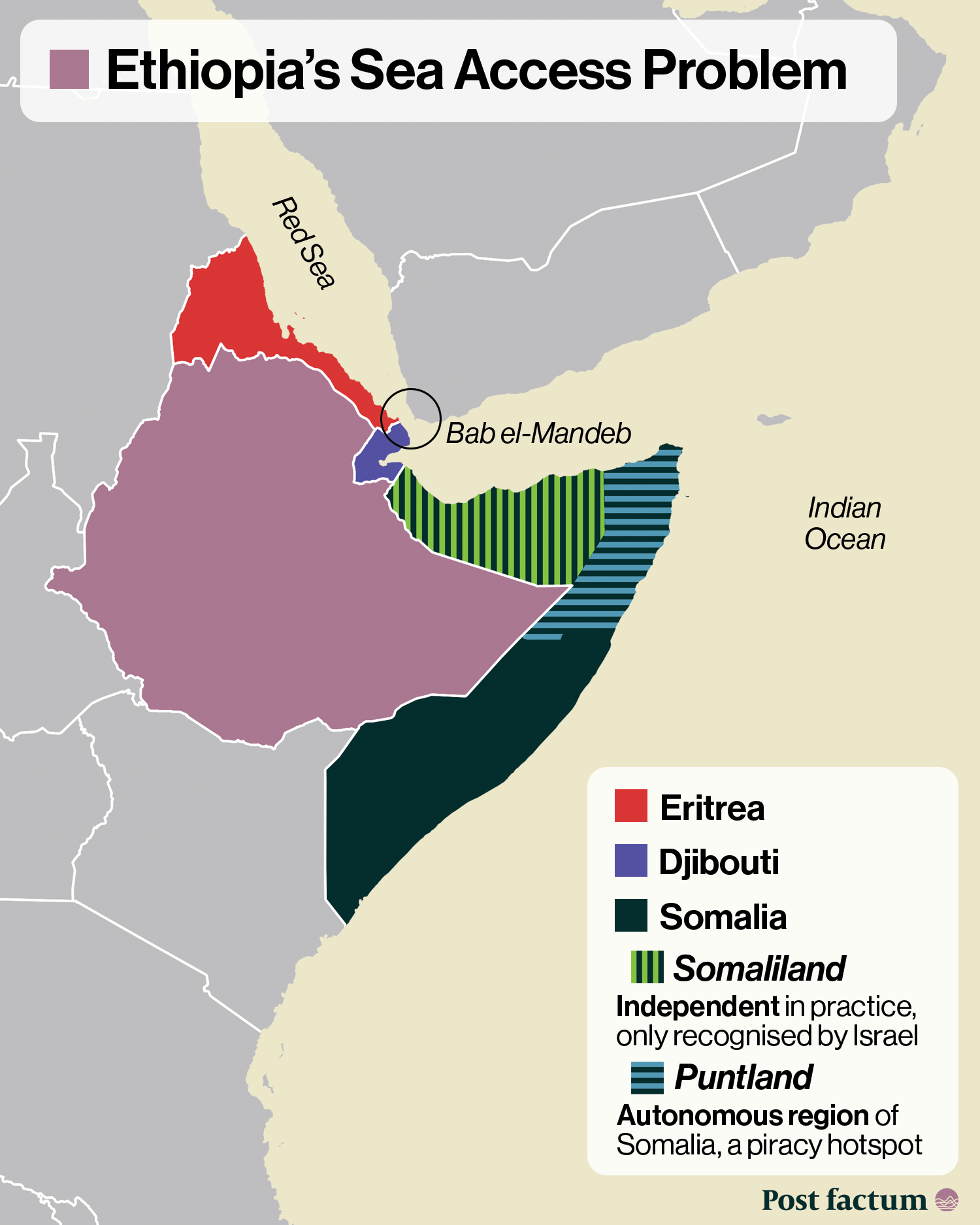
- Landlocked Ethiopia: Africa’s 2nd-largest population, with no direct sea access since Eritrea’s independence in 1991, is pushing to regain it.
- Somalia’s fragmentation: 2 major regions now act independently from the central government, while Islamist militants hold large rural areas.
- War in Sudan: a civil war has split the country in two, with foreign powers backing sides, which we covered in a separate report.
- South Sudan: the region’s only major oil producer; it can only export through Sudan, paying fees to both sides of its war, and has a civil war of its own.
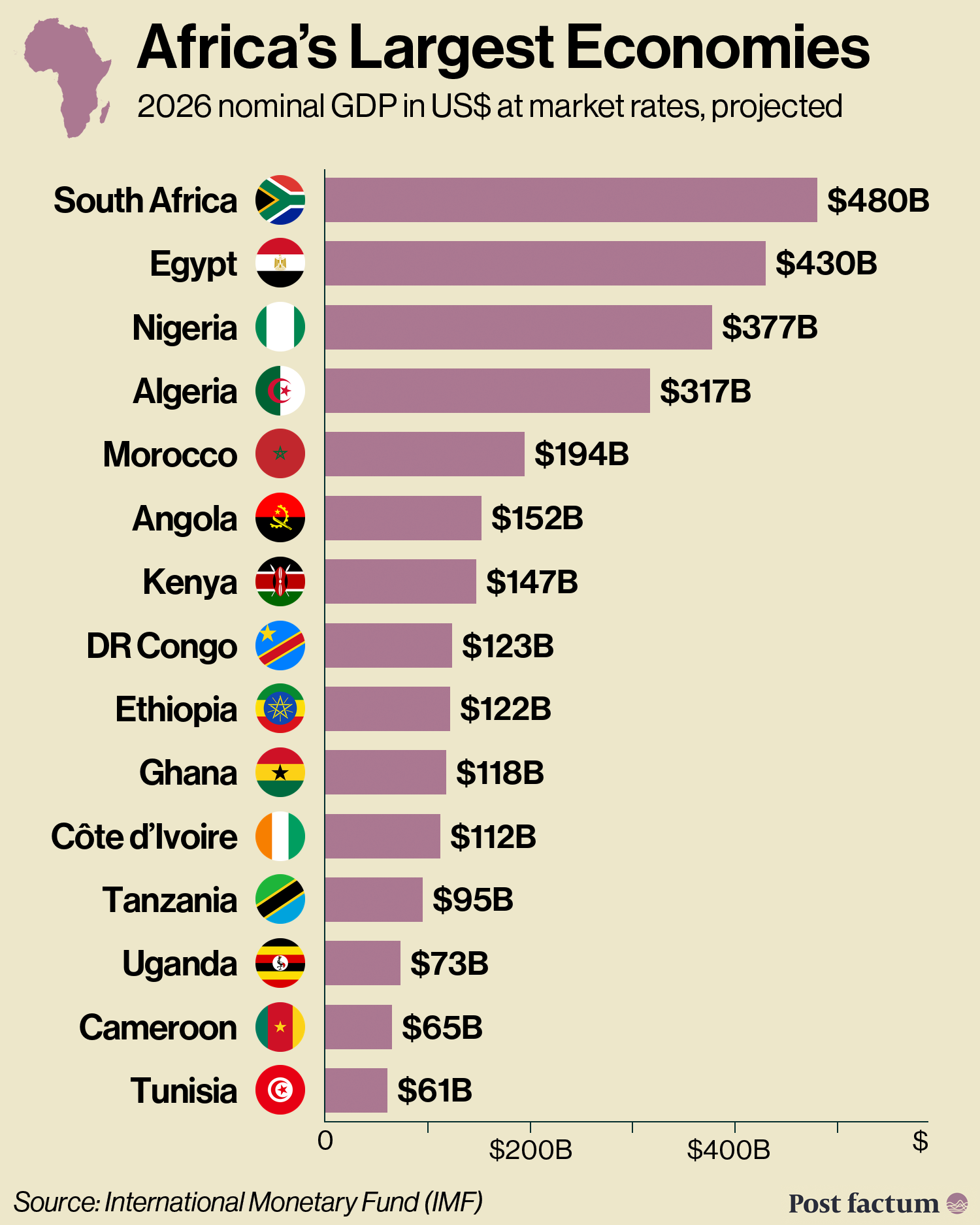
Ethiopia has 130 million people and is Africa’s 9th-largest economy (5th by PPP).
It is projected to be the fastest-growing African economy in 2026 at 9.2%, with agriculture, services and industry as its biggest sectors.
Ethiopia lost its coastline in 1993, when Eritrea became independent after a 30-year war.
- Ethiopia and Eritrea fought a border war in 1998–2000.
- They then fought together against Ethiopia’s Tigray region rebels in 2020–22.
- Each of the 3 conflicts killed over 100,000 people.
In September 2026, war in Tigray resumed and Ethiopia and Eritrea broke off relations, with Ethiopia accusing Eritrea of backing the rebels.
- A coalition of regional groups wants to overthrow Ethiopia’s Prime Minister.
In October 2026, Eritrean soldiers crossed into northern Ethiopia’s Tigray; the Ethiopian army responded with drone strikes.
How does Ethiopia ship its trade?
In the year to July 2026, 97% of Ethiopia’s sea cargo went through Djibouti, its small neighbour.
Ethiopia owns no stake in Djibouti’s ports and pays $1.5–2 billion a year in port fees.
A Chinese-financed electric railway has linked the countries since 2018, but trucks still carry 80% of the cargo.
Fuel, 25% of Ethiopia’s imports by weight, arrives on around 350 tanker-trucks per day.
About 3% of sea cargo went through a port in Somaliland.
Somaliland is a breakaway region of Somalia that only Israel currently recognises as a state.
Ethiopia bought a 19% stake in Somaliland’s Berbera port in 2018 but lost it by 2022 after not paying its share.
In 2024, Ethiopia agreed to rent 20 km of Somaliland’s coast for a naval base in exchange for possible recognition, but the deal stalled.
In 2024, Djibouti offered Ethiopia one of its ports to fully manage, but Ethiopia rejected it, asking for a fully controlled land corridor to the port and a military base there, which Djibouti categorically refused.
Why and how is Somalia fragmenting?
- State collapse: Somalia’s government fell in 1991, and regions built their own administrations during the civil war that followed.
- Jihadists: an Islamist militant group linked to al-Qaeda holds large rural areas and attacks the capital.
- Political fragility: the president’s term ended in May 2026, but he stays in office under a constitutional change that the opposition boycotted.
The 2 breakaway regions of Somalia are Somaliland and Puntland.
Somaliland is de facto (in practice) independent: it has its own currency and army, and wants to be recognised by more states globally.
In December 2025, Israel became the first UN member to recognise Somaliland, a move condemned by Somalia, the African Union and the Arab League.
The UAE, whose company DP World runs the Berbera port in Somaliland, also has a military airstrip there.
Puntland is a fully autonomous region within Somalia.
It manages its own affairs but has not sought international recognition as an independent country.
In 2024, Puntland stopped recognising the federal government, and in August 2026 its forces seized 3 federal-aligned bases.
Puntland is where most pirate activity in Somalia took place.
In 2026, piracy flared up again after a decade of quiet, with 25 incidents so far in 2026.
In April 2026, pirates hijacked a tanker and later killed 5 sailors before Puntland forces retook it, the first such deaths in over a decade.
Puntland has a UAE-funded security force, including for pirate response.
Fresh water geopolitics
Egypt relies on the Nile for over 95% of its fresh water, and most of the river’s water starts in Ethiopia.
Egypt has about 57 billion cubic metres of fresh water per year, out of the 123 billion it needs.
- This is below the 500 cubic metres per person that defines absolute water scarcity.
In 2025, Ethiopia opened Africa’s largest hydropower dam on the Blue Nile, the river’s main branch.
Egypt and Sudan want a binding deal on how the dam is filled and run during droughts, but years of talks have produced no agreement.
Ethiopia plans 3 more dams on the Blue Nile, and in 2026 Egypt formally rejected any new dams.
On 4 October 2026, Egypt, Eritrea, Somalia and Sudan’s army signed a joint declaration opposing one-sided action on the Nile.
- It also rejected Somaliland’s recognition and said only Red Sea coastal states should govern the sea, which excludes Ethiopia.
International intrigue
Outside powers in the region form 2 loose groups:
- Egypt, Saudi Arabia and Türkiye back Sudan’s army and Somalia’s federal government, alongside Eritrea. This group supports formal borders and central governments.
- The UAE works with Ethiopia, Somaliland, Puntland, and the paramilitary group fighting Sudan’s army. Israel is another country that looks to expand its influence through the region’s political changes.
Türkiye has troops, drones and fighter jets in Somalia under a 10-year defence deal signed in 2024.
Türkiye began drilling Somalia’s first deepwater oil well in April 2026.
Djibouti hosts military bases of the US, China, France, Japan and Italy.
In September 2026, the US agreed to phase out UN support for the African Union’s force in Somalia from 2027.
In September 2026, Iran-backed Houthi rebels took Yemen’s side of the Bab el-Mandeb and the strategic Hanish Islands.
In October, Saudi Arabia backed a counter-offensive with 100 fighter jets, while the Houthis struck Saudi cities and oil infrastructure.
Thank you for reading!
We need your support
Post factum is independent and reader-powered.
Pro subscriptions fund our work, giving you exclusive content, community access and other perks.
We have to reach 5,000 Pro members to cover our costs and continue publishing, or the funding we have raised so far will run out.
Please help us hit this goal and keep bringing you concise, factual, long-term reporting.
Join as a Founding Member now to lock in a lower lifetime rate.
Your fee will go towards paying our staff, covering our bills and making more content.
Keep exploring:


This week on Post factum Pro:

Join Post factum Pro to access the comment section.