
Merz’s Germany, analysed
29 September 2026
- Friedrich Merz is the chancellor of Germany from the centre-right party.
- He changed the constitution to allow extra defence and infrastructure spending.
- Merz’s approval rating fell to 14% by September 2026.
How it started
Friedrich Merz’s centre-right Union (CDU+CSU sister parties) won the February 2025 election with 28.5%.
The AfD was second with 20.8% of the vote.
- Brandmauer: other parties see the AfD as “far-right” and have an agreement not to join any coalition with it (officially since 2018).
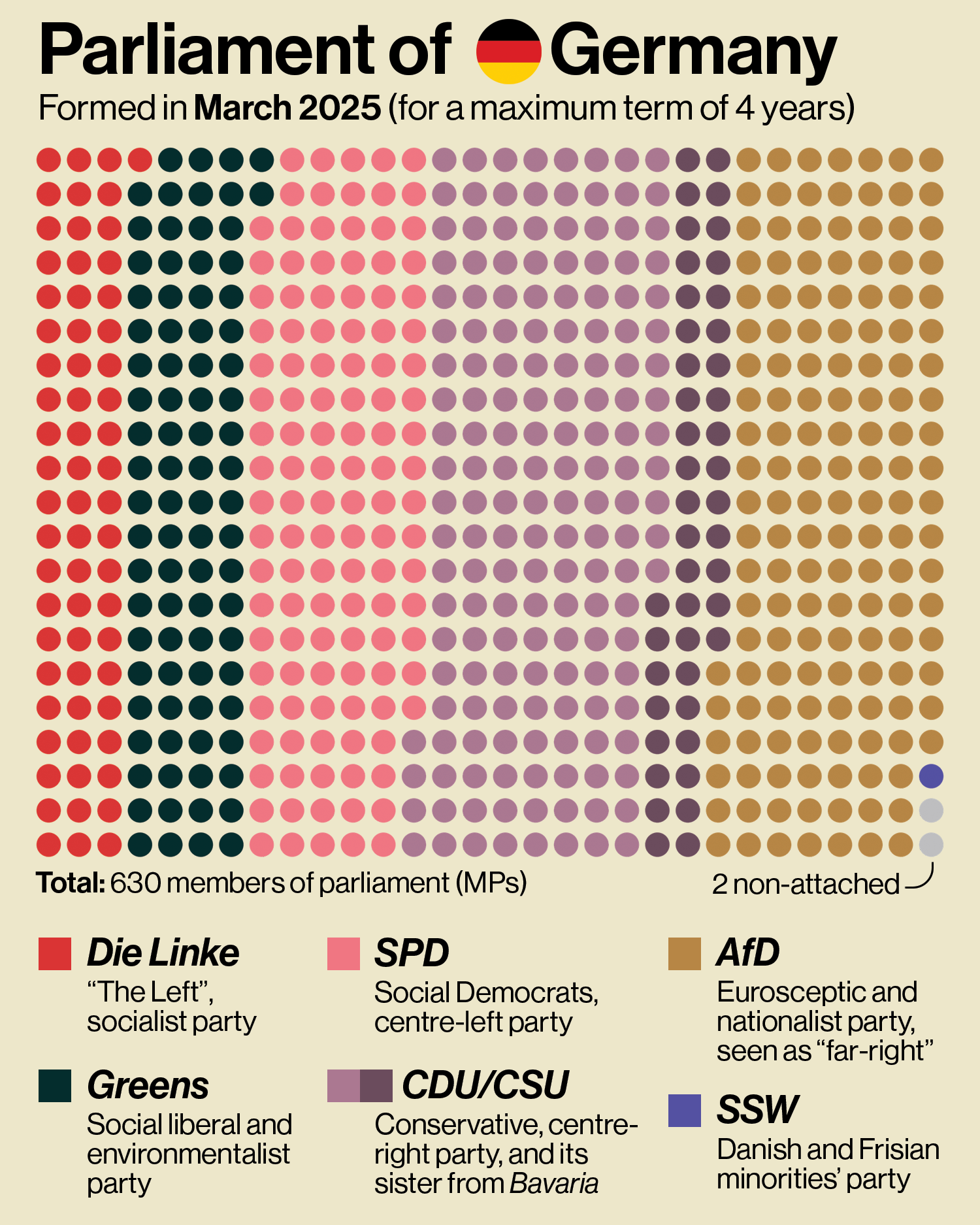
The only possible majority was a coalition of the centre-left SPD and the Union: 328 of 630 seats, a narrow majority of 52%.
A key achievement came soon after, and before Merz took office as chancellor.
For the first 30 days after the election, the earlier parliament was still in power.
This allowed Merz to get the SPD and the Greens to vote with the Union to change the constitution.
The constitution banned any German government from running a budget deficit of over 0.35% of GDP (debt brake).
The change:
- Military spending above 1% of GDP is now an exception to the debt brake.
- €500 billion ($568 billion) of infrastructure spending over 12 years was allowed outside of the debt brake, around 1% of GDP per year.
- Regional governments were also allowed some extra borrowing.
In the current parliament, Union+SPD+Greens do not reach the 66.7% of the seats needed for a constitutional change.
Merz was formally elected chancellor (by the members of parliament) in May 2025.
His vision:
- The constitutional reform was supposed to boost the economy and the government’s ratings.
- For the first year, the focus was on the coalition partner’s (SPD) preferred policies, such as extra welfare spending — measures that support the population.
- Then, the CDU planned to push through its own reforms in 2026, such as increasing the pension age and cutting taxes — less popular measures that promote business and cut costs.
In the rest of this report, we explain why Friedrich Merz enters October 2026 with an approval rating of 14% and most of his reforms delayed.
How it went
In December 2025, pensions were fixed at 48% of average wages until 2031 (the SPD part of the pension reform), despite a revolt by 18 young Union MPs over the cost.
Some of Merz’s own promises passed:
- Migration: border turn-backs of asylum seekers; first-time claims halved in early 2025, partly as Syria’s war ended.
- Business: faster tax write-offs and a company tax cut from 15% to 10% by 2032.
- Labour: stricter unemployment rules since July 2026, including stopping all payments for refusing work.
The promised economic turnaround was limited: GDP grew 0.2% in 2025, after 2 years of decline.
The war in Iran raised energy prices and increased inflation.
The GDP growth forecast for 2026 was halved to 0.5% after the war but has rebounded to 1.3% in September 2026.
Real wages in Germany were at the same level in 2025 as in 2018, while recovering from a drop during the 2022 Ukraine war energy price shock.
Real wages are projected to grow 0.7% in 2026.
- Germany is the largest economy in the European Union.
In July 2026, the ruling coalition agreed 34 reform “points”, including key CDU policies like linking the retirement age to life expectancy, but almost none have been made into law yet.
Every bill put to a vote has passed, but the blocking factor is the negotiations within the coalition, between the Union and the SPD.
With a majority margin of 12 seats, a small revolt could end a proposed bill.
- The SPD itself opposes some details of the package, especially on the pension age.
- The “Young Group” are 18 MPs under the age of 35 on the Union side; they want a quicker and deeper pension reform (completely opposite to the SPD).
- The CSU is the sister party of the CDU in the Bavaria region, but its MPs follow the directions of their own leader, Söder, who bargains with the CDU on some issues.
- The PKM is a group of 100+ MPs (across CDU and CSU) who are supporting the interests of small and medium businesses.
The central piece of the pension reform is linking the pension age to life expectancy: the proposal is to increase it by 8 months for every extra year of life expectancy.
The pension bill has not been drafted, as the SPD wants softer terms and negotiations among the coalition groups continue.
By September 2026, the lack of reforms and a slow economy have contributed to Merz’s approval rating falling to 14%.
The AfD now leads the national polls at 29%, with the CDU at 18%.
In September, the AfD won the state election in one region of east Germany with 43.8%, while far-left Die Linke (the Left) gained support in the capital, Berlin.
Removing a chancellor requires electing a successor with a majority in parliament (316 votes).
The opposition does not have enough votes to appoint its own chancellor, as the SPD, Greens and the Left have 269 seats combined.
The Union could elect a replacement for Merz with SPD support, but no candidate has stepped up so far.
- The CDU has a policy against joining a coalition with the AfD, so they are unlikely to switch their partner from the SPD, as no other party has enough votes for a majority.
Defence and geopolitics
Germany began rearming after Russia’s invasion of Ukraine in 2022.
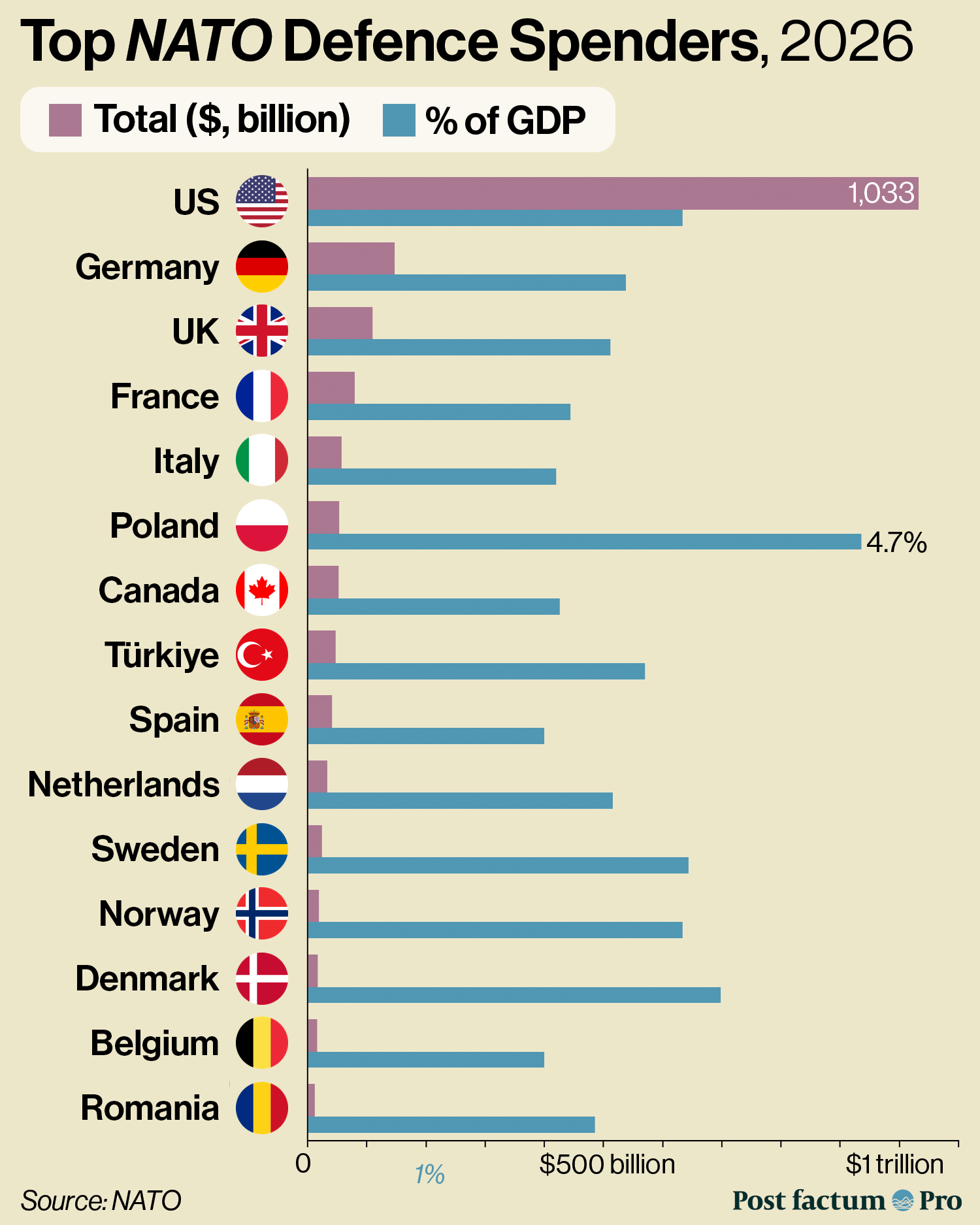
Germany is forecast to spend 2.7% of GDP on defence in 2026, and the government plans 3.5% by 2029, 6 years ahead of NATO’s new target.
The armed forces have 70% of the soldiers they aim for by 2035, and military service remains voluntary.
- A military questionnaire is now required for all men born in 2008 or later.
Germany is Ukraine’s largest European arms donor and opened its first permanent brigade abroad, in Lithuania, in 2025.
Merz’s plan for a $161 billion loan to Ukraine from frozen Russian assets was blocked by Belgium in December 2025.
Merz accepted 15% US tariffs on EU goods in 2025, but opposed US threats over Greenland in 2026.
Reforming the debt brake (discussed at the beginning of the report) was Merz’s first broken promise, as he campaigned on not changing it.
However, it came after the US declared it would reduce support to its NATO allies and require more military spending from them, while Trump and Ukraine’s Zelensky clashed during a meeting in the US.
What other country’s politics would you like us to cover?
Tell us in the comments below, and don’t forget to visit our community page for votes and discussions.
Thank you for reading!
Keep exploring:


