
European Rearmament, revisited
Readiness 2030, Defence Spending and Politics
Published: March 14, 2026
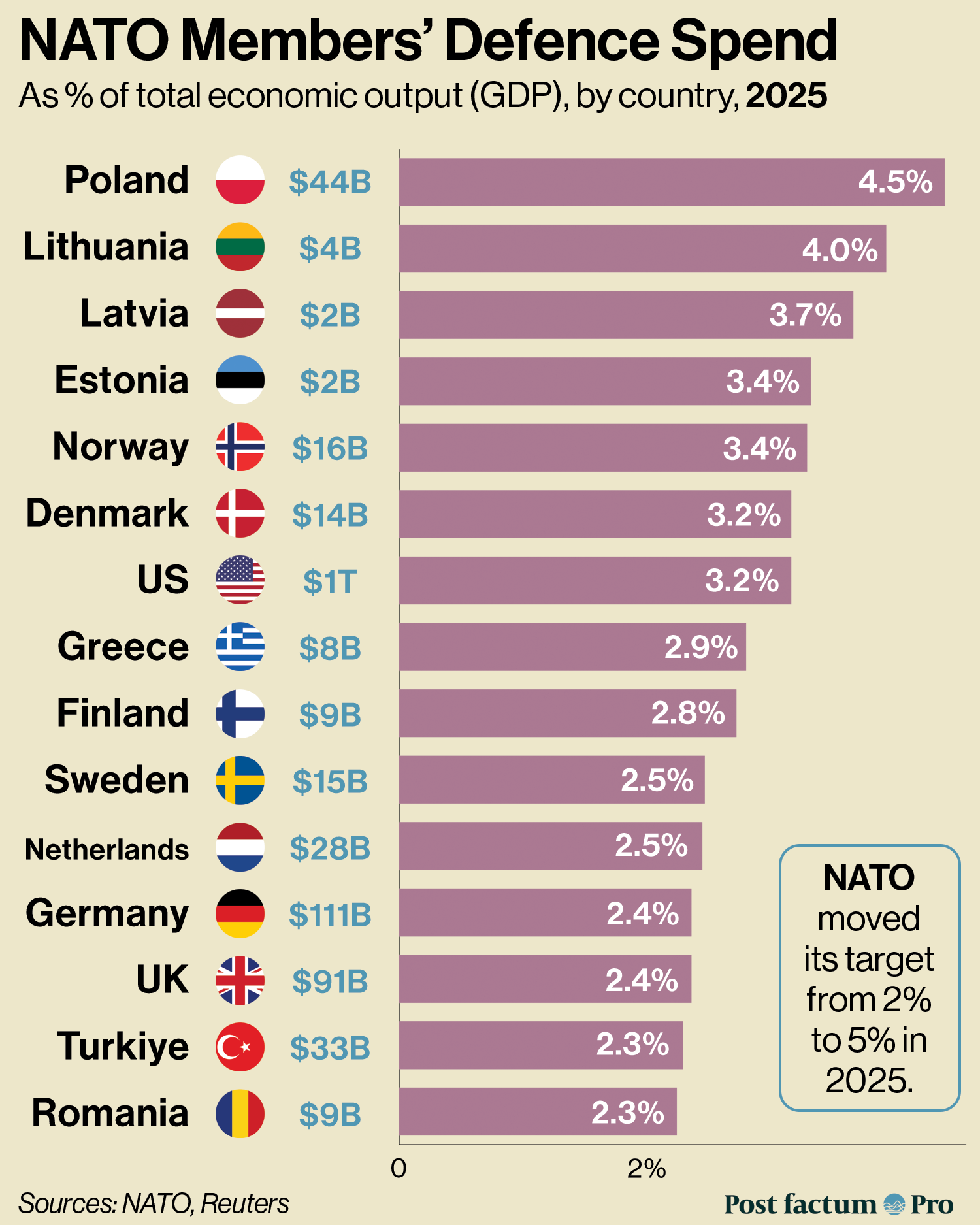
Since Russia's invasion of Ukraine in February 2022, European countries have been increasing their military spending at the fastest rate since the Cold War.
In 2025, European NATO members spent $563 billion on defence, about $86 billion more than the year before.
For the first time, all 32 NATO members are expected to meet the 2% of GDP defence spending target. This is up from just 7 in 2022.
Between 2015 and 2024, European military spending rose 83%, the largest increase of all world regions.
Main reasons:
Russian threat: Russia's invasion turned a land war in Europe from a theoretical risk into reality.
Gaps exposed by the war: Europe's defence industry weakened since the Cold War and could not produce enough equipment to meet the needs of Ukraine.
US pressure: President Trump questioned US support for NATO, demanded higher spending from other members and sought to reduce US military involvement in Europe.
Russia officially allocated about 7.2% of GDP to defence in 2025, double the European NATO average.
Replacing the US military forces and equipment assigned to protect Europe (such as nuclear submarines and missiles) would cost about $1 trillion.
In June 2025, NATO set a new target of 5% of GDP spent on defence by 2035.
This is split between 3.5% for "core" defence, and 1.5% for security-related spending such as cyber or infrastructure.
The EU agreed some goals to improve its collective defence:
Readiness 2030: a broad target to be ready for a large-scale conflict by 2030, including stockpiling.
Closing capability gaps: making sure enough of all required military equipment is produced and ready.
EU collaboration: simplifying and unifying military purchases and strategy between members.
Self-sufficiency: to buy more weapons and equipment from European producers, 40% by 2027.
Also, 2 major programs were launched: a Europe-wide anti-drone system, and a project to fortify the Eastern border of the bloc.
In addition, there are plans for a Europe-wide space defence project, and an air/missile defence project too.
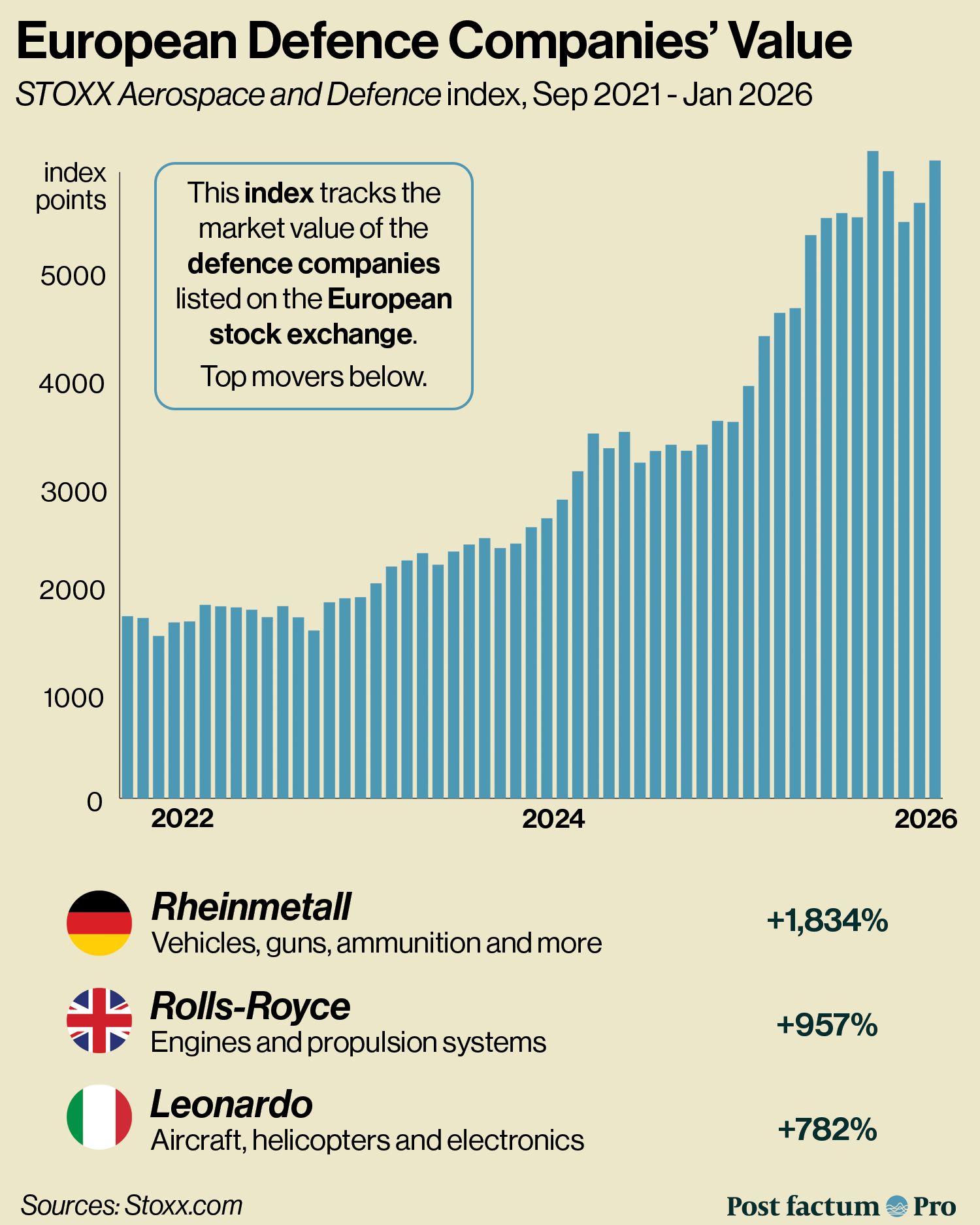
There has been some industrial expansion, with artillery shell production growing by 500% to 2 million units, still below Russia's output.
Major European defence companies now have an average of 4 years worth of orders already placed.
Germany
Germany has been the largest European defence spender, at $111 billion in 2025.
In March 2025, Germany's parliament voted to change the constitution, allowing extra debt to fund defence spending above 1% of GDP.
A separate €500 billion infrastructure fund for Germany was approved alongside.
Germany is now planning to spend €162 billion per year on defence by 2029, or about 3.5% of GDP.
In March 2026, Germany and France set up a joint nuclear coordination group, allowing Germany to take part in French nuclear exercises and inspections of strategic sites.
Poland
Poland spends the highest share of GDP on defence among NATO members (4.5% in 2025) and signed over $55 billion in US arms deals between 2022 and 2024.
However, how to pay for the build-up has become a political dispute.
In May 2025, the EU adopted SAFE (Security Action for Europe), a €150 billion loan fund to help member states finance defence spending.
On 12 March 2026, Poland's president blocked the law needed to access €43.7 billion from SAFE, the largest national share among EU countries.
The president argued that the loans would burden taxpayers and reduce national control over defence decisions.
Poland's central bank has proposed using profits from its gold reserves to fund the extra spending instead.
France
France ordered a new nuclear-powered aircraft carrier in December 2025, costing over €10 billion, the largest European warship ever planned.
France is targeting 3.5% of GDP on defence by the NATO deadline of 2035, equivalent to about €100 billion per year.
The French president called Russia an "existential threat" and proposed extending France's nuclear protection to other European states.
UK
The UK is planning to spend 2.5% of GDP on defence by 2027, and 3% by 2029.
The UK is developing a next-generation fighter jet together with Japan and Italy, in a project competing with a France-Germany-Spain collaboration.
In July 2025, the UK and France signed a new defence pact expanding military cooperation to space and cyber.
NATO
Finland and Sweden joined NATO in 2023 and 2024.
Combined, the Nordic countries now spend over $50 billion on defence, more than double their 2020 levels.
Some countries have re-introduced or expanded conscription since 2022, including Croatia, Denmark and Latvia.
Conscription (or draft) is military service that is required of some citizens by law, whether they want to serve or not.
Germany has also introduced a requirement for all 18-year-old males to register their fitness and interest in military service, though the service itself is not required.
However, the European military build-up is not uniform.
Spain received an exemption from the new 5% target, mainly to protect social spending, while it also experiences high debt levels.
The Czech Republic's 2026 budget reduced defence spending compared to earlier plans, as the government prioritised cost of living for its citizens.
EU countries still buy most of their defence equipment from the US, even as the EU targets 55% sourced from European factories by 2030. South Korea and Israel account for 9% and 8% respectively.
Thank you for reading!
Leave a comment below: