
Germany: Rise of the AfD Party
Published: July 17, 2025
Important! This report follows the outdated format of Post factum Pro.
Back then, we focused on analysing how other media outlets covered the event.
Let us know if you want to see more of something like this!
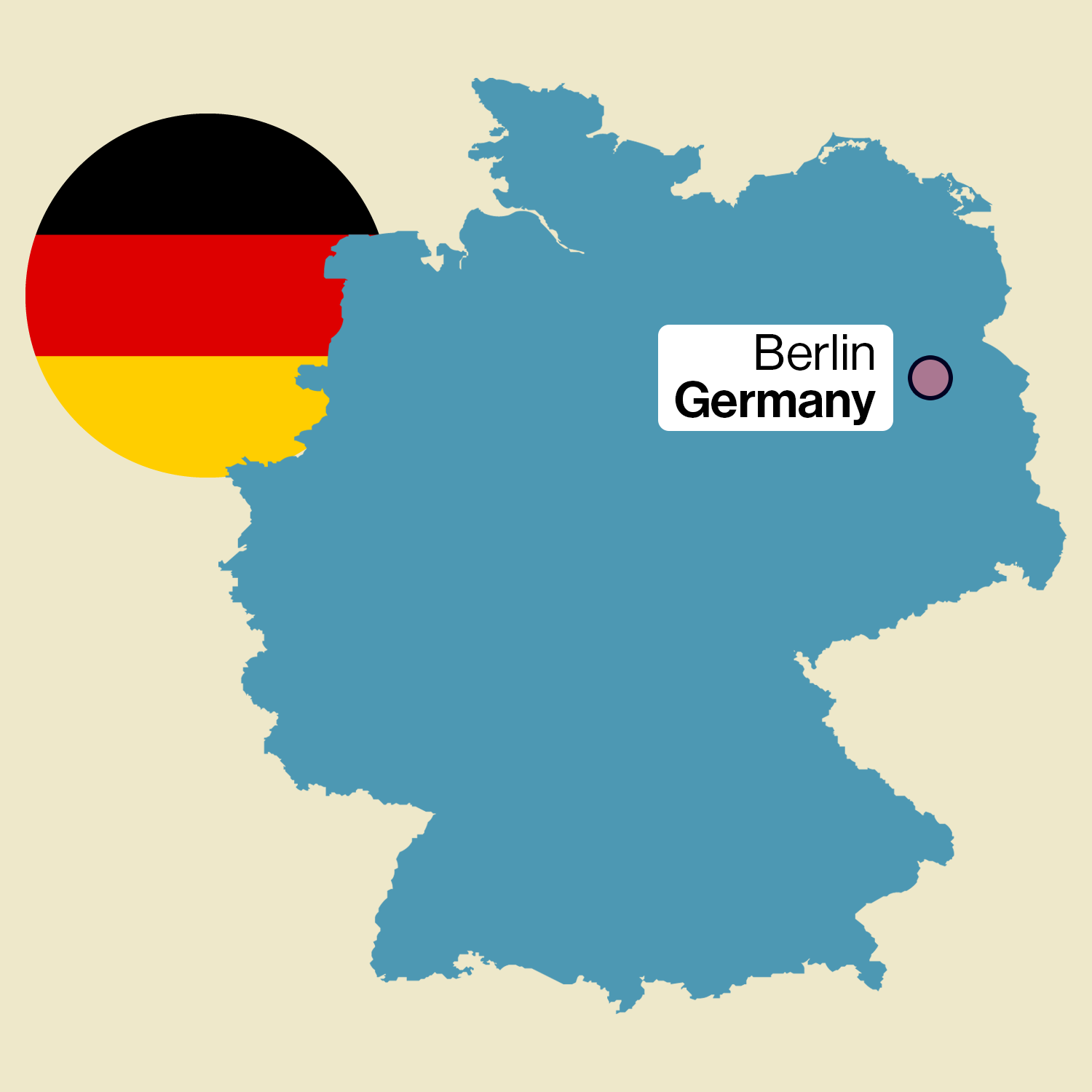
Alternative for Germany (AfD) is a German political party formed in 2013.
Its focus then was to oppose the bailouts (financial support) to the economies of Greece, Portugal and other countries failing during the eurozone crisis.
After the 2014 European refugee crisis, the AfD added active opposition to migration as its key policy promise.
AfD missed out on seats in the German parliament in 2013 but got them in 2017 and 2021 with 13% and 10% of the votes.
On 23 February 2025, AfD came second with 21% of the votes in a snap (unplanned) election, forced by the falling apart of a centre-left ruling coalition.
The centre-right party (CDU) has won the election and formed a ruling coalition with the centre-left party that came third.
CDU has a “firewall” policy: a formal promise to not form a government with “far-right” parties.
In 2021, a German intelligence service ruled that AfD is a “suspected far-right extremist force” leading to special observation measures.
AfD is seen as far-right by most of the mainstream media and politicians. This is because of AfD’s comparatively radical conservative policies, such as mass deportations or Germany leaving the European Union.
However, this label focuses on the extreme nature of the party’s proposals and leaves out the reasons behind them.
There are other descriptions of the AfD that explain its ideology:
Nationalist — AfD wants to put the interests of Germany first, in particular when it comes to helping other countries at the expense of Germany. Their policies focus on national strength, rather than international cooperation.
Eurosceptic — AfD started as a party that opposed European currency integration (the euro) and political integration (the EU). They see the EU as a flawed project that is not beneficial to Germany.
Populist — AfD can shift its principles to attract more voters. Its proposals and promises focus on issues that are relevant and emotional to large groups of the population at a particular moment.
Anti-establishment — one of AfD’s goals is to counter and disrupt the status quo (existing state of things). It sees the government and the ruling elites as corrupt, ineffective and having a left-wing bias.
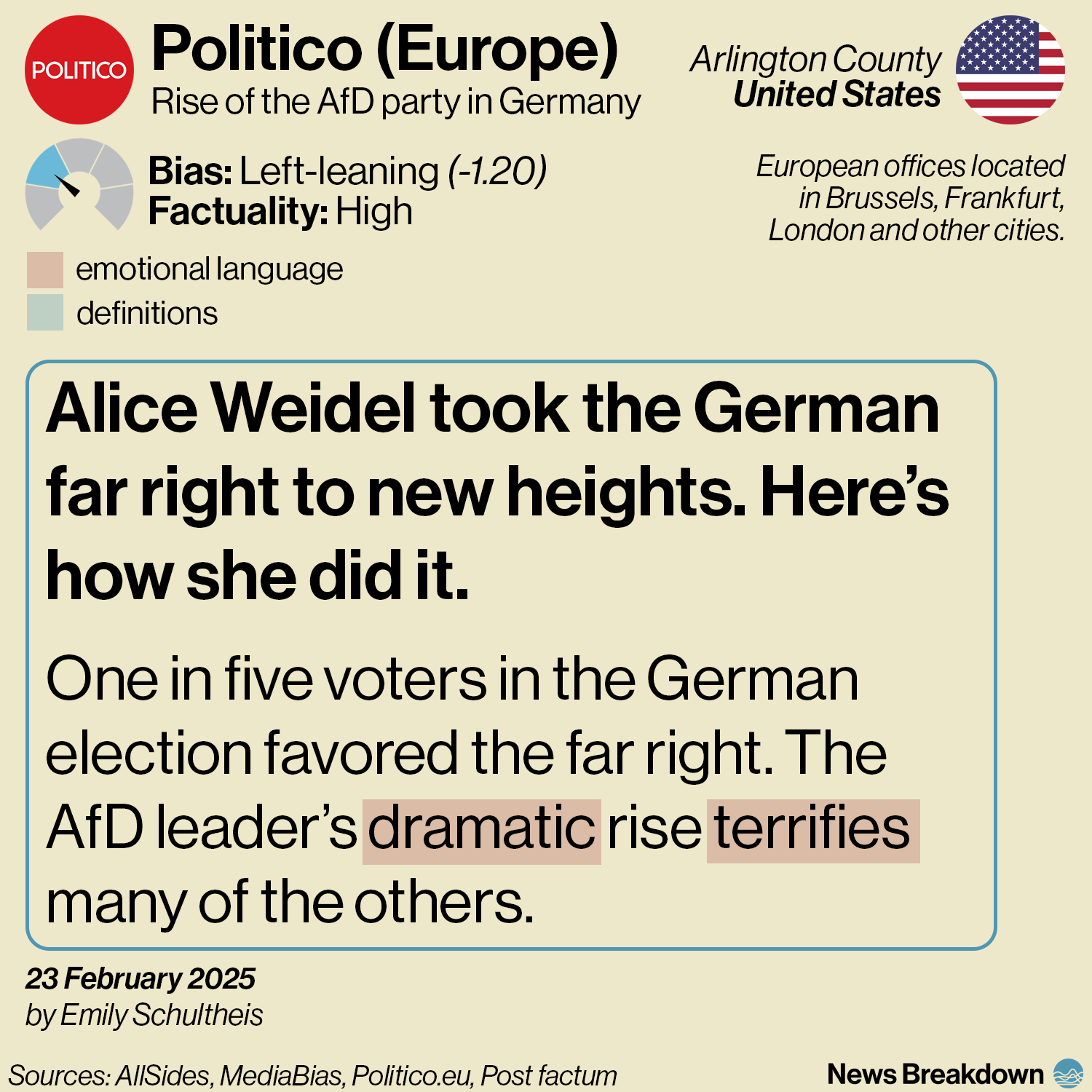
Politico: US-based digital news organisation.
Atlanticist: supports close cooperation between Europe and the US, and their joint role in global security.
Angle: argues that AfD and its leader are becoming increasingly more radical.
Politico is openly critical of the AfD and uses emotional language in this news piece, such as by suggesting the 80% of Germans who did not vote for the AfD are “terrified”.
The article starts by describing a crowd of supporters cheering for the AfD’s leader, Alice Weidel, after their impressive result in February.
The crowd is shouting “Alice für Deutschland!” or “Alice for Germany!”.
This sounds almost identical to “Alles für Deutschland” (“Everything for Germany”) which was the slogan of Adolf Hitler’s paramilitary groups.
Politico then suggests that this is “an undeniable sign of the increasingly open radicalism of the party and its candidate”.
The article argues that “radical-right figures” joined the AfD around 2015 when it shifted focus towards being anti-immigrant, supposedly “pushing out many of the founders”.
It is true that in 2015, a smaller group split from AfD to form a party with an economic liberal ideology, while the AfD focused on national-conservative and right-wing populist policies.
Politico gives two more reference points as evidence of AfD’s radicalisation:
A leading AfD member being fined for ending his speech with the banned “Alles für Deutscheland” slogan.
A 2017 speech by an AfD politician that advocates for a “turnaround in policy of remembrance” of the Holocaust (the mass murder of European Jews by Nazi Germany). This speech also criticised the Holocaust memorial in Berlin as a “monument of shame”.
The article by Politico gives some evidence for the radical nature of AfD policies and the extremist rhetoric by some of its members.
However, it does not show a recent trend of radicalisation of the AfD, instead discussing their ideological shift around and after 2015.
The article leaves out the details of most policies proposed by the AfD and the issues of concern to AfD supporters, such as poverty, climate policy, immigration, crime or European integration.
This article is also a profile of Alice Weidel that gives some biographical information such as:
Her background in finance and investment banking.
Her identifying as lesbian and “(living) in Switzerland with a woman from Sri Lanka”.
The article states that her unconventional profile “allows her to deny accusations that the party is intolerant or far-right”.
This suggests the accusations may be true, without saying so openly, showing Politico’s critical stance towards the AfD.
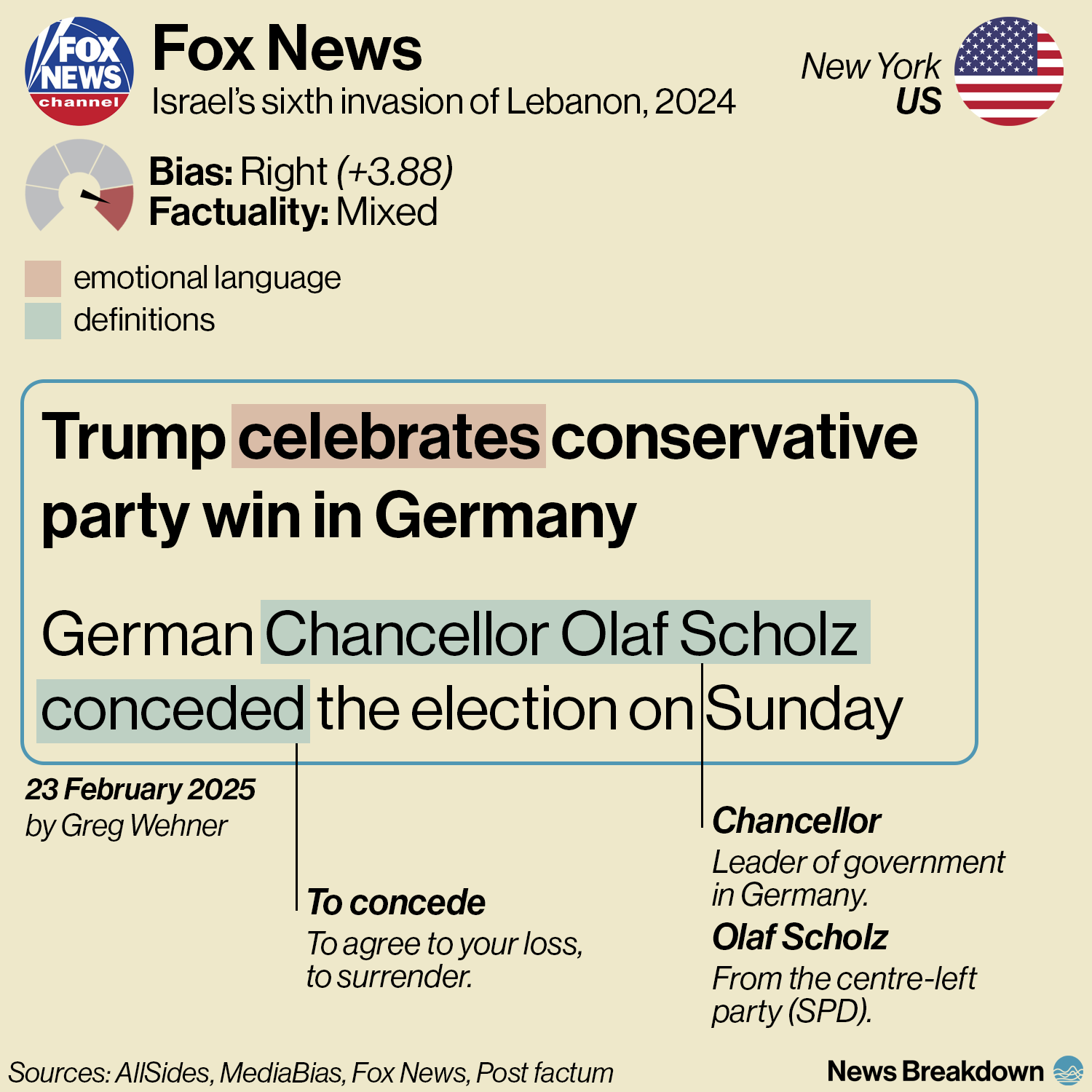
Fox News: conservative US news TV channel and website.
Angle: focuses on Trump’s positive reaction to Conservatives’ win in Germany.
Fox News explains that the new chancellor will replace a centre-left Social Democrat leader.
The article then gives two paragraphs of quotes from Donald Trump’s social media, in full capital letters, as he posted it.
Trump compares Germany with the US, suggesting that both his own victory in the US presidential election, and the Conservatives’ win in Germany come from people being “tired of the no common sense agenda, especially on energy and immigration”.
The article describes the AfD as “right-wing” rather than the widely used description as “far-right”.
Fox writes that Europe is struggling with “illegal immigration and a souring (weakening) economy” without explaining the claim.
It mentions that the new chancellor is promising to implement a 15-point policy to combat immigration, while the AfD advocates for mass deportations.
The article ends on the suggestion that the AfD could do even better (win) in 2029, especially given that it was “endorsed [publicly supported] by Trump and Elon Musk”.
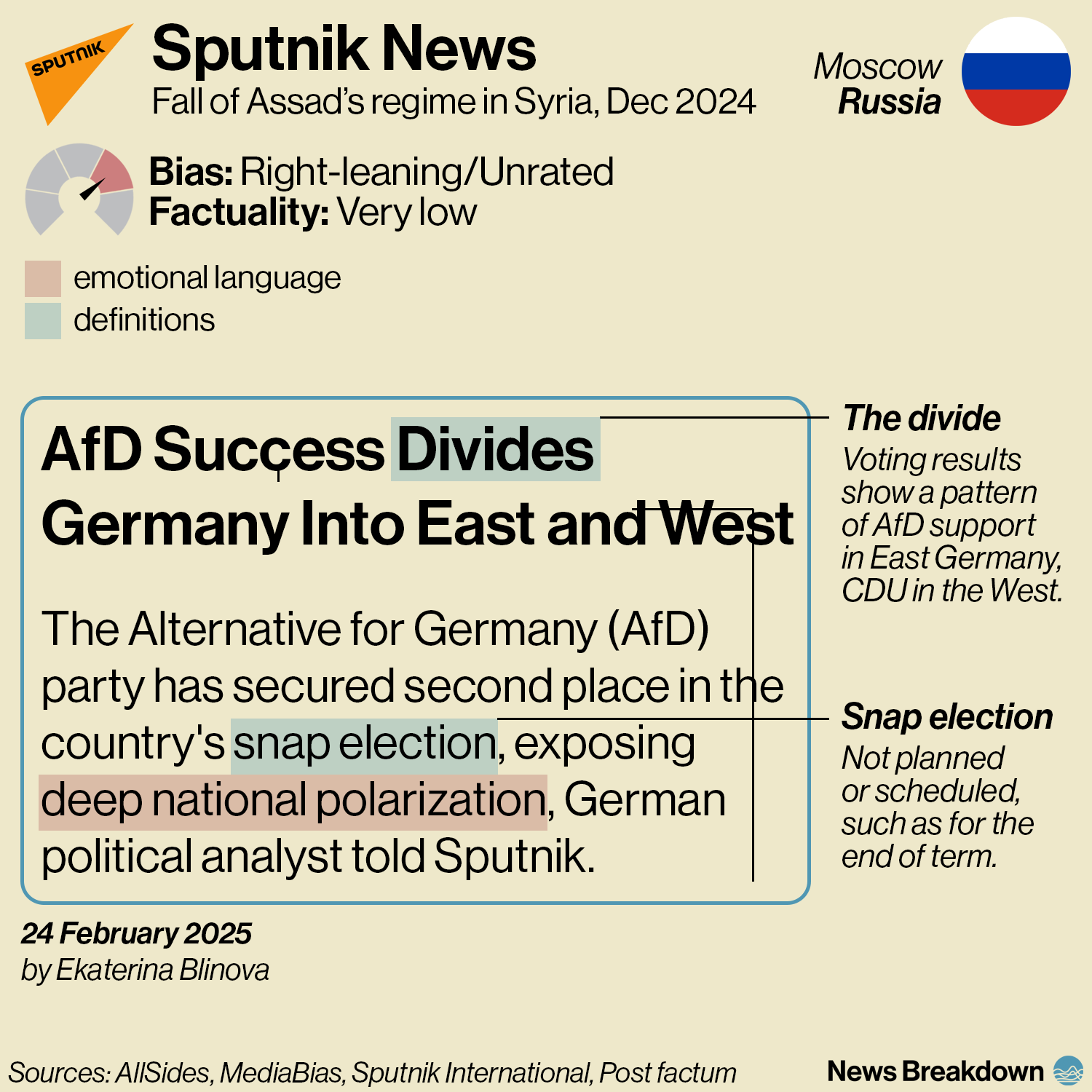
Sputnik: Russian state-owned news agency.
International: focused on global affairs and foreign audiences.
Propaganda: promotes official narratives, banned in the European Union.
Angle: focuses on the East-West divide in Germany and supportive of the AfD.
In its main online article covering the German election results, Sputnik does not mention the winner. They mention that AfD came second and suggest this “exposes deep national polarisation”.
AfD is the only major party in Germany that advocates for peaceful diplomatic relations with Russia regardless of its actions in Ukraine.
The Sputnik article is based on quotes from “a German political analyst”. He is actually a German journalist who has studied, lived and worked in Russia for at least the last 25 years, according to his own social media profile.
Sputnik highlights the East-West divide in Germany. It notes that the AfD performed better in the East.
East Germany was a satellite (dependent) state of the Soviet Union before the fall of the Berlin Wall in 1989, and the re-unification of Germany.
The article avoids describing the AfD as far-right or right-wing. Instead, it describes it as Eurosceptic (misspelled in the text as Euroskeptic).
The description reflects Russian opposition to EU integration and expansion.
According to the analyst quoted, AfD’s success is due to the failure of mainstream parties to fix problems like terrorism, “recession” and deindustrialisation (the relocation of industrial production and factories overseas).
This may be an attempt to portray Germany as weak.
But it also reflects real dissatisfaction among some voters over a failure to tackle issues they care about.
Instead, politicians have often focused on issues that they may even reject, such as the green agenda or diversity and inclusion.
Post factum
The AfD received 21% of the overall votes and 24% of the seats in the German parliament (152 out of 630).
They are the largest opposition party, followed by the Greens (85 seats) and the Left (64 seats).
The centre-right conservative party remained strong on its promise to not form a coalition with the AfD.
In May 2025, the German domestic intelligence service completed its investigation and ruled that the AfD is a “confirmed right-wing extremist”, suggesting that it is a racist party that does not see people of “migration background” as equal members of the German people.
This ruling would allow to potentially ban the AfD under the German law if it acts “aggressively”.
However, after AfD filed an emergency court application, the intelligence agency agreed to freeze their ruling while the court makes a decision.
The ruling is now most likely going to face a long legal battle in German courts.
This would be the first time in modern German history that a party with seats in parliament is found to be a “confirmed right-wing extremist”.
AfD keeps hope of disrupting the coalition between centre-right and centre-left parties, forcing their way into government.
In the summer of 2025, the ruling coalition of chancellor Friedrich Merz has seen some setbacks in coming to joint decisions on policy and appointments.
AfD is continuing to promise further moderation of its policies to improve its support among both politicians and voters.
The endorsements AfD received from US officials and some leaders globally are helping them exit political isolation, but the party remains an outcast in German politics.
Thank you for reading!
Author Benedict Mander
Editor Anton Kutuzov