
Trump-Zelenskyy Clash, revisited
Published: August 15, 2025
Important! This report follows the outdated format of Post factum Pro.
Back then, we focused on analysing how other media outlets covered the event.
Let us know if you want to see more of something like this!
In this report, we explain Trump’s changing policy on Ukraine and discuss how it affected international support for the country. Then, we analyse the most noteworthy media takes.
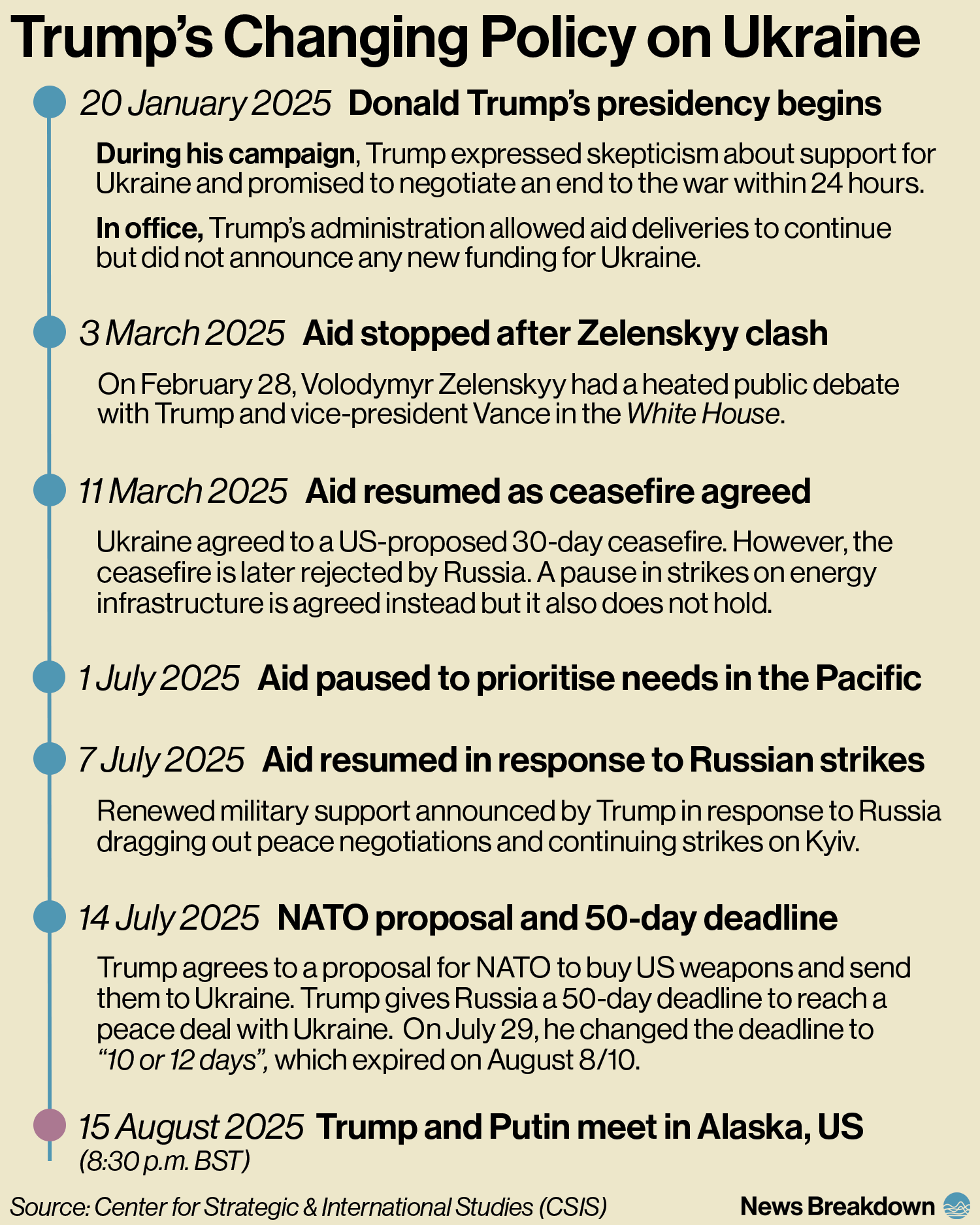
On 28 February 2025, Ukraine’s president Volodymyr Zelenskyy met with Donald Trump and his vice president JD Vance in the Oval Office of the White House.
After the meeting, Ukraine and the US were expected to sign a “mineral resources agreement”: a deal giving the US a share of profits from future rare earth elements mining projects in Ukraine. In exchange, the US would have confirmed its partnership with Ukraine.
Ukraine wanted the US to give it security guarantees: a formal promise to defend it. However, the draft deal only stated that the US “supports Ukraine’s effort to obtain security guarantees”.
There were many causes for tension leading up to the meeting, from Zelenskyy’s past support for Joe Biden and the Democratic Party, to the increasing stakes of the peace negotiations and Zelenskyy’s refusal to follow the White House dress code.
A joint press conference with Trump, Zelenskyy and Vance turned into a heated and emotional debate, as Zelenskyy repeatedly questioned the effectiveness of a ceasefire and diplomatic negotiations with Vladimir Putin, citing examples from the past.
Following the initial exchange between Zelenskyy and Vance, Trump joined in after Zelenskyy speculated that the consequences of the Russia-Ukraine war will soon have negative effects on the US.
Trump accused Zelenskyy of “gambling with World War III” and “being disrespectful”, later ending the meeting early and asking the Ukrainian delegation to leave.
Most US’ international allies voiced their support for Ukraine and Zelenskyy after the meeting.
3 days later, Trump stopped the delivery of aid to Ukraine, stating that the Oval Office meeting showed Ukraine is not looking to make peace.
1 week later, on 10 March 2025, the aid was resumed as Ukraine agreed to a US-proposed 30-day ceasefire. However, this ceasefire was ultimately rejected by Russia.
Instead, Russia and Ukraine agreed to a pause in the strikes on energy infrastructure but this deal also failed.
Ukraine and the US signed the Mineral Resources Agreement on April 30 that established a Fund with US-Ukraine joint ownership of profits from future mining projects.
The new agreement is more detailed and is slightly more favourable to Ukraine than the first version, including more clearly defined terms.
It also specifies that the US can provide military aid that would count toward its contribution to the fund.
The new deal states that it “is an expression of a broader, long-term strategic alignment” and “a tangible demonstration of the US support for Ukraine's security, prosperity, reconstruction, and integration into global economic frameworks”.
The agreement still does not provide Ukraine with specific security guarantees.
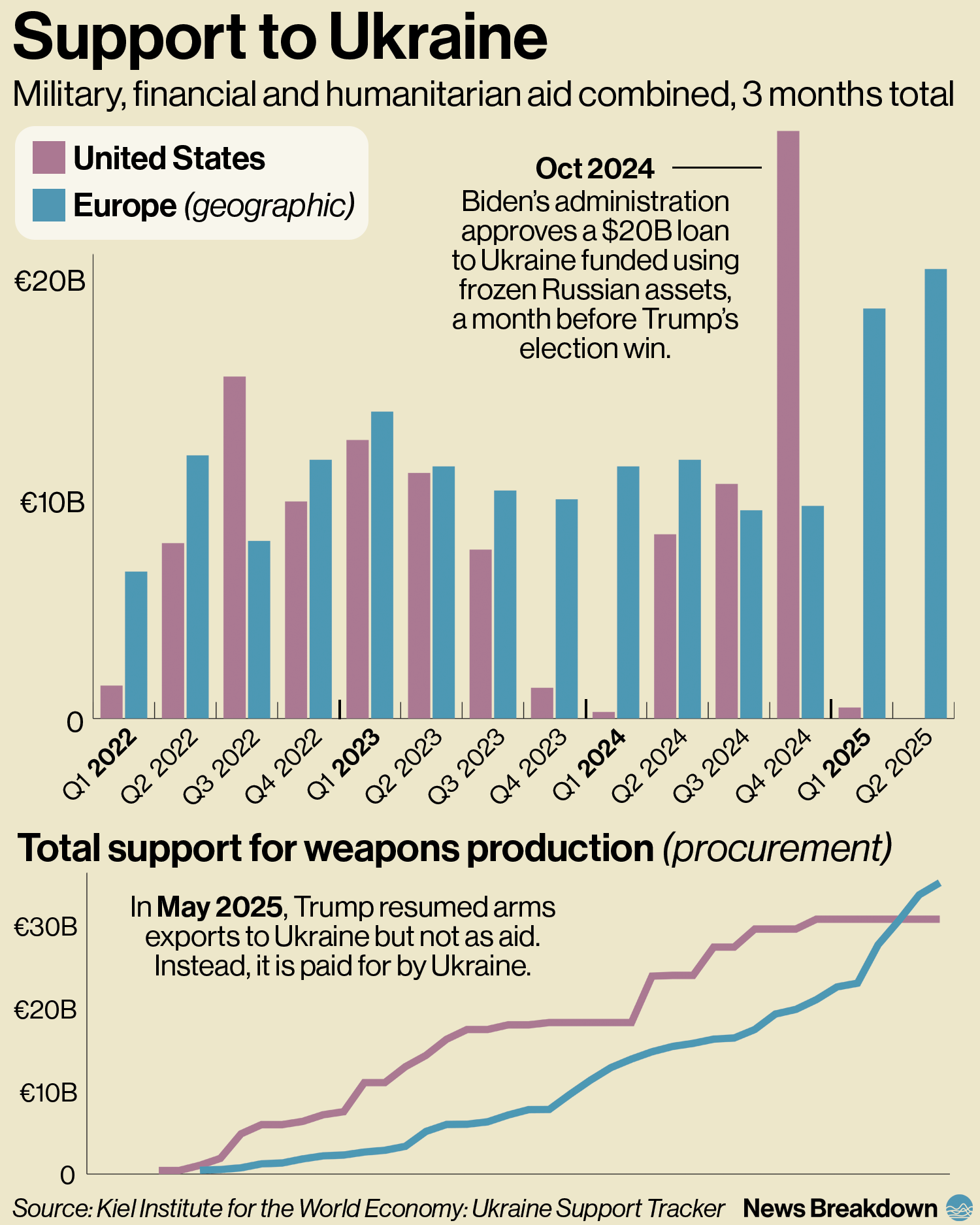
How did aid to Ukraine change since Trump’s election?
In 2025, Europe has approximately doubled the volume of its aid to Ukraine and maintained this higher level.
A large share of the weapons now come not from the stockpiles of European armies but directly from the weapons industry.
Europe has now overtaken the US in the total volume of weapons supplied to Ukraine by industry.
A large share of European financial aid to Ukraine now comes through loans financed by frozen Russian assets.
In 2022, around $300 billion worth of financial assets held by Russia in Western banks were “frozen”. In 2024, the Biden administration approved a $20 billion loan to Ukraine financed by investing these frozen assets.
In May 2025, Trump for the first time approved the export of weapons to Ukraine.
However, this was not military aid, as the exports were paid for by Ukraine with financial assistance from Europe.
The US produces and exports uniquely valuable weapons such as Patriot air defence systems that do not have direct replacements made in Europe.
While the Trump administration did not approve any additional funding for Ukraine, it has control over how previously approved aid is delivered.
Another form of US support for Ukraine comes in the form of intelligence sharing.
This includes information from satellite and aerial footage, intercepted communications, human intelligence and other sources.
Intelligence sharing was paused by Trump alongside other aid to Ukraine on March 3 and resumed by March 11.
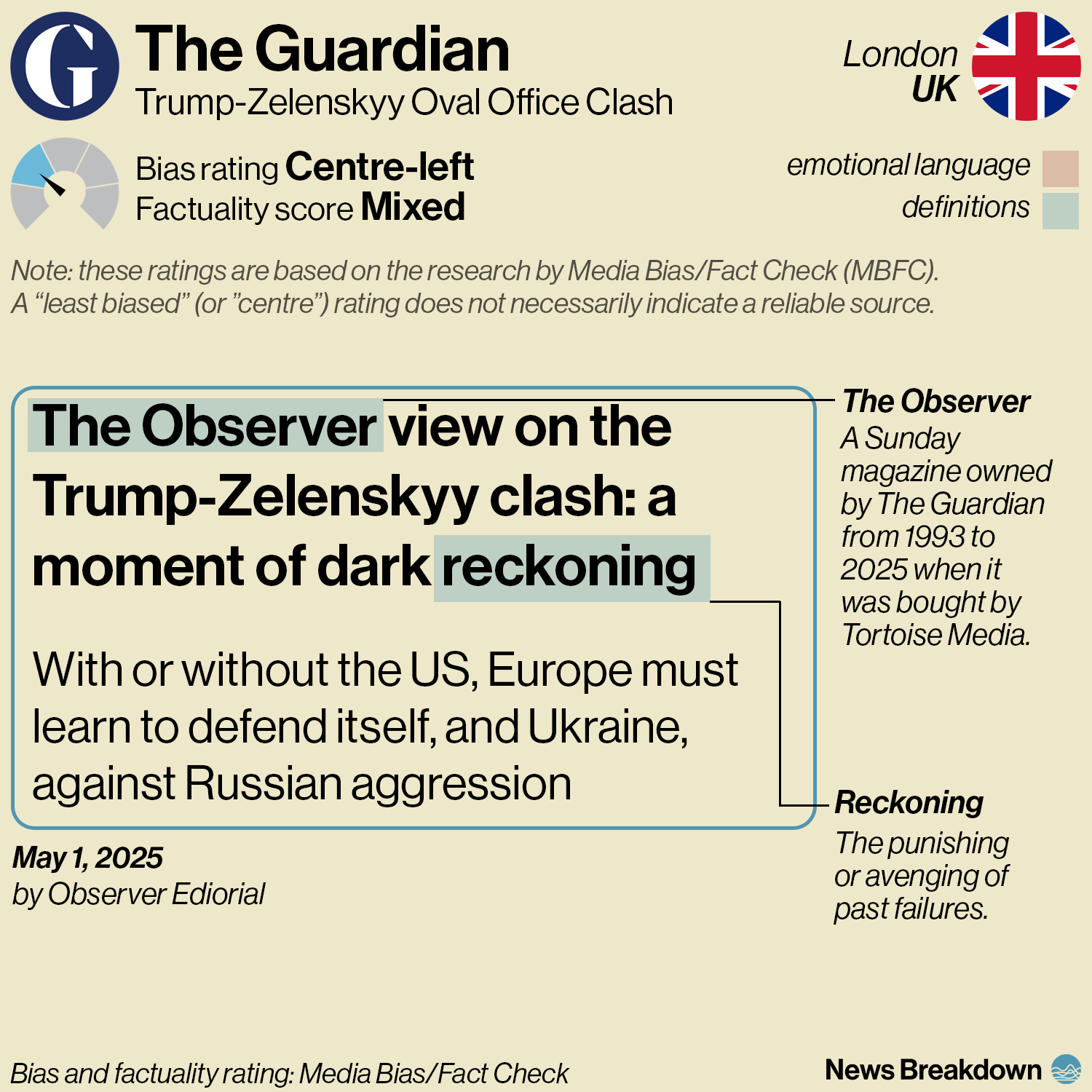
This piece by the Guardian/Observer describes the meeting as “one of the most profoundly shocking moments in US diplomacy in decades”.
The text uses emotional language regularly and clearly expresses its negative opinion of the way Donald Trump and JD Vance acted. The Guardian regularly criticises both.
It presents the view that was common among US allies: Zelenskyy is “the wartime leader of a democratic European country that is fighting against an illegal invasion by Russia” and therefore Trump’s accusations are unfair.
This is accurate, as Ukraine is fighting a defensive war against an invasion. It does not have an opportunity to agree a long-lasting peace without security guarantees from more powerful nations, fearing another invasion in the future.
It is also true that Zelenskyy won in a democratic election in 2019, and the delay of the 2024 presidential elections is legal and reasonable under the conditions of martial (wartime) law and partial occupation.
The extension of the martial law in Ukraine is voted on by the parliament every 90 days.
Earlier, Trump called Zelenskyy “a dictator without elections” but later took that statement back.
However, the piece by the Observer spins the argument into a (left-wing) conspiracy theory:
The authors argue that the Trump-Zelenskyy clash “appears to have been a staged confrontation”.
This means they believe that Trump or his administration had planned a verbal attack on Zelenskyy in advance, likely to force a peace deal quicker although this is not specified by the authors.
There is also no strong evidence of the confrontation having been pre-planned. In fact, there is indirect evidence of the opposite, as preparations were made for the deal signing and a later dinner.
Trump’s priority was to secure a peace deal between Russia and Ukraine quickly, on terms that would not create a backlash against him in the US.
For him, media reactions and public opinion were important.
Zelenskyy was planning to use this meeting to negotiate potential security guarantees with the US as Ukrainians see it as the only way to secure long-lasting peace.
For him, the substance of the deal and “facts on the ground” were of greater importance.
This created a natural setting for a clash that did not necessarily benefit any side.
However, the piece by the Observer calls this a “deeply disturbing performance” and “a vicious, ignorant and mendacious [full of lies] attack”.
No supporting arguments are presented.
The article then focuses on the need for Europe to act decisively in support of Ukraine, not relying on US assistance and leadership.
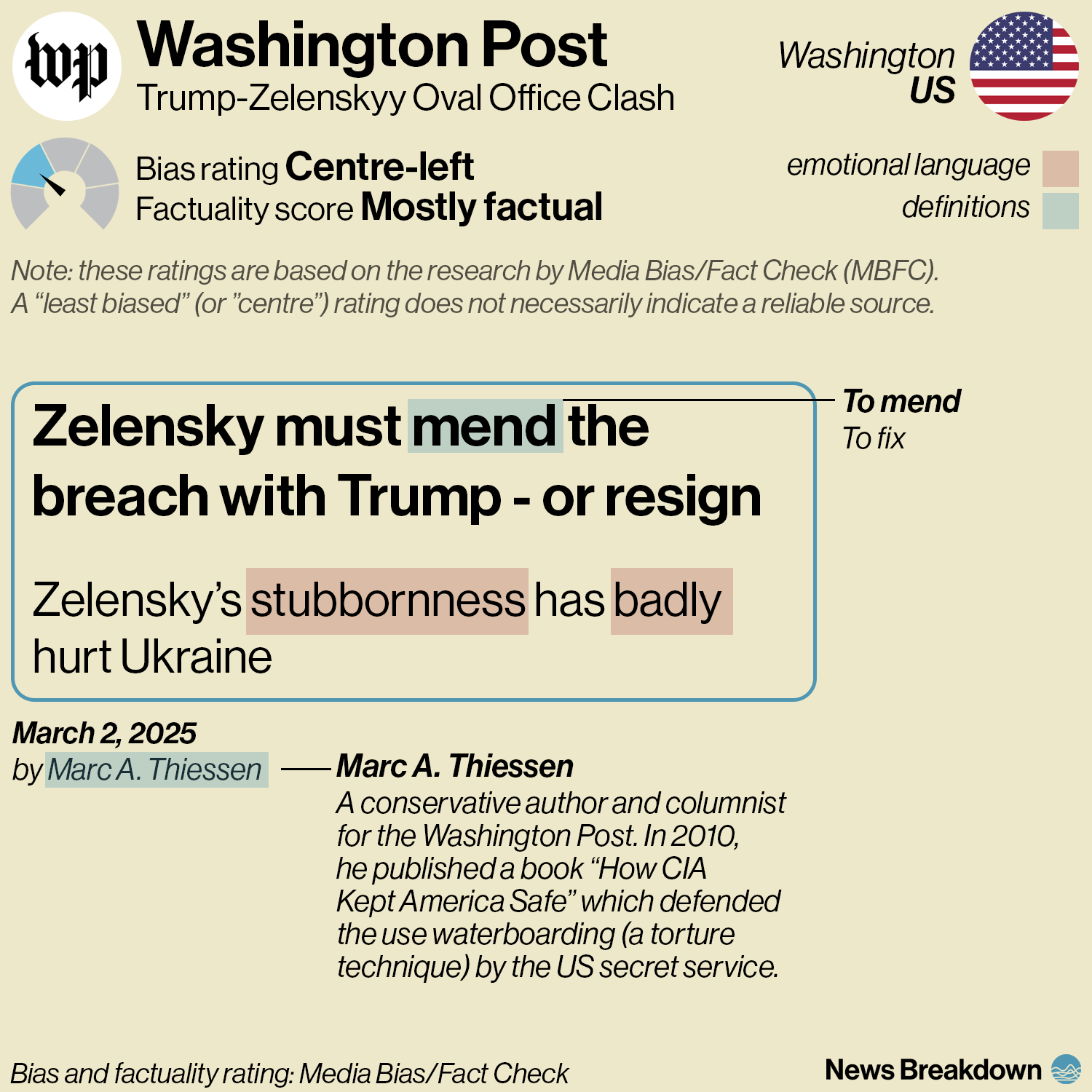
The opinion piece in the Washington Post (WP) is authored by a conservative (right-wing) commentator, which does not necessarily reflect WP’s left-leaning bias score and libertarian agenda.
The author argues that “the blowup was Zelensky’s fault”.
He presents an argument that uses Trump’s quotes on support for Ukraine to claim that his rhetoric should have been “music to Zelensky’s ears”.
He argues that “Zelensky should not have litigated (debated) any disagreements with Trump in front of the media”.
The point being that Zelensky should have recognised the need for Trump to make himself look good to the US media and helped him by keeping quiet, potentially negotiating privately.
However, it is also true that Ukraine has little power to enforce any demands in behind-the-scenes negotiations, and may need to sway US media to gain this influence.
The text also mixes up Trump’s rhetoric and verbal promises with definitive commitments on policy.
Both before and after the Oval Office clash, Trump has made contradicting comments and promises in relation to Ukraine, as well as other policy areas.
For example, the author interpreted the following quote by Trump as a public pledge to help Ukraine regain occupied territories: “we're going to see if we can get [some of the sea line] back or get a lot of it back for Ukraine."
The author misleadingly presents Trump’s comment “I think he is dressed beautifully” as a compliment to Zelenskyy when it was seemingly a sarcastic remark.
“This should have been a backslapping [very friendly], feel-good meeting celebrating the minerals deal”, the author writes.
He argues that Zelensky’s refusal to be friendly and sign the deal without debate “badly hurt Ukraine”, claiming that this empowered anti-Ukraine Republicans and weakened the positions of pro-Ukraine politicians.
Zelenskyy refused to apologise to Trump publicly but later sent a personal letter to him which allegedly included an apology for the incident, shortly prior to the resumption of aid and cooperation.
The author of this column, Marc Thiessen, is particularly known for his book “How CIA Kept America Safe” which defended the use of the waterboarding torture technique by the US secret services and military.
Waterboarding involves pouring water on top of a cloth over a person’s face that feels exactly like drowning but is not lethal and can be repeated.
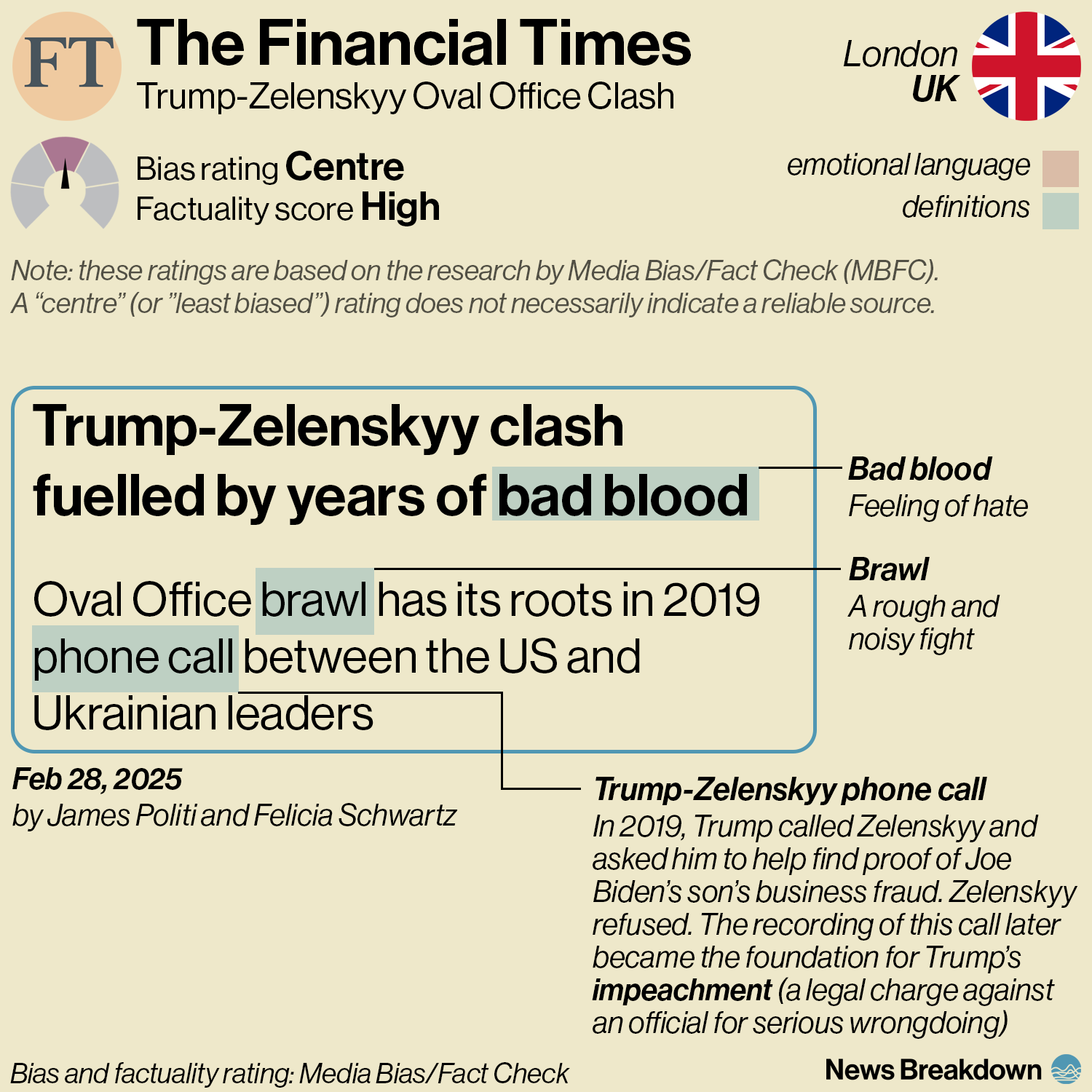
A piece by the Financial Times (FT) presents the Trump-Zelenskyy clash as a result of long-term tensions that “erupted” in a loud confrontation.
It points to three major sources of tension:
2019 phone call: during Trump’s first presidential term, he called recently-elected Zelenskyy, asking him to help find information proving that Joe Biden’s son engaged in fraud in his business dealings in Ukraine.
Zelenskyy refused the request. Later, a recording of the phone call became the foundation for Donald Trump’s impeachment.
Impeachment is a legal charge for serious wrongdoing made against a public official.
Support for Democrats: Zelenskyy had notably favoured Trump’s opponents , the Democratic Party, before the 2024 US election.
In particular, on one of his visits that year he went to Pennsylvania, a highly-contested swing state, but was only accompanied by Democrat politicians, which angered Republicans.
Given the high probability of a Trump win at the time, this may be seen as a strategic error for Zelenskyy.
It is possible that Ukraine wanted to influence the outcome of the election by clearly indicating their preferred partner.
Finally, the FT piece explains the more recent tensions, coming from Zelenskyy’s reluctance to accept a superficial ceasefire deal and pushing for a tougher policy towards Putin and definitive security guarantees for Ukraine.
FT notes that it is highly unusual for a vice president to openly debate a foreign leader in the Oval Office in front of the US president.
It quotes a historian who suggests the incident “appeared to be quite orchestrated” but does not go beyond that.
This could be interpreted as JD Vance receiving an approval from Trump to challenge Zelenskyy publicly.
Two weeks before the clash, JD Vance made a speech in Munich criticising Europe for democratic backsliding and dependence on the US for defence.
In hindsight, the negative consequences of the Trump-Zelenskyy clash for Ukraine seem mostly short-lived.
It is not clear if Ukraine could have been in a noticeably better position by avoiding the confrontation, or if there was a risk of rushing into an unfavourable peace deal or ceasefire that was avoided.
Thank you for reading!
Author Anton Kutuzov
More below: