
How Saudi Arabia Goes Around Hormuz
East-West Pipeline, Suez Canal, Bab el-Mandeb
29 July 2026
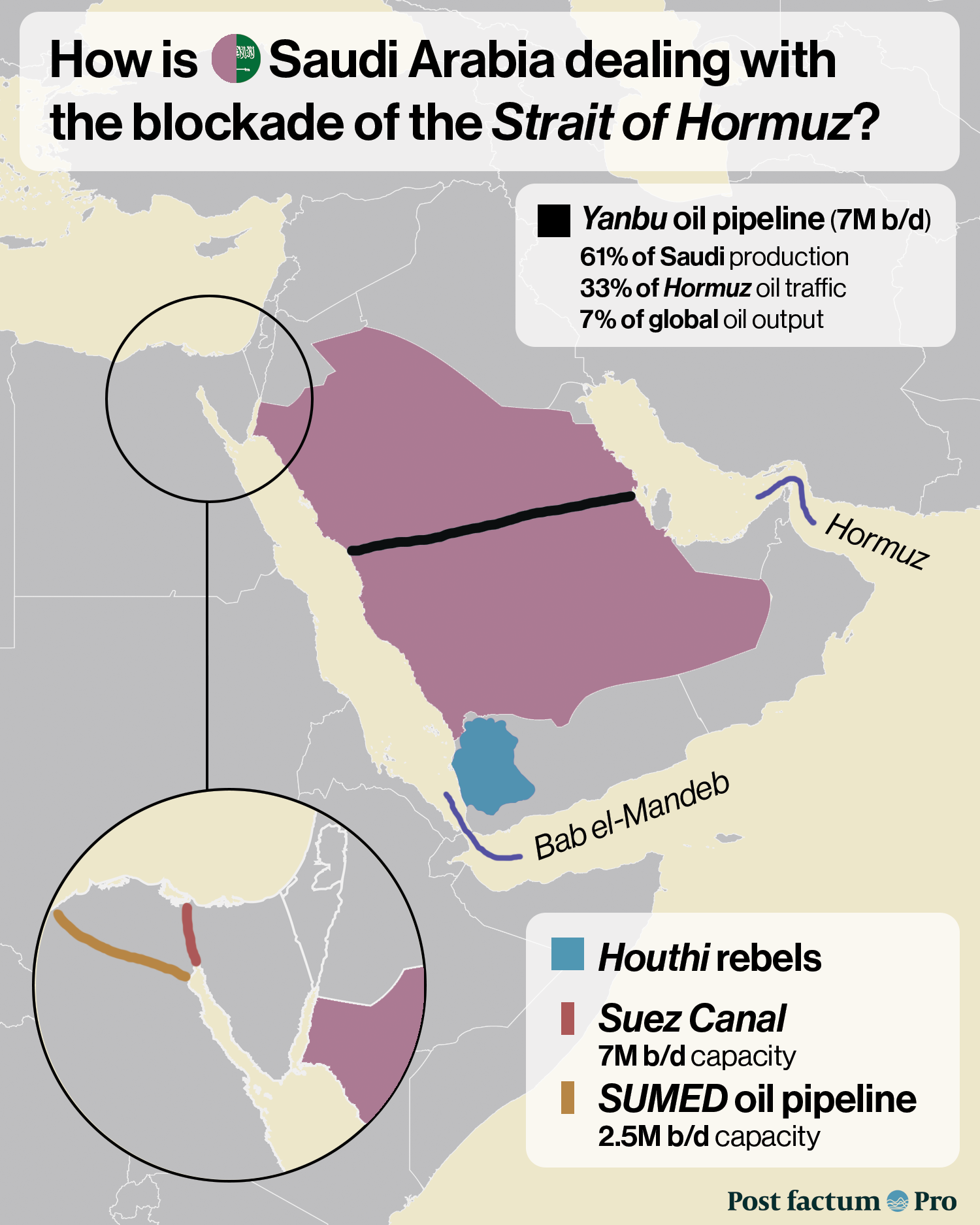
Iran’s blockade of Hormuz closed an export route for around 20% of the world’s crude oil, half of it from Saudi Arabia.
Saudi Arabia has an oil pipeline designed for a situation like this, to move its oil from the east coast to the west, avoiding Hormuz.
- The Yanbu oil pipeline has a maximum capacity of 7 million barrels per day.
From the Red Sea, the oil can be shipped south, through Bab el-Mandeb, or north through the Suez Canal.
Saudi Arabia sells 78% of its oil to Asia.
This oil needs to go south through Bab el-Mandeb, or go all the way around Africa after leaving through Suez.
Capacity issues
Bab el-Mandeb can take 10 million barrels per day and more but is disrupted by Houthi attacks on commercial ships.
- On 23 July, days before a new pause in fighting, the Houthis attacked 2 tankers in the Red Sea, pushing the price of oil to $100.
The Suez Canal has a hard limit of 9.5-10 million barrels per day:
- 2.5 million b/d can be shipped through the SUMED pipeline and re-loaded onto tankers on the other side.
- 7 million b/d can be shipped through the canal itself, but it cannot take a standard tanker of 2 million barrels, instead needing Suezmax tankers, half the size.
The Diversion, and the Houthi Problem
The strategic Yanbu pipeline was built in 1981, during the Iran-Iraq War, to bypass the Strait of Hormuz.
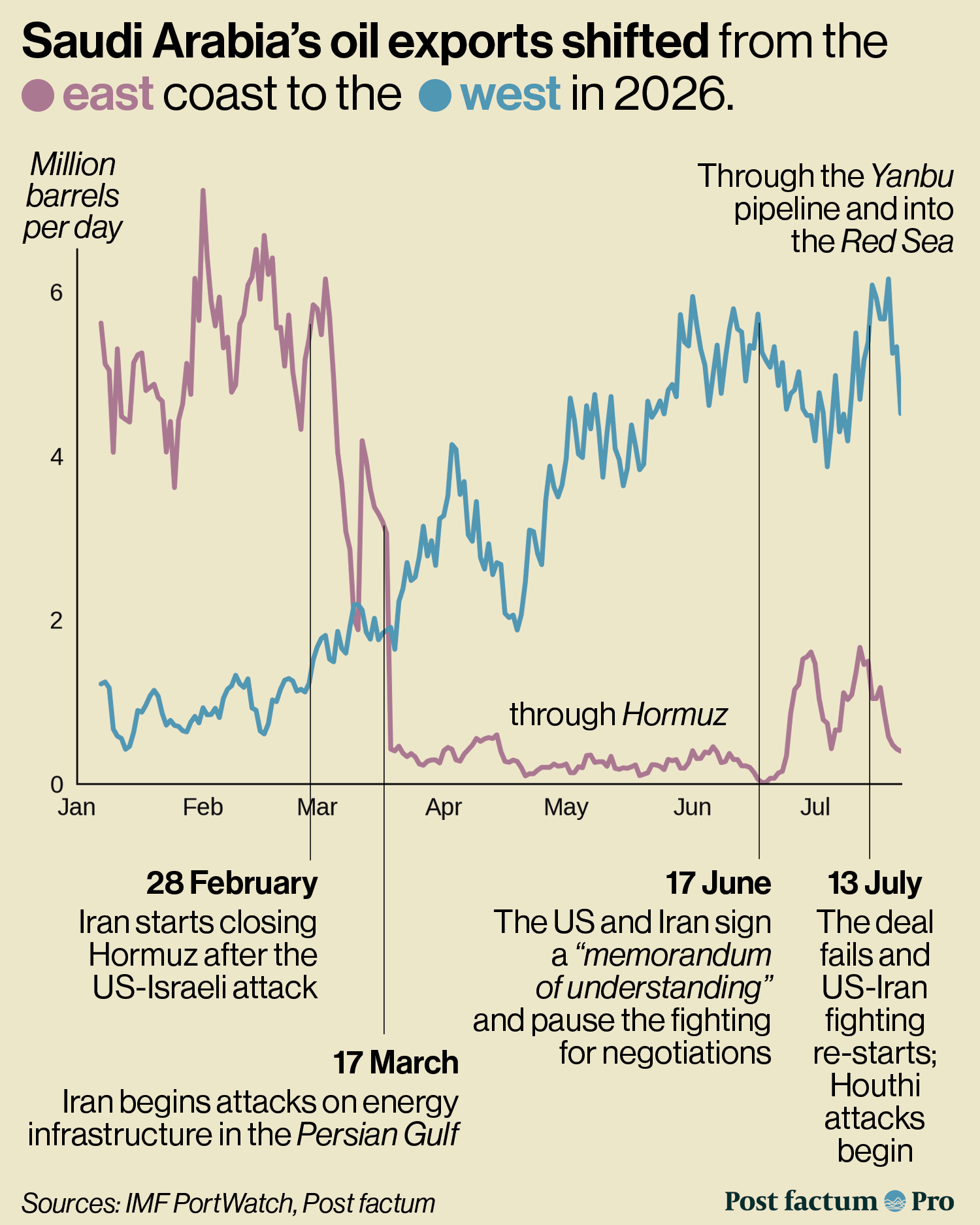
It was utilised at around 30% most of the time but sped up to near its full capacity of 7 million barrels per day during the 2026 Iran War.
Around 2 million of its throughput is used by Saudi oil refineries on the west coast to produce fuels and other materials.
The rest can be exported through the Red Sea, making up almost half of Saudi pre-war oil exports: 4.5-5M barrels out of around 11M.
However, the Houthi rebels, who are backed by Iran and control the west of Yemen, have entered the war.
On 13 July, they fired missiles at Saudi Arabia after an Iranian aircraft was struck by the Saudi-backed government of Yemen when landing in a Houthi-controlled airport.
On 22 July, the Houthis re-started attacks on commercial shipping in Bab el-Mandeb by striking 2 Saudi tankers.
This resulted in Saudi Arabia, as well as other countries, stopping any export through the strait.
- Ships linked to Russia and China are allowed safe passage by the Houthis.
The price of crude oil jumped to $100.
The next day, the US paused its strikes on Iran and a day later the Iranian side agreed to also pause attacks.
Because most Saudi oil is sold to Asia, it would need to exit the Red Sea through the Suez Canal and be shipped around Africa:
- Adding 30 days to a normally 19-day route
- Costing $1m per ship at Suez
- Needing additional insurance
In addition, the Suez Canal and the SUMED pipeline may struggle to meet the increased demand.
The Houthis attacked another Saudi tanker just before Iran’s announcement of a pause in strikes, but then again on 28 July.
Also, Iran-backed militants based in Iraq fired drones at Saudi oil facilities and US military targets in the region.
This has started yet another round of escalation, as oil prices rose and the US threatened new strikes on Iran.
Iranian influence in Iraq has grown since the US-led invasion ended the regime of Saddam Hussein.
This month, an anti-corruption crackdown in Iraq removed 47 pro-Iranian government officials and parliament members.
Other Workarounds
While Saudi Arabia produces 11% of the world’s oil, Iraq, Iran and the United Arab Emirates (UAE) produce around 5% each, and their exports were also cut off.
Iraq, like Kuwait, Qatar and Bahrain, does not have an alternative coast to export from.
It does have an oil pipeline going to Türkiye, reaching the Mediterranean Sea.
However, it is going through the territory of Iraqi Kurds, and political tensions have limited its throughput.
The UAE has an oil pipeline going to its east coast, which avoids Hormuz but still ends close to it and was attacked by Iran during the war.
The pipeline was already operating at more than half of its capacity pre-crisis and has only added about 0.5M barrels per day since.
Many countries in the region have started fast-tracked projects for new oil pipelines avoiding Hormuz, investing billions of dollars in 2026.
Thank you for reading!
Keep exploring:


