
Government Debt, explained
Bonds, Yields, Inflation, GDP and Geopolitics
1 November 2026
Governments of the world owe around $100 trillion (equal to 95% of global GDP in 2025).
Countries mostly borrow money by selling bonds and bills (contracts to pay a specific sum) to investors.
- Bonds run for 1-10 years or more, with regular interest payments.
- Bills are short-term debt (sold at a discount to their repayment value, instead of paying interest).
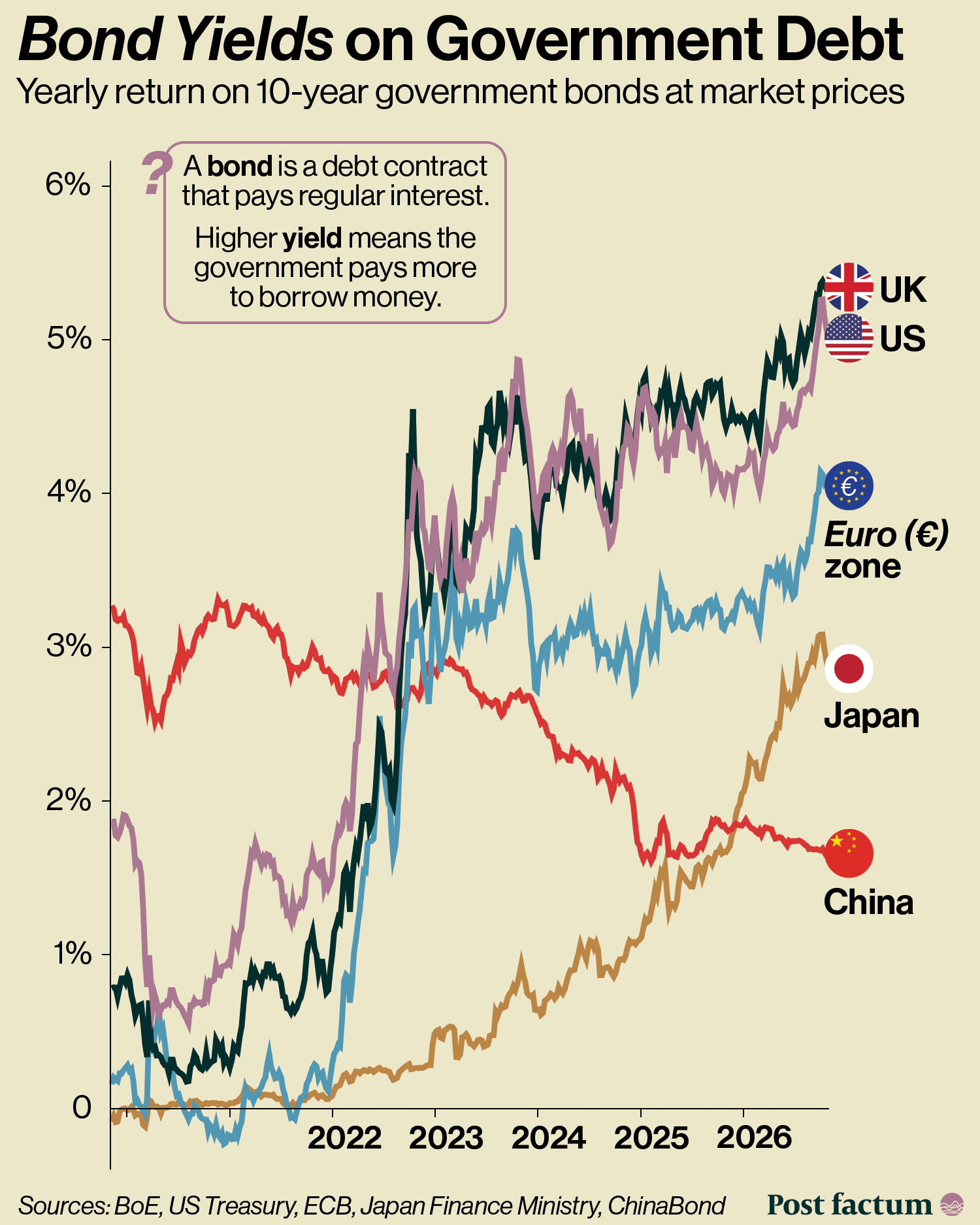
Yields are the returns investors earn on bonds and bills, compared to their current market prices.
Bond prices and yields change depending on investors’ demand for the debt of the government that issued them.
- When more investors want to buy the government’s debt, bond prices go up, and bond yields go down.
- When more investors sell their bonds, the yields increase.
October 2026 saw a global government bond sell-off, with prices falling and yields rising as investors asked for higher returns on lending.
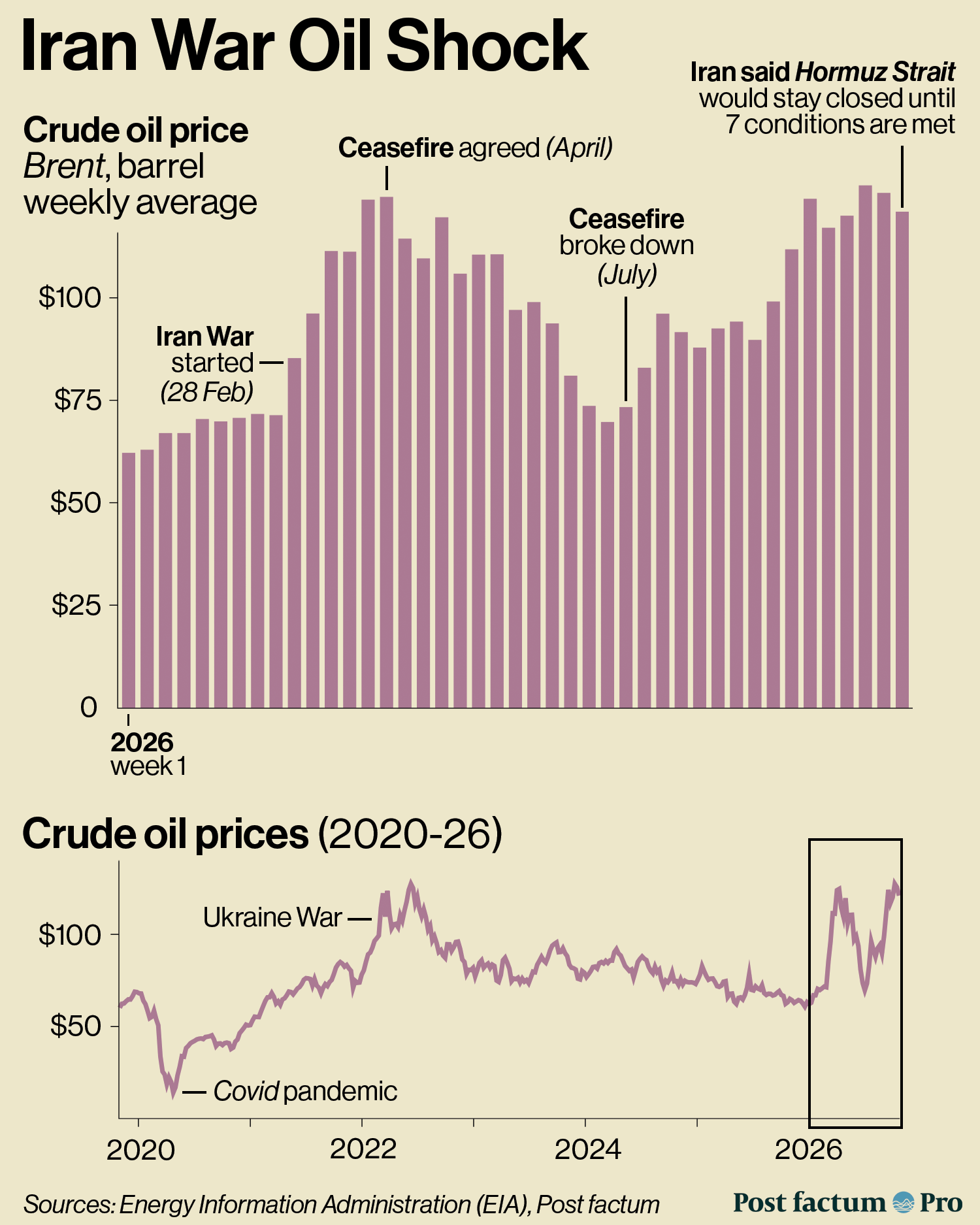
- High inflation and energy prices put pressure on the economy.
- Higher interest rates set by central banks to slow down inflation make all borrowing more expensive.
- Growing spending by governments on the economy, defence, AI and more requires extra debt.
- Competition with AI companies issuing their own debt at a record pace is making investors choose.
- Geopolitical uncertainty, including over conflicts in the Middle East and Ukraine, adds to risks.
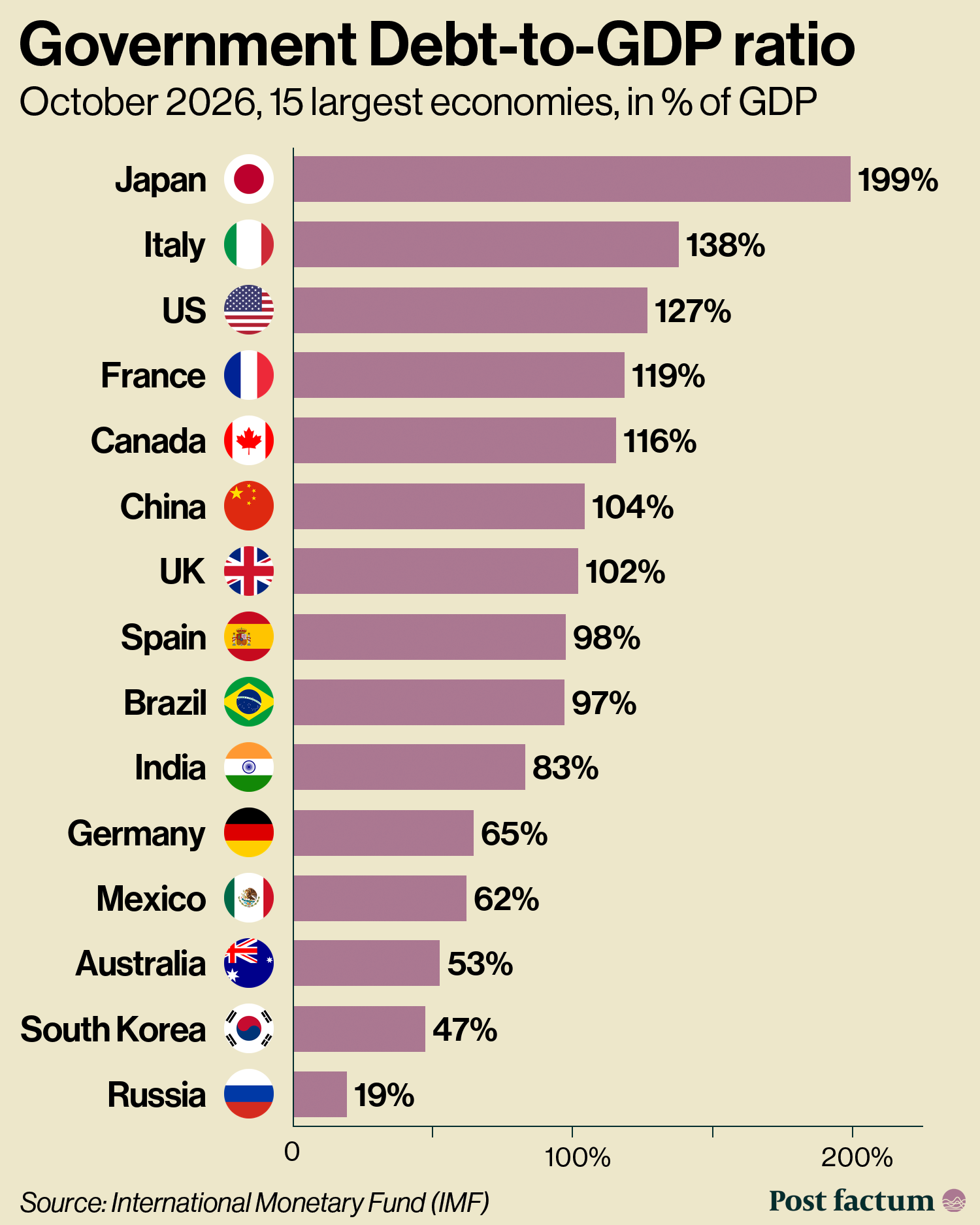
The debt-to-GDP ratio compares the size of government debt with the size of the economy (nominal GDP), measured in % of GDP.
- Global debt-to-GDP is 95% in 2026: historically high, approaching the 120% seen after the Second World War.
A high debt-to-GDP does not necessarily mean the country is in crisis.
A debt crisis is a broad label to describe financial difficulties related to government debt.
A government default is its failure or refusal to repay debt when it is due.
- Restructuring: a default typically leads to negotiations with the lenders to change repayment terms.
With lenders inside the country (internal debt), restructuring could be easier to negotiate, but losses for local banks and individual savers can weaken public trust or financial stability.
External debt is owed to international investors, including banks, countries and financial institutions.
Debt issued in local currency can be repaid by printing more money, but this leads to inflation and the local currency losing value.
- When the country’s currency loses value, its debt in US dollars or other foreign currency becomes relatively larger.
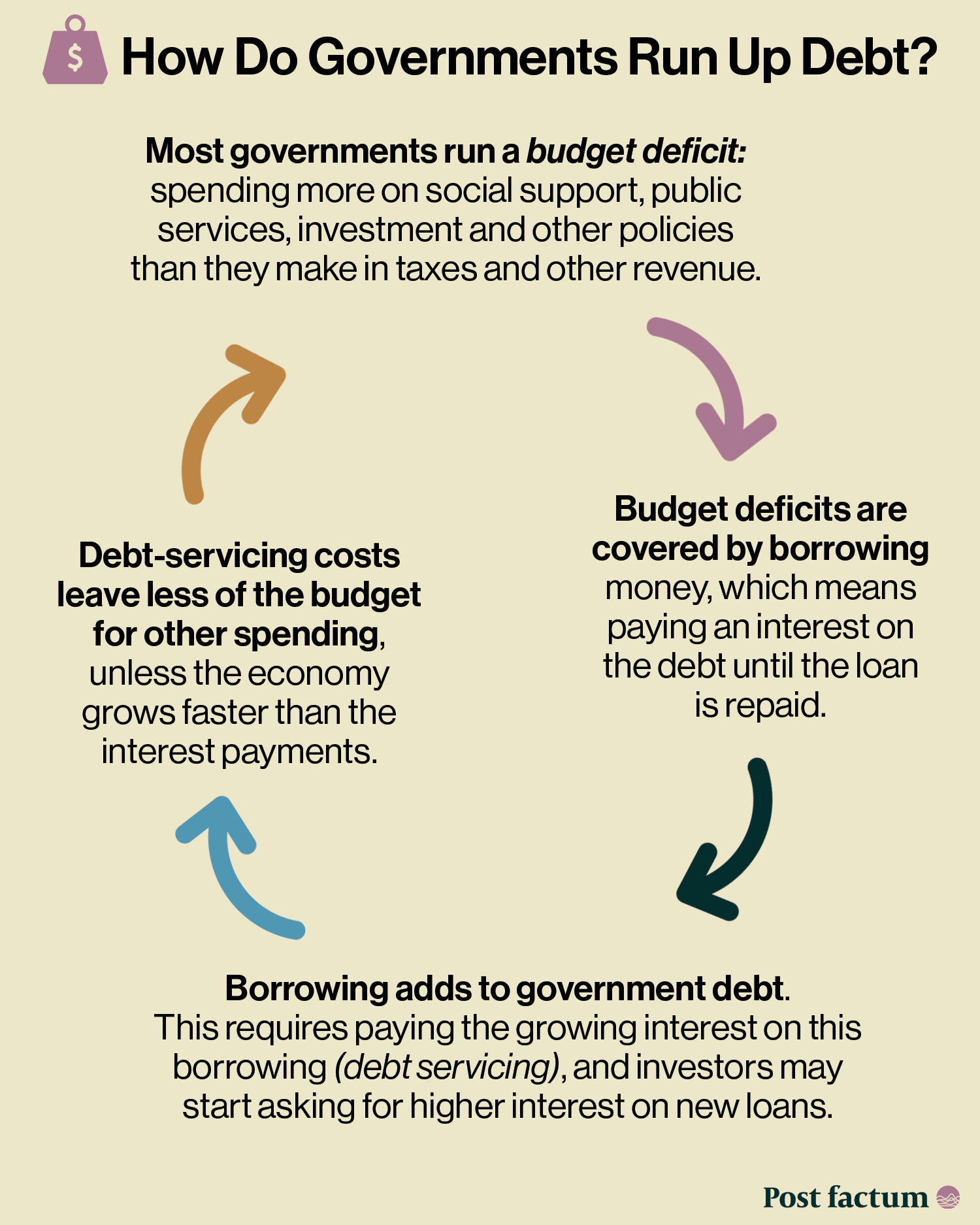
Whether debt creates problems depends on (1) how quickly the economy grows and (2) the cost and size of borrowing.
If the economy grows faster than the debt, debt-to-GDP falls even with more borrowing that year.
Here, economy size includes both real growth and inflation.
Growing prices (inflation) increase the value of the economy in local currency or dollars even without real growth.
This makes the size of government debt relatively smaller.
- For example, the UK increased its debt by 3.8% of GDP in 2025-26, but debt-to-GDP fell by 0.1 percentage points, as the nominal economy grew 3.9% (of which 1.3% was real growth and the rest was inflation).
Real economic growth and inflation are the main ways to reduce debt-to-GDP.
Debt problems could damage investors’ confidence in the economy or result in a downgrade of the country’s credit rating, making international borrowing harder to access and more expensive.
Countries also take direct loans from other countries, private banks and international institutions.
The International Monetary Fund (IMF) lends to countries facing financial crises.
IMF loans are conditional on economic policy changes, aimed at addressing the underlying problems.
- Countries owe $171 billion to the IMF as of late 2026, and it gave $30 billion in new loans in 2025.
BRICS set up an alternative to the IMF, but it had made no loans as of October 2026.
China became a major lender to developing countries in the 2010s through its Belt and Road Initiative.
- New loans from China peaked at $50 billion in 2016, more than all Western creditors combined.
Japan
Japan’s debt-to-GDP stands at 199%, but its economy is growing faster than the interest on its debt.
Japan’s budget deficits decreased from 8% to 1% of GDP between 2021 and 2025.
Japan borrows mainly in its local currency (yen) and has a stable credit rating, which gives it access to cheap international financing.
Since 2021, yields on Japan’s 10-year government bonds have increased from around 0% to 3%.
Japan under Prime Minister Sanae Takaichi is planning to increase real government spending by around $60 billion per year from 2027, which could be financed by extra borrowing depending on growth.
- We cover Japan in more detail in our next Pro report, including the strictest form of Chinese rare-earth controls that it faces.
Greece
Greece had debt-to-GDP of around 100% in 2001, when it joined the eurozone.
Adopting the euro (€) allowed Greece to borrow more cheaply.
For years, Greece under-reported its budget deficits, falsely presenting them as below the EU limit of 3% of GDP, while borrowing and government debt kept rising.
The Greek economy struggled after the 2008 financial crisis.
The real deficit in 2009 was 15% of GDP, 4 times the officially reported figure.
- GDP fell by 10% in 2011.
- Borrowing costs reached 29% in 2012.
In 2012, Greece defaulted on debt held by private investors and restructured around $260 billion in government bonds.
Greece got over $300 billion in emergency loans from EU institutions, eurozone countries and the IMF, tied to economic reforms and strict budgetary (fiscal) savings.
In 2018, Greece completed its bailout programme and regained the ability to borrow money independently.
Greece has been one of the EU’s fastest-growing economies since 2018.
In 2026, the Greek economy is set to grow by 2% in real terms, with a budget surplus and a falling debt-to-GDP ratio.
Argentina
Argentina has defaulted on its debt 9 times, most recently in 2020.
After the 2019 election raised uncertainty over economic policy, the local currency (peso) lost over 40% of its value.
Much of its debt was in US dollars, so Argentina had to spend about 30% of its foreign currency reserves to cover debt servicing.
Downgraded credit ratings restricted access to international financing.
Argentinian governments also printed money to cover their spending obligations in pesos.
Argentina continued to struggle with its government debt until the election of Javier Milei in 2023 and his economic reforms: we discuss the effect of his policies in a recent Pro report.
The United States
US debt-to-GDP is 127%, nearly double the level of 20 years ago.
Continued global demand for US bonds and bills helps the US to keep borrowing.
30% of US federal government debt is external.
Japan, the UK and China are the 3 largest country-holders.
Issuers of dollar-backed stablecoin cryptocurrencies are major holders of US federal debt, owning more than Brazil, Germany, India or Saudi Arabia.
The US borrows in its own currency, so it does not face higher repayment costs when the dollar falls (depreciates) against other currencies.
The US has a legal debt ceiling: Congress suspended it in 2023 to avoid a default and raised it in 2025 to allow extra borrowing.
Thank you for reading!
We need your support
Post factum is independent and reader-powered.
Pro subscriptions fund our work, giving you exclusive content, community access and other perks.
We have to reach 5,000 Pro members to cover our costs and continue publishing, or the funding we have raised so far will run out.
Please help us hit this goal and keep bringing you concise, factual and accessible reporting.
Join as a Founding Member now to lock in a lower lifetime rate.
Your fee will go towards paying our staff, covering our bills and making more content.
Keep exploring:


This week on Post factum Pro:
Join Post factum Pro to access the comment section.