
China Rare Earths Controls
Magnet Crisis, Trade War, Busan Truce, Chips and Jet Engines
14 October 2026
What happened?
On 2 April 2025, President Trump announced additional tariffs on imports from nearly all countries.
This included 34% on imports from China, in addition to pre-existing tariffs on some or all Chinese goods.
China responded with a matching tariff and some restrictions on exports of rare earths.
- Rare earths are 17 metals with unique uses in various technologies, from lasers to ceramics.
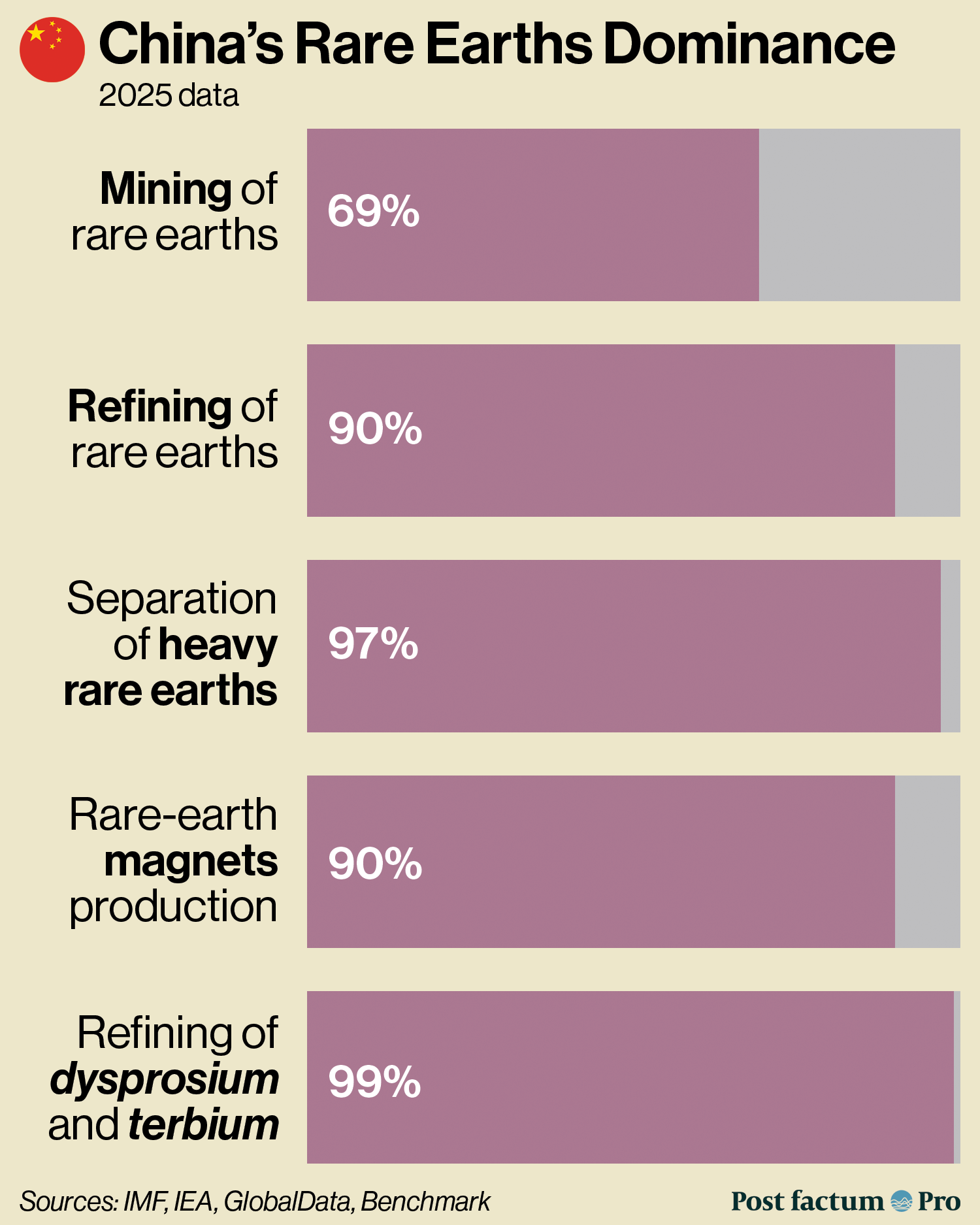
China controls 90% of rare-earth refining.
Permanent magnets are the main use of rare earths by value.
China’s April 2025 controls covered 7 “heavy” rare-earth elements, including 1 used in jet engines, and 3 used for heat-resistant magnets.
- Heat-resistant permanent magnets are used in motors that heat up above 80°C (176°F).
Almost every car uses these magnets, in small motors for braking, steering and seats, and in engines for electric vehicles.
China makes 90% of rare-earth magnets and 99% of the dysprosium and terbium that keep them working when hot.
China required export licences, with reviews sometimes taking months, while customs checks also delayed shipments of non-controlled magnets.
China’s rare-earth magnet exports were 74% lower in May 2025 than a year earlier.
Car factories globally started shutting down within weeks: Ford and Suzuki paused production in May, and European parts makers closed some plants by June.
In May 2025, the US and China agreed to cut baseline tariffs to 30% and 10% respectively.
London framework: in June 2025, China agreed to speed up licences, and the US agreed to lift new export curbs on chip-design software, commercial jet engines, and ethane gas.
Magnet exports returned to pre-crisis levels by July, but the licence system stayed.
China threatens bigger measures
In October 2025, after the US widened its export blacklist, China announced expanded rare-earth controls from November, including:
- 5 more metals on the list
- Controls on export and use of China’s rare-earth technologies
- Licences required for foreign-made magnets and parts with 0.1%+ of the controlled Chinese rare earths by value
It is not clear how strictly these measures would have been enforced.
The US threatened an extra 100% tariff in response.
Busan truce: on 30 October, both sides agreed a 1-year delay to these new measures.
In September 2026, the sides extended the truce to 10 January 2027.
Existing controls are still damaging
Yttrium is the most affected metal.
It is used in coatings for jet engines and turbine parts to withstand heat, as well as in chipmaking, lasers and screens.
- Export licences for all 7 controlled rare earths require naming the end user, and most military companies are refused.
China’s yttrium exports to the US fell from 333 to 17 tonnes (comparing the 8 months before and after the controls).
In February 2026, 2 North American coating makers paused production, and another stopped selling yttrium oxide products.
No cuts to engine output have been reported as of October 2026.
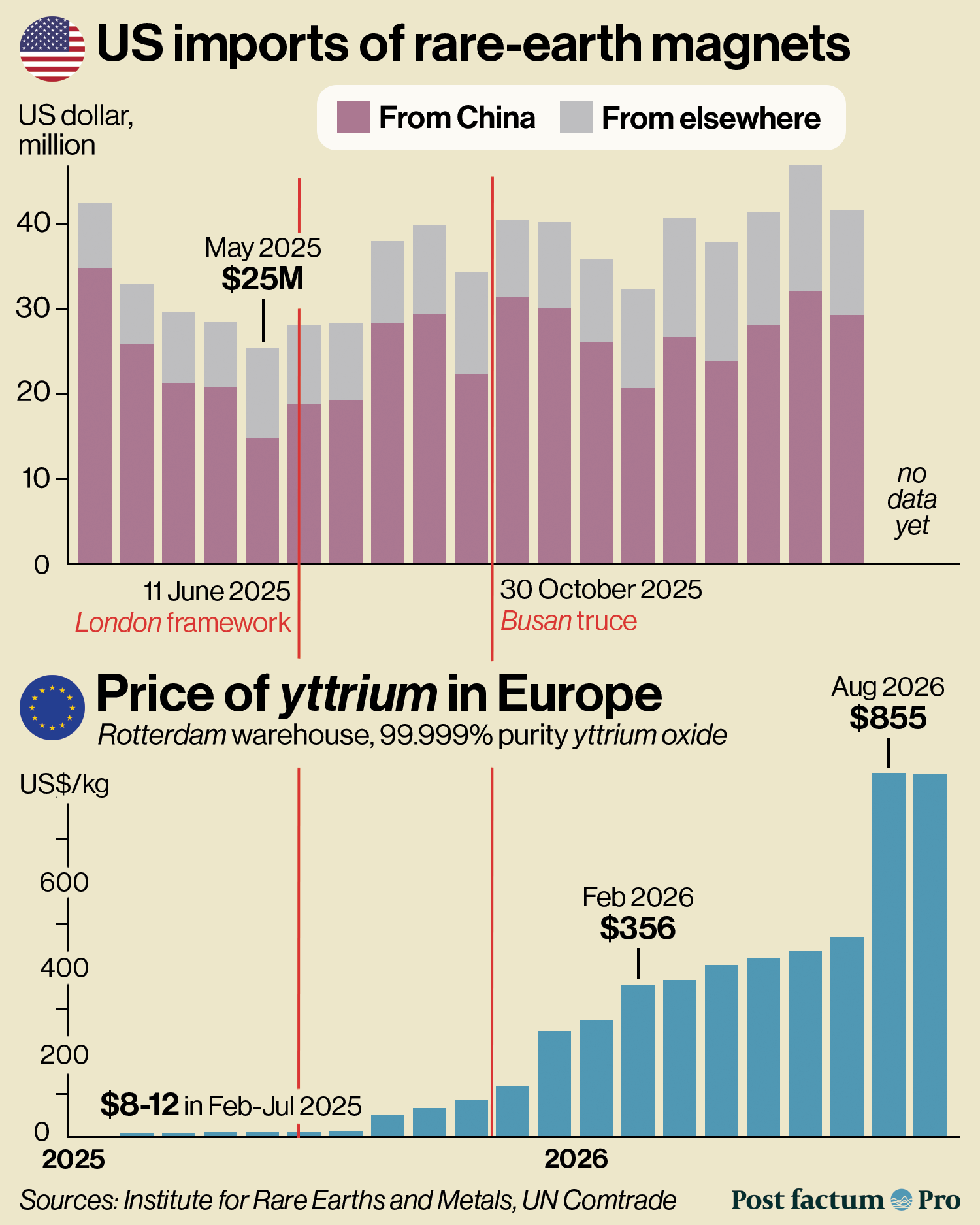
The yttrium price in Europe reached $852 per kilogram in 2026, over 20 times higher than China’s export price of $39, as few suppliers hold a licence.
Dysprosium and terbium (for heat-resistant magnets) cost 4+ times China’s export price.
Samarium is also used in heat-resistant magnets.
It accounts for 2% of rare-earth magnets, but some defence industries depend on those, such as for making missiles.
Samarium reached 60 times China’s export price.
US company Raytheon (maker of the Tomahawk missile) was cut off from samarium, but another US supplier held a year’s worth of stock.
- Another year’s supply of semi-refined decades-old samarium was bought in France, to be refined in France, the UK and the US.
Scandium, used for 5G-signal chips, was also short in early 2026.
How is the West reducing dependency?
The US government bought the largest stake (15%) in the country’s largest rare-earth miner.
The US also set up a $12 billion minerals stockpile fund to build up reserves.
The only commercial heavy rare-earth refiner outside China is the Australian company, Lynas.
Lynas produced 2% of the world’s dysprosium and terbium in the year to June 2026 (its first year of producing those).
- Lynas mines in Australia and refines in Malaysia.
It started producing samarium in March 2026.
Yttrium production is planned for 2028.
Lynas produces oxides for 6% of the world’s rare-earth magnets (40% of supply outside China), most of which are not controlled.
- These non-controlled magnets are not heat resistant, because they are made with neodymium or praseodymium only, without adding the heat-resistant rare earths.
The US planned to invest $96 million in a Lynas factory in Texas, US, but chose instead to spend this money on buying its rare earths.
Geopolitics, bargaining, and AI
Rare earths and magnets are a $30 billion-a-year market, but larger industries depend on it.
- The IMF modelled an 80% rare-earth supply cut (to individual countries only) and found real GDP losses of 1.5-2.3% within a year in Germany, Japan and the US.
In return for rare earths, China won changes to some US controls, especially those introduced after April 2025.
The London framework lifted new US export curbs:
- Chip design software: China relied on it for making microchips, including for its AI sector.
- Jet engines: China’s state-owned COMAC aims to break the Boeing-Airbus dominance of the commercial airliner market but still relies on Western parts.
- Ethane: it is used to make plastics and chemicals; most of China’s ethane comes from the US, accounting for 50% of US ethane exports.
China also got access to better AI chips:
In July 2025, sales of Nvidia’s H20 chips were allowed, but China refused them, telling its firms not to buy any.
In December 2025, the US allowed the sale of more advanced H200 chips.
China approved the purchase of over 400,000 units; 20,000 had been delivered by August 2026.
Nvidia pays 25% of the sale value to the US government, and each deal needs approval from both the US and China.
- H200 uses Nvidia’s 2022 Hopper architecture, with the current one being Blackwell (B), and the next-generation Rubin planned for 2026.
- H20 was a weaker version of H200 made to follow President Biden’s 2022-23 restrictions.
In Busan, the US agreed to cut to 10% the 20% extra tariff on Chinese goods specifically linked to the opioid drug fentanyl.
- This cut, and the restrictions on H200 chips, were the 2 measures introduced before April 2025 that the US lifted.
China agreed to buy at least 25 million tonnes of US soybeans a year in 2026-28.
This would restore the trade to 2024 levels, at around $10 billion, or 20% of China’s soybean imports.
In 2025, China imported 72% fewer soybeans from the US than in 2024.
The US wants to reduce its trade deficit with China and other states.
Since June 2026, China has blocked exports to 10 more US defence and rare-earth firms, including the US-backed miner, and to 14 European entities.
From 1 January 2027, the US bans magnets with Chinese-mined or refined material from defence supply chains.
The delay to China’s October 2025 rare-earth controls package (which never took effect) is currently due to expire on 10 January 2027.
Thank you for reading!
Keep exploring:


