Mexico’s Cartels, explained
17 November 2026
- President Claudia Sheinbaum abandoned her predecessor’s “hugs, not bullets” policy
- CJNG did not fragment after its leader was killed in 2026
- The Sinaloa Cartel has been in a civil war since 2024
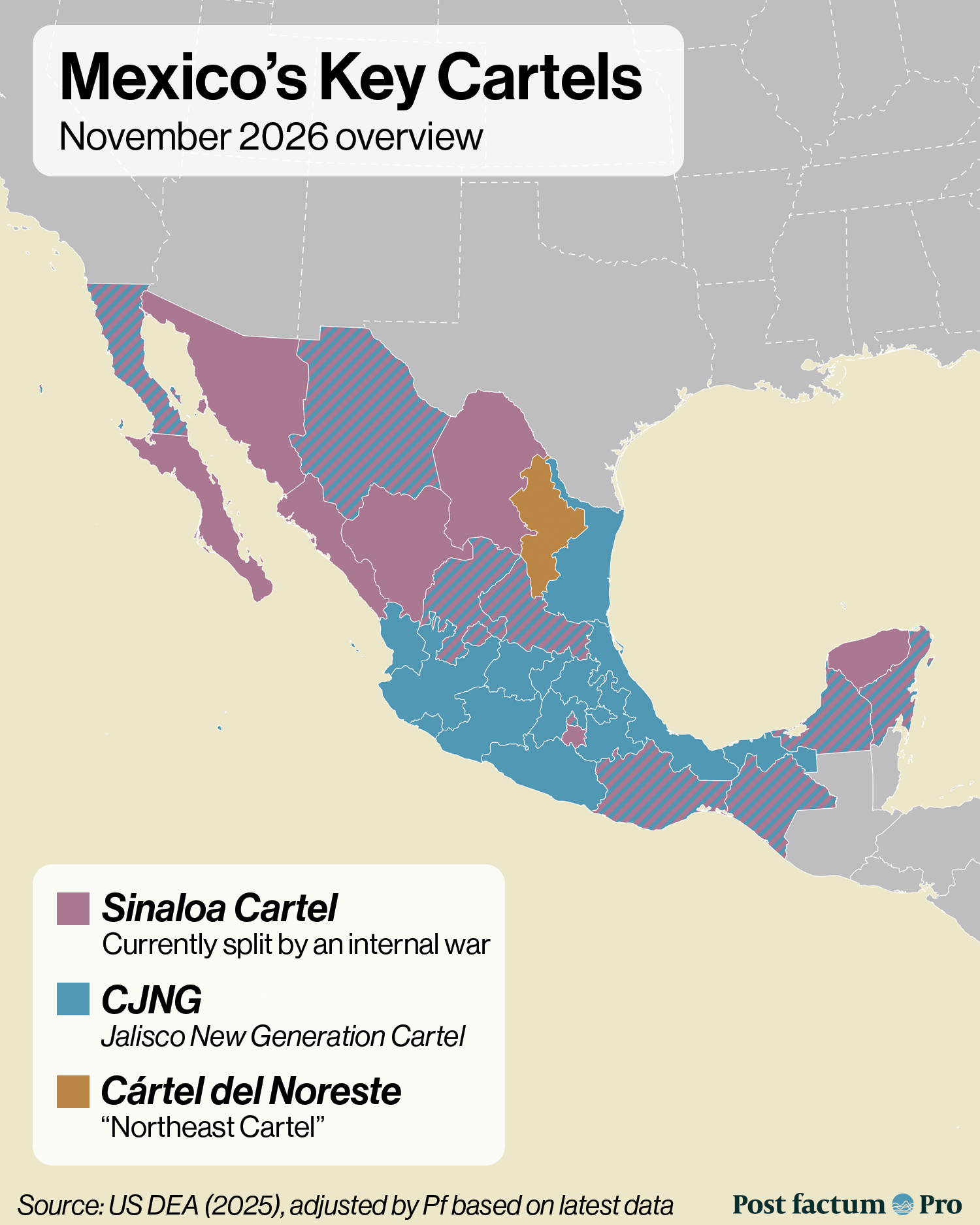
Mexico’s cartels are international criminal organisations with over 150,000 members.
They produce, sell and smuggle drugs across borders, especially into the US.
- 60-80% of their profit comes from drugs (the rest from other criminal activity and from legal businesses used as cover).
The two main cartels in Mexico are the Sinaloa Cartel and the CJNG (Jalisco New Generation Cartel).
Sinaloa
The Sinaloa Cartel was founded in the 1980s by two traffickers: El Chapo and El Mayo.
It is an alliance of factions with no single leader.
Sinaloa sells drugs in over 40 countries and earns from human smuggling and extortion.
Sinaloa’s two main factions have been at war with each other since September 2024 (more below).
Sinaloa often prefers bribery to open violence.
- A former Mexican security minister got over 38 years in a US prison in 2024 for taking its bribes.
CJNG
CJNG grew out of a group that worked for Sinaloa and became a separate cartel around 2010.
It expanded across almost every Mexican state and became Sinaloa’s rival by 2017.
It is run as a franchise of semi-independent local groups under one command.
Its methods are openly violent: CJNG trains recruits in brutality and posts videos of executions.
Besides drugs, it profits from stealing fuel from the state oil company’s pipelines, and other activities.
War on drugs
Mexico’s government has used the army against the cartels since 2006.
Each president announced a different policy:
- Calderón (2006-2012): declared war on the cartels and sent tens of thousands of troops to capture or kill their leaders.
- Peña Nieto (2012-2018): promised to reduce violence first but still relied on the army and removing cartel kingpins.
- López Obrador (2018-2024): “hugs, not bullets”, tackling the social and economic causes of crime, instead of hunting leaders.
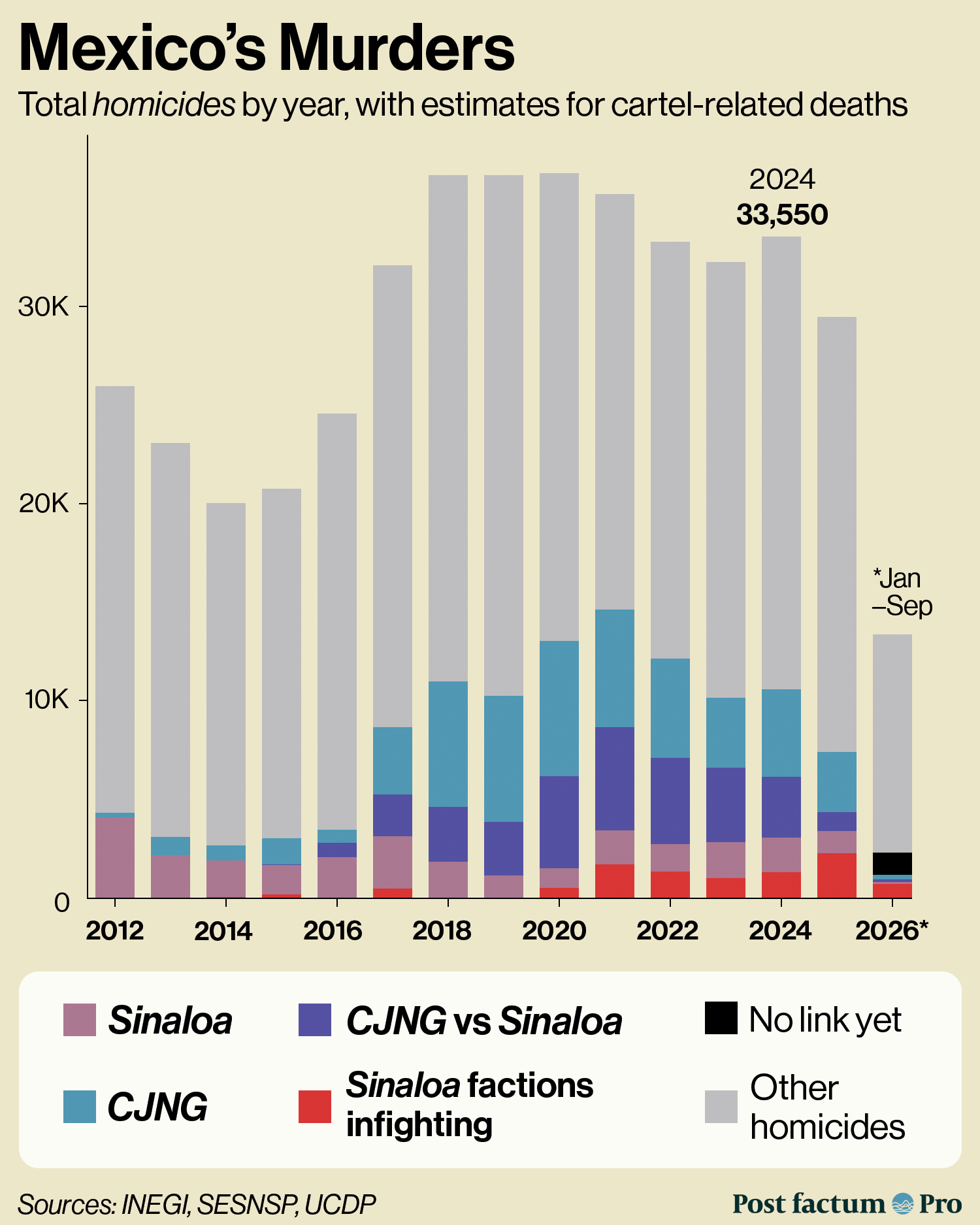
The number of killings jumped around 2017, coinciding with increasing cartel-on-cartel violence involving CJNG.
Sheinbaum, president since October 2024, took a more aggressive approach:
- 74,000 arrests
- 92 prisoners handed to the US
- the killing of CJNG’s leader
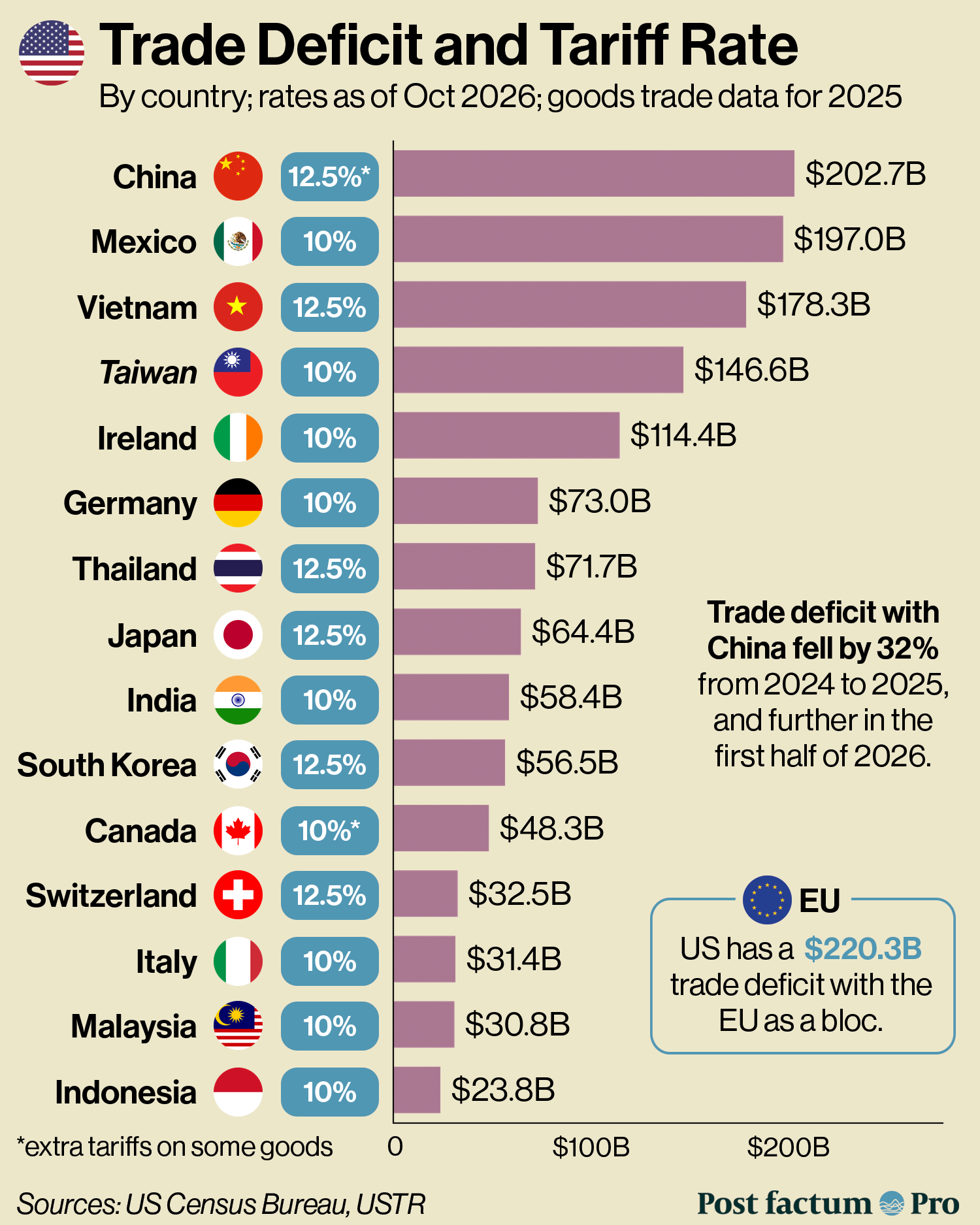
She faces pressure from the US, the buyer of about 80% of Mexico’s exports:
- Donald Trump tied tariffs on Mexican goods to actions against the fentanyl drug trade.
- He also threatened strikes on cartels (like those in Venezuela).
In 2025, the US listed 8 Mexican criminal groups as terrorist organisations and asked for joint operations inside Mexico, which Sheinbaum refused.
In 2025 and 2026, Mexico changed its constitution to ban any foreign intervention, military operation or election interference, and introduce strict penalties for weapons smuggling.
- 68% of firearms recovered in Mexico in 2020-2024 came from the US.
- 2 US officials, reported to be CIA officers, died in Mexico in April 2026 after a drug lab raid.
Since November 2024, 111 public officials have been arrested over alleged links to organised crime, including 7 serving mayors.
118 politicians were killed in Mexico in 2025.
The US Supreme Court struck down the drug-linked tariffs in February 2026.
- The 10% tariff that replaced them exempts goods under the US-Mexico-Canada trade agreement (covering 88% of US-Mexico trade).
Sheinbaum’s approval was 69% in October 2026, but only 17% rated her handling of security well.
- Her coalition holds two-thirds majorities in both houses of parliament, which allows her to pass laws and potentially change the constitution.
Killing of El Mencho
On 22 February 2026, Mexican special forces killed El Mencho, CJNG’s co-founder and leader, with US intelligence support.
CJNG answered with road blockades and attacks in 20 states, which were mostly over within a day.
- About 70 people died, including 28 soldiers and police.
CJNG has not split so far, despite the general trend for cartels to splinter after the killing of their leader (“decapitation”).
- El Mencho’s stepson became the new leader, and most regional branches still operate.
Violence drop
The number of killings (homicides) fell by 10-20% in 2025, and further by 31% in January-September 2026.
Deaths in fighting between cartels decreased by 48% in 2021-2025.
Conflicts involving CJNG account for all of that decrease.
Armed-group violence in Jalisco, CJNG’s home state, fell by 41% in January-August 2026.
There are many disputed causes:
- Government actions: the 2025 drop coincided with stricter and more active policy, but there is little directly measured effect, and the fall in violence began earlier.
- Dominance: when a group defeats its rivals in a territory, the killings there may drop off.
- US pressure: with Donald Trump’s administration prioritising actions against drug trafficking, the cartels may want to avoid attention.
- Tactical retreat: CJNG may be reorganising after surviving a decapitation.
Sinaloa Cartel civil war
The war began in 2024 after a son of El Chapo, the jailed co-founder, kidnapped the other founder, El Mayo, and flew him to the US.
The two sides at war are the Chapitos, led by El Chapo’s sons, and the Mayiza, led by El Mayo’s son.
Sinaloa state recorded over 3,700 homicides in 2 years of fighting, about 5 per day.
- It is 1 of only 3 states with more homicides now than 2 years ago.
The Mayiza has gained ground in 2024-26, while 2 of the 4 Chapitos brothers are under arrest in the US.
- US prosecutors charged Sinaloa’s governor (from Sheinbaum’s party) in April 2026, claiming that he promised the Chapitos protection; he denies this and is on “indefinite leave”.
CJNG took a side in Sinaloa’s war: Mexico’s security minister said El Mencho funded and reinforced the Chapitos until his death.
Fentanyl
Fentanyl is a synthetic (lab-made) opioid, a drug type involved in about 70% of US overdose deaths at their 2023 peak.
Both cartels make fentanyl, using chemicals shipped mainly from China.
- It is smuggled into the US, mostly through official border crossings, hidden inside cars or trucks.
US deaths involving opioids fell by 57% between mid-2023 and mid-2026, and border seizures more than halved.
Researchers disagree on the causes:
- Supply shortage: China tightened controls on the precursor chemicals in 2024-2025; the recorded purity of seized fentanyl fell.
- Sinaloa’s ban: the Chapitos banned production in their home state in 2023; some producers moved.
- Enforcement: the US and Mexican governments credit operations against the cartels and drug labs, border security, and seizures.
The availability of treatment (like medication against overdose) also contributed, but the effect is too small to explain the fall in deaths.
Thank you for reading!
Keep exploring: