
Thailand-Cambodia 2025 Conflict, revisited
Forced Labour Scam Centres and Global Politics
Published: March 6, 2026
In 2025, Thailand and Cambodia fought two rounds of armed conflict over their shared 817 km border, about 25% of which is disputed.
The fighting killed at least 150 people and displaced over 500,000.
The conflict has roots in century-old border disputes over ancient temples but is now connected to a multi-billion online scam industry, domestic politics and global interests.
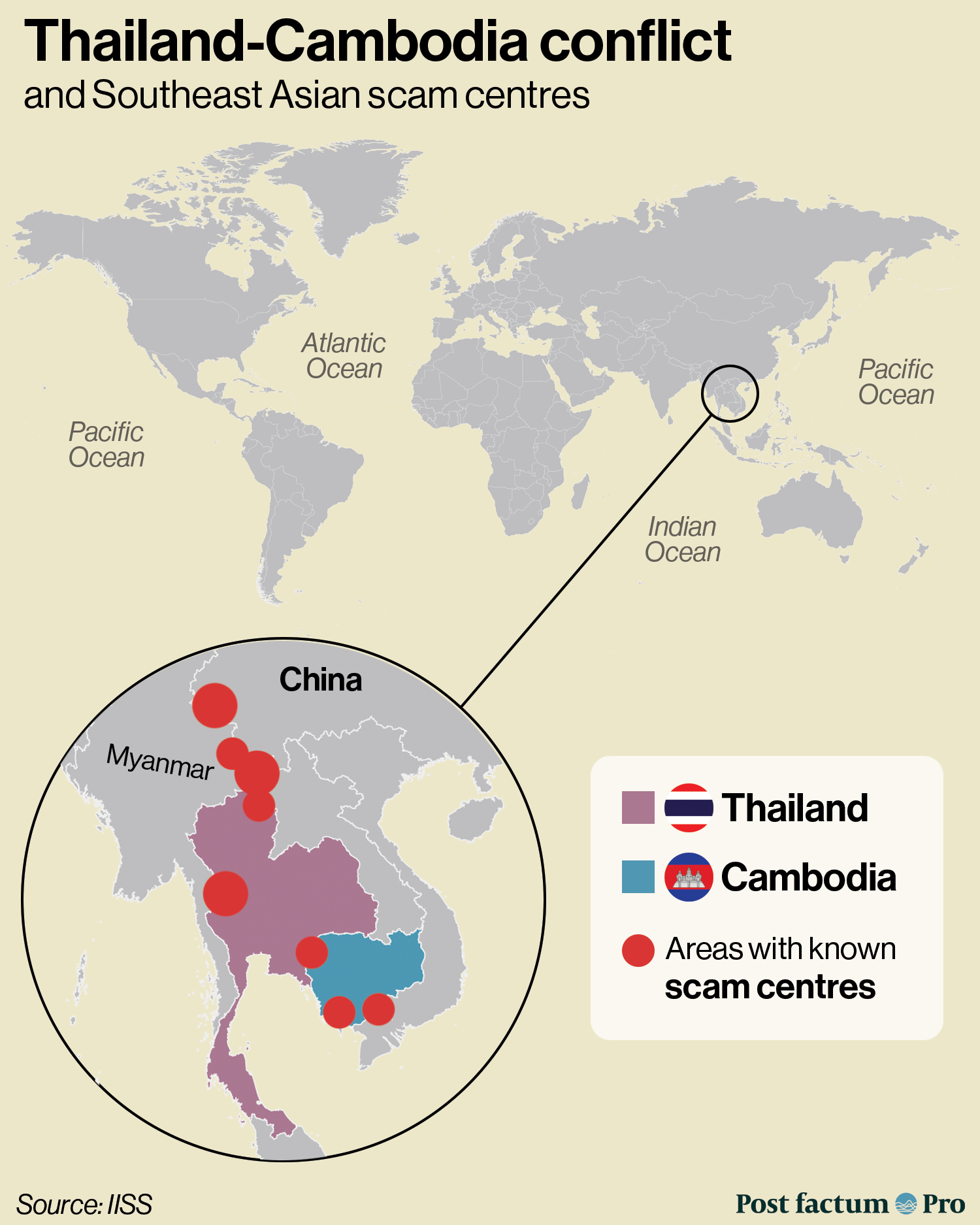
The main causes of the conflict include:
Disputed border: over 100 years of competing territorial claims, especially around ancient temples given to Cambodia when it was a French colony.
Scam industry: Thailand launched airstrikes on Cambodian casino complexes it claimed were scam centres connected to government officials.
Nationalism: leaders on both sides were pressured by conservative voters, and used the conflict to boost domestic support ahead of elections.
The border between Thailand and Cambodia was drawn by France in 1907, when Cambodia was a French colony.
It gave some lands and ancient temples to Cambodia, but they remained claimed by Thailand (then called Siam).
In 1962, an international court officially ruled that one of the major disputed temples belonged to Cambodia.
In 2008, Cambodia got the temple listed as a UNESCO world heritage site, triggering Thai protests and armed border clashes that killed at least 20 people between 2008 and 2011.
A second court ruling in 2013 confirmed Cambodia's ownership of the temple and the land just outside of it, but not the larger surrounding area.
The dispute went quiet for 12 years.
In May 2025, a border clash killed 1 Cambodian soldier, with both sides blaming each other.
Cambodia banned some Thai goods and cut internet links to Thailand.
Thailand closed border crossings to Cambodia.
In June, a leaked phone call between the Thai prime minister and Cambodia's former leader created a political crisis in Thailand.
The Thai PM was accused of being too close to Cambodia, suspended from office and later formally removed.
In late July, full fighting broke out in 12 border regions, involving artillery, rockets and Thai airstrikes.
Malaysia brokered an immediate ceasefire on 28 July, with the US and China both involved in the talks.
In October, the two sides signed a peace deal, witnessed by Trump and the prime minister of Malaysia (then chair of ASEAN).
ASEAN (Association of Southeast Asian Nations) is a group of 11 countries in Southeast Asia that cooperates on trade, security and diplomacy.
However, Thailand suspended the peace deal in November after a landmine explosion injured more Thai soldiers.
In December, Thailand launched airstrikes on Cambodian military positions and at least 6 casino-hotel complexes it claimed were scam centres.
The second round of fighting killed at least 101 people and displaced over 500,000.
A second ceasefire was signed on 27 December after 3 days of direct talks.
In February 2026, Thailand held parliamentary elections, with the ruling party winning 39% of the seats, outperforming expectations, on a nationalist campaign.
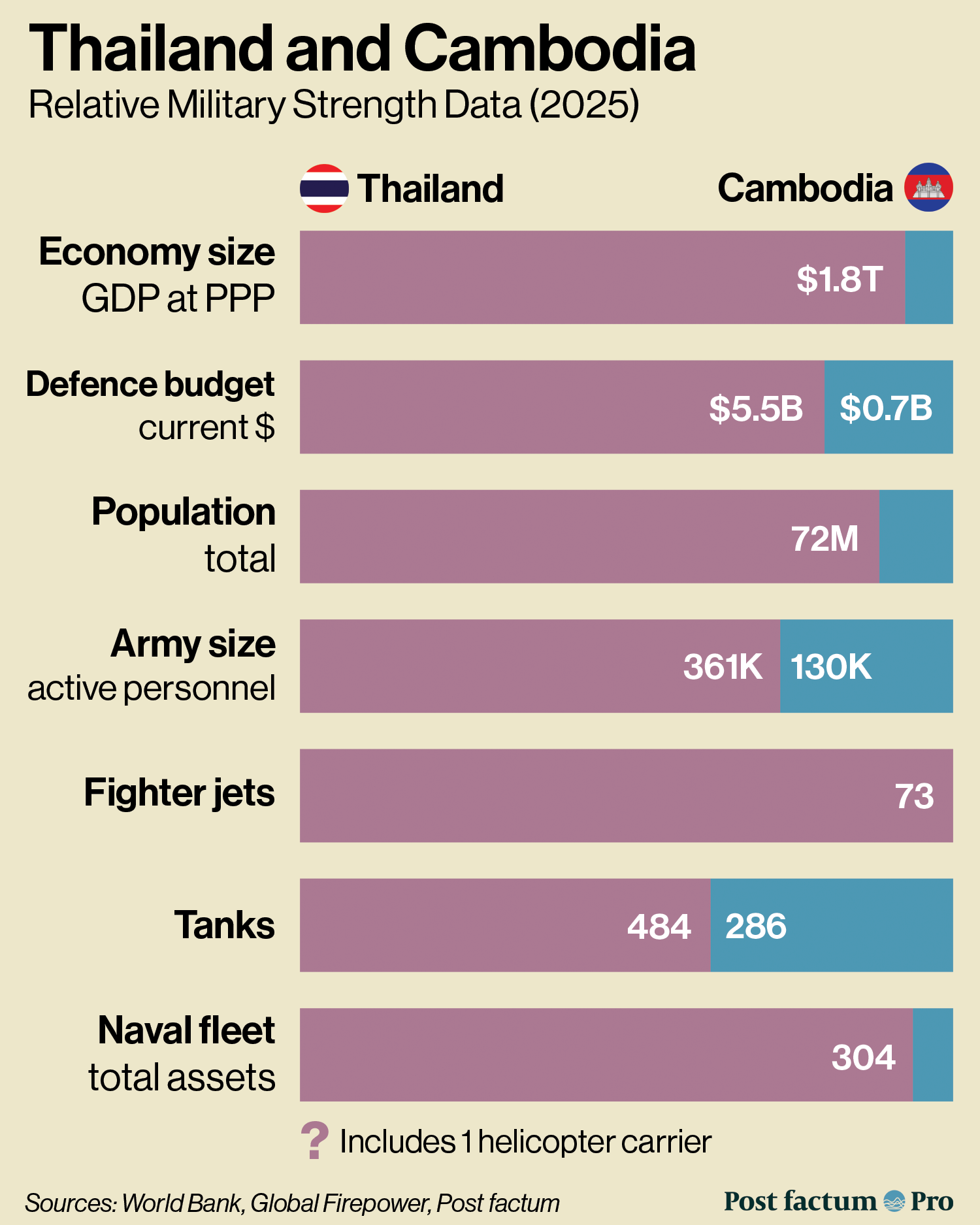
Scam Industry
Cambodia hosts over 50 scam compounds, many of them former casinos converted after an online gambling ban in 2019.
The scam industry generates around $15 billion per year, or around a third of Cambodia's GDP.
Trafficked workers are forced to scam people online, generating money for criminal groups, some linked to China.
The spread of scam centres across Southeast Asia started after the civil war in Myanmar began, with some compounds set up in free trade zones linked to Chinese investors.
An estimated 150,000 people are held in scam compounds across Cambodia alone, many trafficked from countries across Asia, Africa, Oceania and beyond.
During the December airstrikes, workers inside the compounds were not allowed to leave, and some were forced to continue working as bombs landed nearby.
In September 2024, the US placed sanctions on a Cambodian businessman and his casino resort for forced-labour scam operations.
In January 2026, Cambodia arrested a billionaire with close ties to the ruling family, closed down a bank he owned and deported him to China.
Thailand uses the scam issue to position itself internationally, with Thai media calling Cambodia "Scambodia" to further link its government to the scam centres.
In 2024, Thai citizens lost an estimated $17 billion to scams, equal to about 3% of the country's economic output.
US and China's involvement
China is Cambodia's largest trade partner and creditor, with trade reaching $15 billion in 2024.
China has also sold Cambodia weapons including rocket-launcher systems and has unique access to a Cambodian naval base.
In 2025, China sold Thailand a diesel submarine, expected to arrive in 2028.
China is the largest source of imports for both Cambodia (50%) and Thailand (25%).
After the December ceasefire, both countries' foreign ministers met with the Chinese foreign minister.
The US accounts for around 7% of Thailand's trade and maintains close military ties with weapon sales and joint exercises.
Cambodia sells around 37% of its exports to the US.
After July clashes, Donald Trump threatened tariffs of up to 49% on Cambodian exports.
The US announced $45 million in ceasefire support aid: $20 million for anti-scam efforts, $15 million for border security and $10 million for clearing landmines.
Latest outcomes
As of early March 2026, the ceasefire holds but the border remains partly disputed.
Scam centres continue to operate despite a claimed crackdown by Cambodian officials, and some reopen in new locations soon after closures.
ASEAN observers are stationed on the border since late December but have not prevented minor incidents.
Cambodia filed a new border dispute case at the International Court of Justice, breaking with ASEAN's norm to resolve disputes internally.
Thank you for reading!
Author Elia Preto Martini
Editor Anton Kutuzov
Leave a comment below: