
In December 2024, the President of South Korea tried to take full control over the country by declaring martial law.
Martial law allows the army to rule the country instead of the civilian government. This normally happens during a war or in a major crisis.
South Korea has been under authoritarian military rule from 1948 to 1987 when mass protests helped set up a democracy.
In 2024, President Yoon Suk Yeol faced a political crisis:
Gridlock: the parliament was controlled by the opposition and blocked Yoon’s law and budget proposals.
Corruption: Yoon’s wife was accused of bribery and stock manipulations. She was later sentenced to 20 months in prison in 2026.
The suddenly announced martial law banned any political activity (including the parliament), and ordered all media to come under state control.
Yoon also ordered the arrest of the leaders of the opposition, and sent police and army units to prevent the parliament from gathering.
However, his attempt ultimately failed, and Yoon was arrested.
He was sentenced to life in prison in February 2026 and faces 6 other trials but avoided a possible death sentence.
How did South Korean democracy survive? And what went wrong for Yoon?
South Korean Martial Law Crisis, revisited
Life sentence for ex-president Yoon
Published: February 20, 2026
On 3 December 2024, at 21:50, Korean TV broadcasters received a message that the President was planning an emergency address.
Half an hour later, Yoon announced the martial law decree to the country.
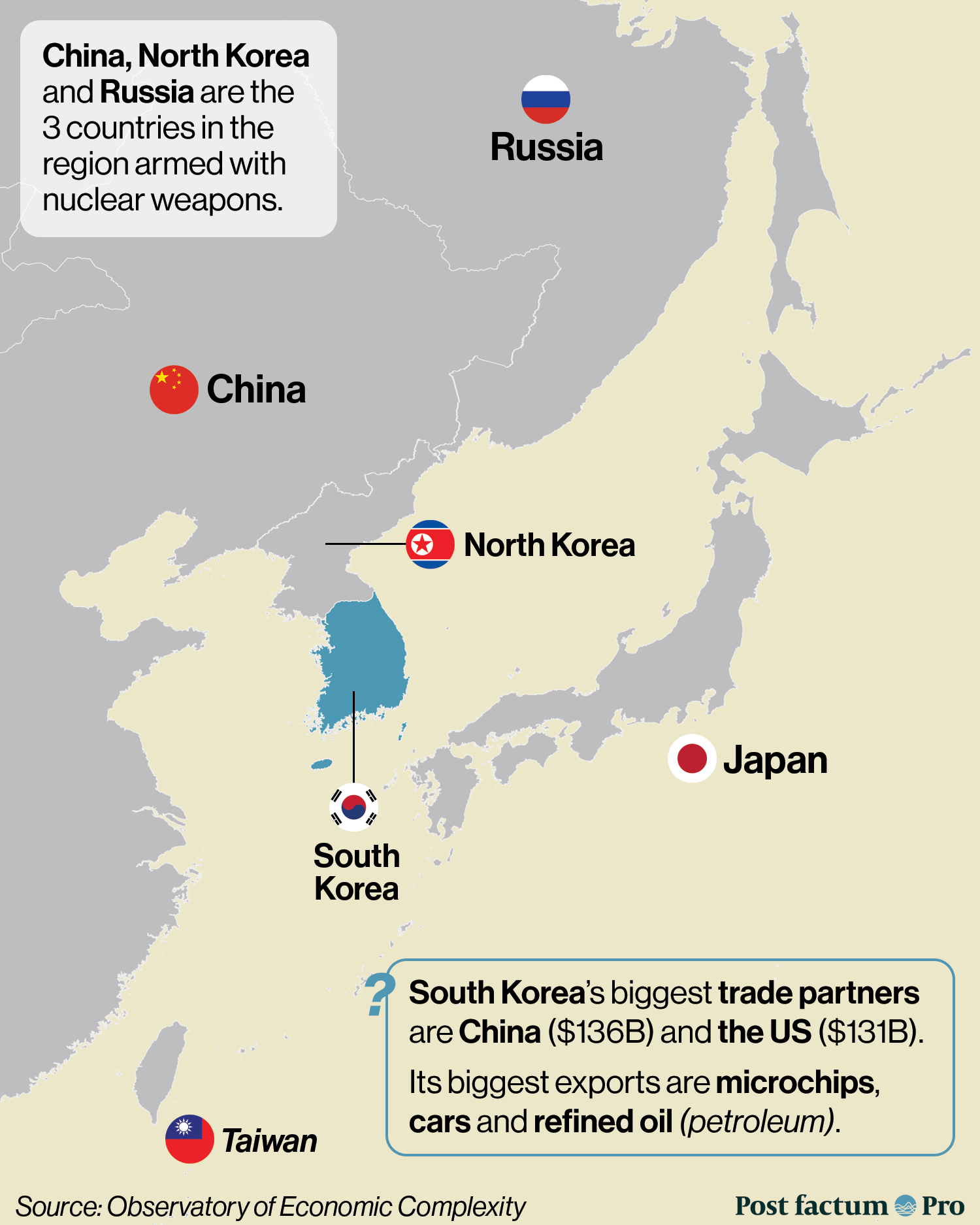
Yoon claimed that the opposition party was acting against the interests of the country, aiming to overthrow the free democracy in collaboration with North Korea.
Key moment: Yoon needed to stop the parliament from gathering and voting against the martial law but failed.
Police units were sent to block the National Assembly building while politicians raced to the scene and eventually climbed the walls to enter.
The police and special forces did not act decisively in support of Yoon and were confused by the orders given.
However, the parliamentarians constructed barricades and had to physically defend the building, including by spraying fire extinguishers at the police.
Around 1,000 troops were sent to the National Assembly, carrying 5,000 live rounds of ammunition and 3,000 blanks.
At 1 am, 190 lawmakers (out of 300) were present in the building, and all voted against the martial law decree, after which the soldiers left, some were seen apologising.
10 days later, the parliament vote to remove Yoon from the presidential office (an impeachment).
Yoon then fled to his presidential residence and ordered his security detail to stop any attempts to arrest him.
Weeks later, and after a failed attempt, Yoon was taken into custody in an early morning police raid.
There was no North Korean military activity during the crisis.
Yoon was charged with 7 different crimes, the most severe being “insurrection” which can be punished by a death sentence or life in prison, with possibility of labour.
South Korea last carried out an execution in 1997, when 23 murderers were executed in a single day, including 5 women.
Other officials involved in the martial law declaration have so far been sentenced for up to 30 years in prison.
The former Defense Minister made an unsuccessful suicide attempt in custody.
The crisis did not have any lasting negative impact on South Korean economy due to how short it was.
Over the course of 2025, South Korean stock market experienced historic growth: it more than doubled in size, adding $1.7 trillion, driven by AI and tech.
The economy overall grew at a moderate 1% in 2025, with stronger growth expected in 2026.
South Korea is a major player in the microchips industry, especially in design, materials and assembly.
The country’s laws were adjusted to ban the police from blocking the parliamentary building without the Speaker’s approval in case of martial law.
In the end, the declaration of the martial law lasted around 3 hours, showing the relative strength of the pro-democratic movement in the country.
The politicians and military officials declaring the martial law were unable to organise it well and did not have enough control over the police forces.
Yoon’s refusal to cooperate with officials has created concerns over the strength of South Korean democracy but it was able to overcome the crisis.
In South Korea, the President has wide executive power but is limited to one term.
Multiple ex-presidents have faced legal action for corruption or abuse of power.
Some have later been pardoned, including those on a life sentence.
In January 2026, 58% of Koreans supported a death sentence for Yoon.
He was sentenced to life in prison over the most serious charge he faced, with the possibility of parole after 20 years.
Thank you for reading!
Author Anton Kutuzov
Leave a comment below: