
1 year of Labour, reviewed
Published: August 21, 2025
Plus: How other media outlets reviewed Labour’s first year in power.
The UK’s political system is dominated by two main parties: the centre-right Conservatives and centre-left Labour.
The two have alternated in government for the last 100 years.
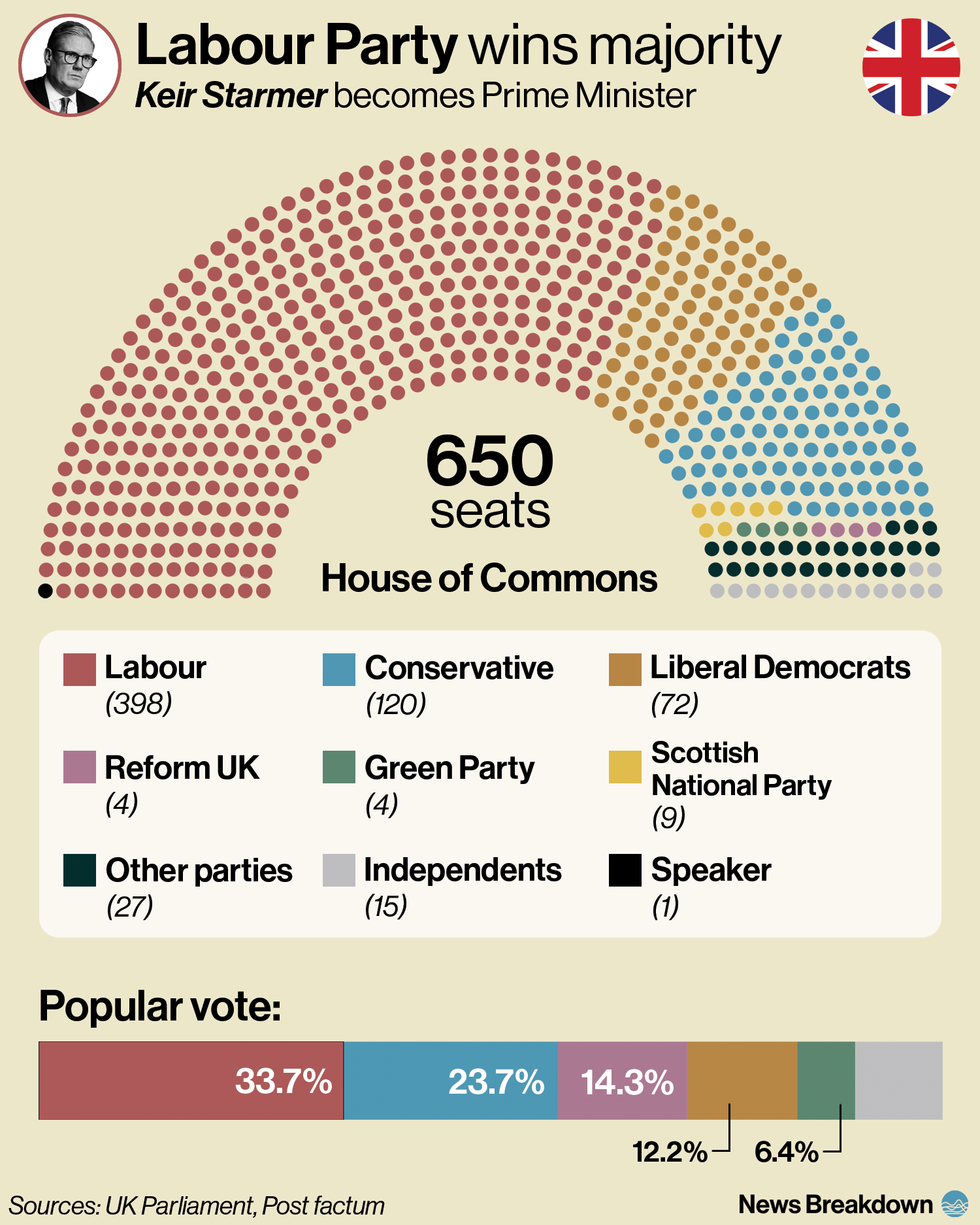
On 4 July 2024, the Labour Party returned to power under the leadership of Keir Starmer.
Labour won 34% of the vote, giving it 64% of the seats in the House of Commons.
This came after 14 years of rule by the Conservative Party, marked by austerity (low government spending to reduce debt) and the UK’s exit from the EU.
Labour promised 6 “first steps” in its election manifesto:
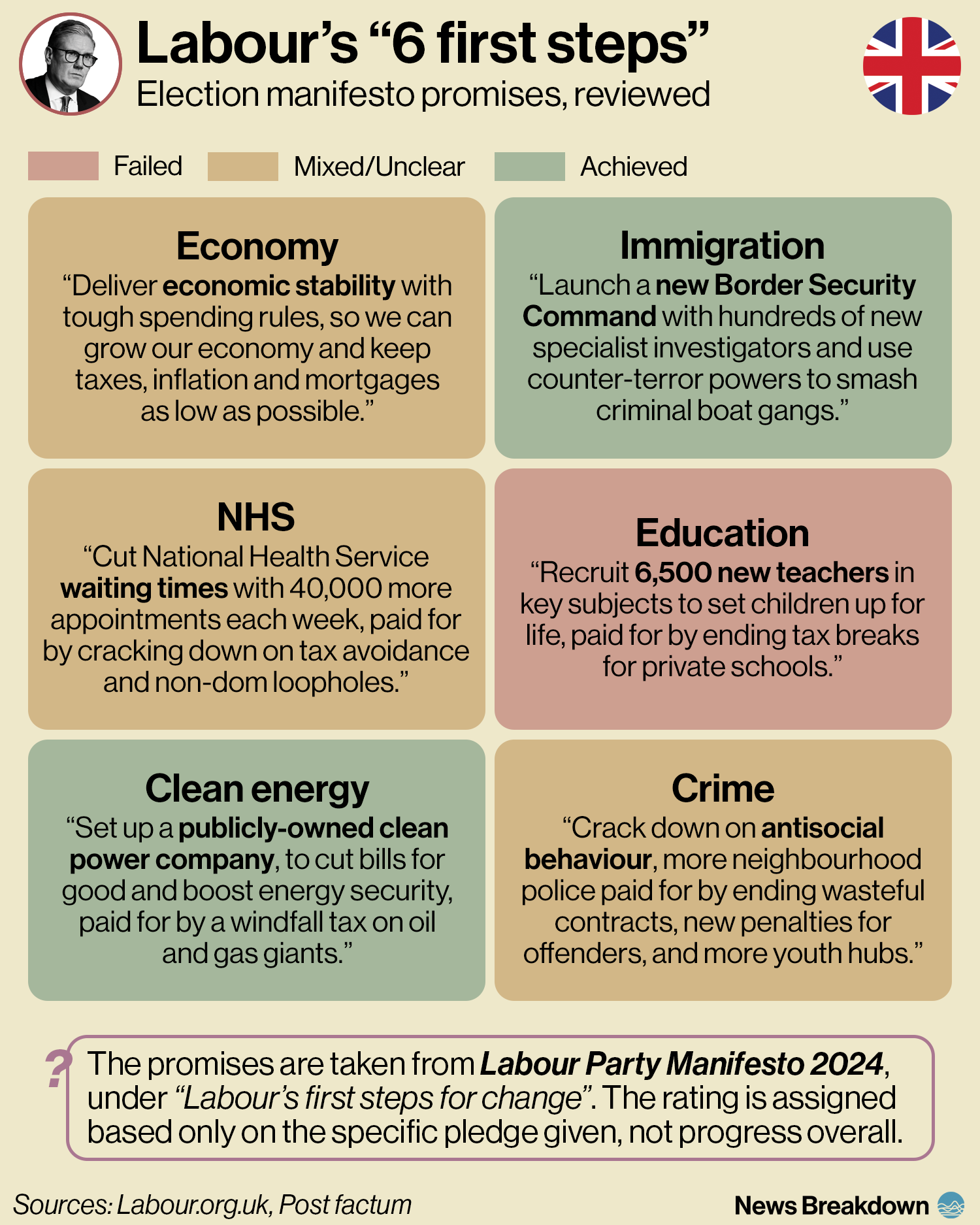
Economy: the commitment to stability is more rhetorical than measurable. The commitment to “more money in pockets” can be measured by the changes in real disposable income.
Real disposable income per person grew very slightly by around 1%, and markets have remained relatively stable.
In autumn 2024 the Labour government presented acontroversial Budget (statement of economic policy).
Some main points:
£40 billion in tax increases, including on private school fees
Raised the minimum wage by 6.7%
Increased spending on healthcare, defence and other sectors
Many outlets, such as Bloomberg or The Guardian, reported the loss of 250,000 jobs as businesses face higher taxes and an increase in the minimum wage.
However, this only measures payroll employment, not including self-employment and other types. Overall employment grew in the past year.
The UK’s unemployment rate increased by 0.6% since Labour’s win.
Labour’s goal of becoming the fastest-growing G7 economy has not yet been achieved, with the US and Canada still growing faster.
Immigration: Labour has met its formal pledge to establish a new Border Security Force but this does not signal progress on immigration.
Small boat arrivals from France rose by 40% in the year since Labour came to power and are at record highs.
Net migration has fallen, but thanks mostly to policies implemented by the previous government.
Crime: the promise of “cracking down on antisocial behaviour” is more rhetorical.
Violent crime fell by just over 1% in the first six months compared to the same period in the previous year.
NHS: Waiting lists are slightly down, 5% below record highs in September 2023, but still far above pre-pandemic levels.
Education: The teacher recruitment target (6,500) was not met. Labour did end the VAT exemption for private school tuition.
Some private school parents who could afford it pre-paid months or years of tuition in advance to avoid the 20% tax, to the sum of over £500 million.
However, some experts argue that the government will still be able to claim some of this tax.
Clean energy: Labour met its pledge ofsetting up a publicly-owned clean energy company.
A ban on new onshore wind turbines was lifted, and support given to 131 new renewable energy projects.
Reform UK rises
Reform UK is a Eurosceptic, right-wing populist, anti-establishment political party.
It was founded in 2018 as the Brexit Party, advocating for leaving the EU specifically without negotiating a new deal.
In 2024, Reform UK was re-joined by Nigel Farage, a well-known far-right politician and former leader of the Eurosceptic Independence Party.
He led Reform to gaining over 14% in the 2024 general election, which secured them only 5 parliamentary seats as each requires placing first in a given constituency (area).
The party was successful at attracting ex-Conservative voters, disappointed with the party’s failures on issues like immigration, the economy and defence.
In local elections on May 1 (held in some constituencies), Reform had 29% of the national vote (most), with Labour getting 23%.
Media analysis
Here, we focus on 3 perspectives:
Left-leaning media playing up Labour’s successes, trying to present the issues more positively.
Left-leaning outlets criticising Starmer’s Labour for being centrist, not left-wing or similar to Conservatives.
Right-leaning outlets playing up Labour’s failures or negatively interpreting their economic data.
Pro-Labour perspective
One chart-driven analysis by the Mirror, a left-wing tabloid newspaper in the UK, played up Labour’s successes by focusing on more positive metrics.
For example, when assessing education, the Mirror discussed Labour’s move to start charging VAT on private school fees, but not the promise of recruiting more teachers, which was not met.
Where the results were poor or mixed, such as illegal immigration, the verdict was that the issue “needs improvement”, in contrast with harsher views in more neutral outlets.
In a separate analysis, Mirror admits that Starmer’s first year has been “testing”, while governing “has proved to be a challenge”.
It describes welfare as Labour’s “most messy and unpopular area”.
It highlights the “disastrous decision” to strip millions of pensioners of the winter fuel allowance. This issue is likely sensitive for a number of Labour’s target voters and the Mirror’s readers too.
It argues that the economy has been “a rocky ride”, while “much longed-for economic growth has been feeble”.
Mirror notes that the funding is not enough to achieve targets to grow the police force.
Meanwhile, immigration is “turning into a big problem”. Failure to drive down small boat arrivals “will be catastrophic”.
The article is most positive about Starmer’s foreign policy, calling the UK prime minister a “Trump whisperer”.
It also describes him as “a serious, thoughtful man, who understands the deep challenges facing Britain.”
Criticism from the left
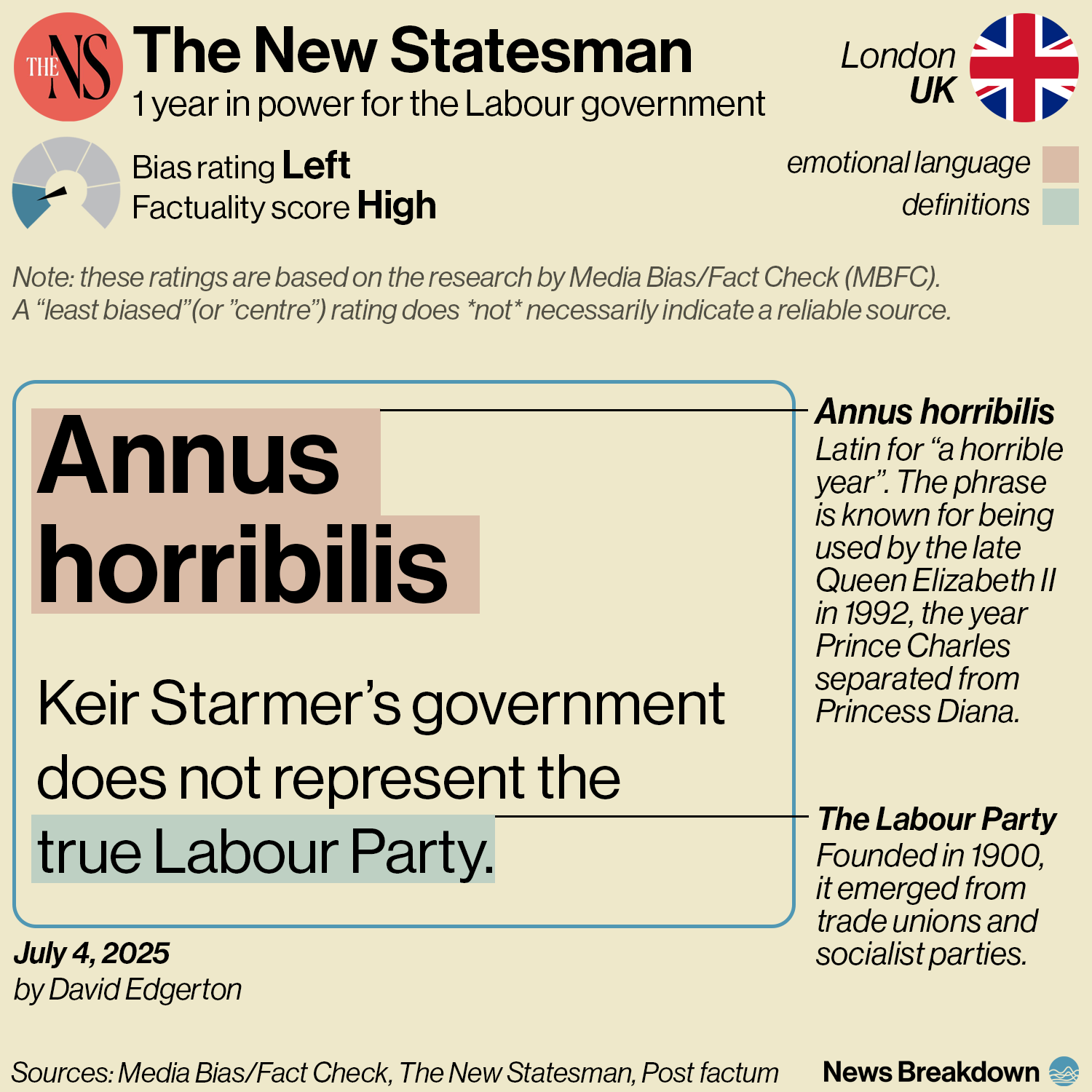
The New Statesman, a leading left-wing weekly magazine, argues that:
Starmer changed little compared to the Conservative government.
This Labour government does not represent truly left-wing voters and politicians.
It says that Labour has continued right-wing policies favouring:
“Fiscal rectitude” (careful spending) and deregulation
Higher defence spending instead of foreign aid
Welfare cuts instead of tax rises
“Building prisons instead of schools”
“Not protecting Palestinians from Israel”
A new party has launched to the left of Labour:
Provisionally named "Your Party", its leaders include Jeremy Corbyn, Labour’s leader before Starmer took over in 2020.
The far-left US magazine Jacobin predicted that the new party could be "devastating" for Labour.
Describing Starmer as a “dim-witted imperial bureaucrat”, it speculated that the party had “every chance of rallying 10 or 15% of the electorate even in a short time frame”.
Criticism from the right
The negative view taken by the right-wing press is less surprising.
The Daily Express describes Labour’s first year as a “disaster” and highlights that Starmer’s popularity is “plummeting” while Reform UK party is “surging”.
The Express also published an opinion piece by the opposition’s shadow (would-be) finance minister, Mel Stride, who attacks Labour on its economic record.
He notes that there is now “weaker growth, higher taxes, the cost of living rising, unemployment up, borrowing through the roof and the public finances in disarray.”
Some of these points are debatable: for example, while the cost of living has risen, wages have risen more in the past year.
It also ignores the state of public finances inherited from the previous government.
More fairly, the article also accuses the government of “spending with no plan to pay”, setting the country on “a dangerous path to soaring taxes and spiralling debt”.
The consequence: “as sure as night follows day, Labour will put up your taxes… tax rises are now inevitable… Labour's thirst for tax rises cannot be quenched.”
This plays on long-held fears on the right that Labour always increases taxes.
More sensationalist outlets, such as GB News, also described Starmer’s first year as “disastrous”.
GB News quotes an editor from The Telegraph warning that Labour’s poor performance, and the emergence of another party on the far left, could make this the “last ever Labour government”.
He adds: “In fact, it's the worst ever first year for any Government, I think. Labour are failing disastrously, they're unravelling completely, they have no agenda and they are collapsing [in] the polls."
GB News focused another article on a Labour voter and disability campaigner stating that the country has "gone to the dogs" after Labour's first year in power, pointing to the left-wing voters disappointed by the welfare cuts introduced by Labour.
Theoretically, making welfare cuts is a way to reduce the need for increasing taxes with spending in other areas growing.
However, misjudging what welfare benefits can be cut can lead to some people suffering hardship.
Thank you for reading!
Author Benedict Mander
Editor Anton Kutuzov