
US Foreign Aid Cuts, revisited
Reasons, Impact, New Policy
Published: November 13, 2025
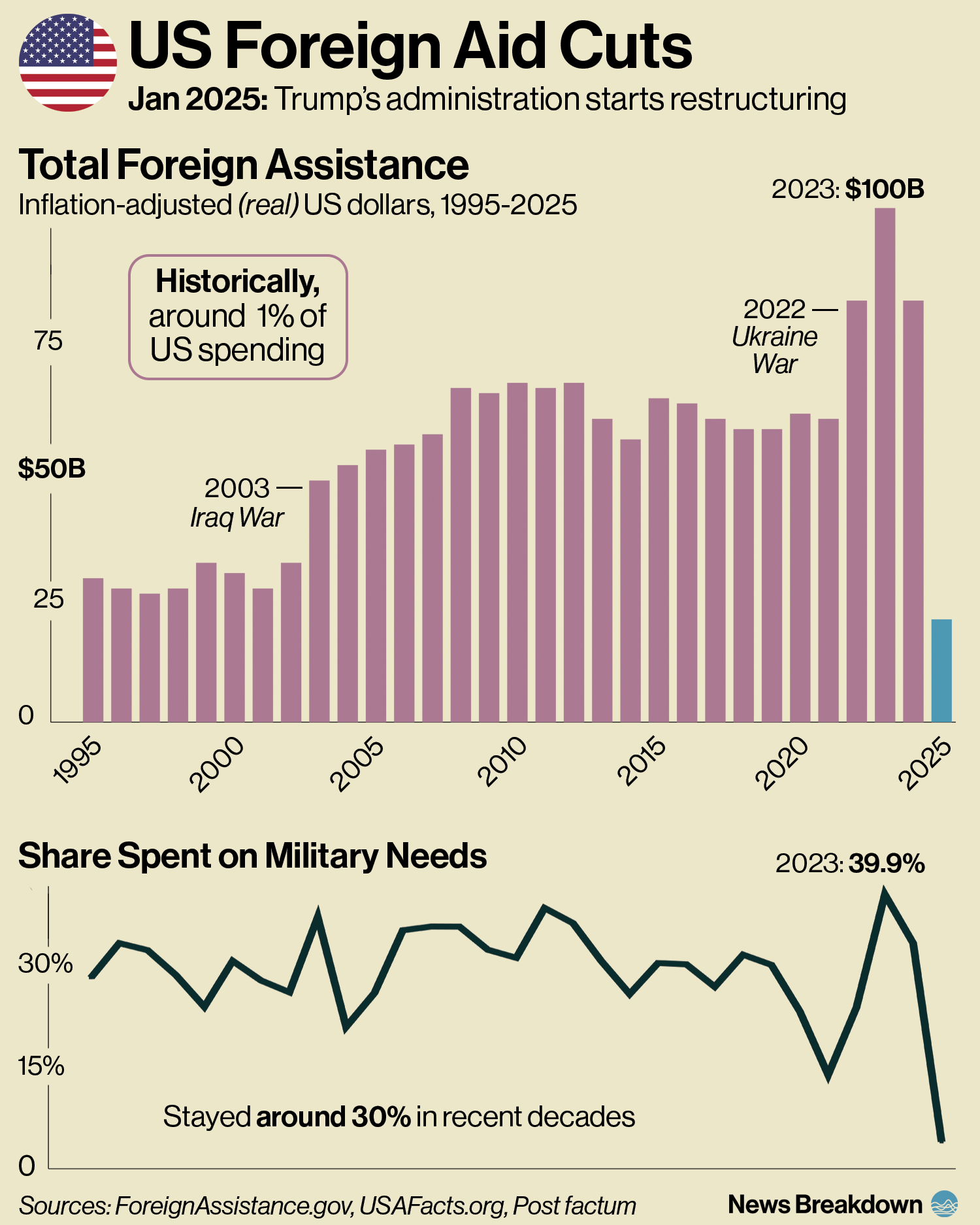
On his first day in office, US President Trump paused all foreign aid given by the country.
The Trump administration started a 90-day review of the aid on (1) effectiveness and (2) if it supports US foreign policy interests.
Total foreign aid was cut from $68B in 2024 to around $30B in 2025.
$18B in foreign aid is planned for 2026.
Budget for Global Health is being cut from $10B in 2025 to $4B in 2026.
The Trump administration promised to keep the funding for all “lifesaving” aid but it is not clear if this is possible given the budget cuts. (More in section 2)
The cuts have focused on USAID (US Agency for International Development) which has been effectively closed down.
83% of its projects were cancelled and the rest transferred to the foreign affairs ministry (the State Department).
USAID was founded in 1961 as a way of competing with the Soviet Union through giving aid as soft power.
Soft power is the use of economic and cultural influence to achieve diplomatic goals.
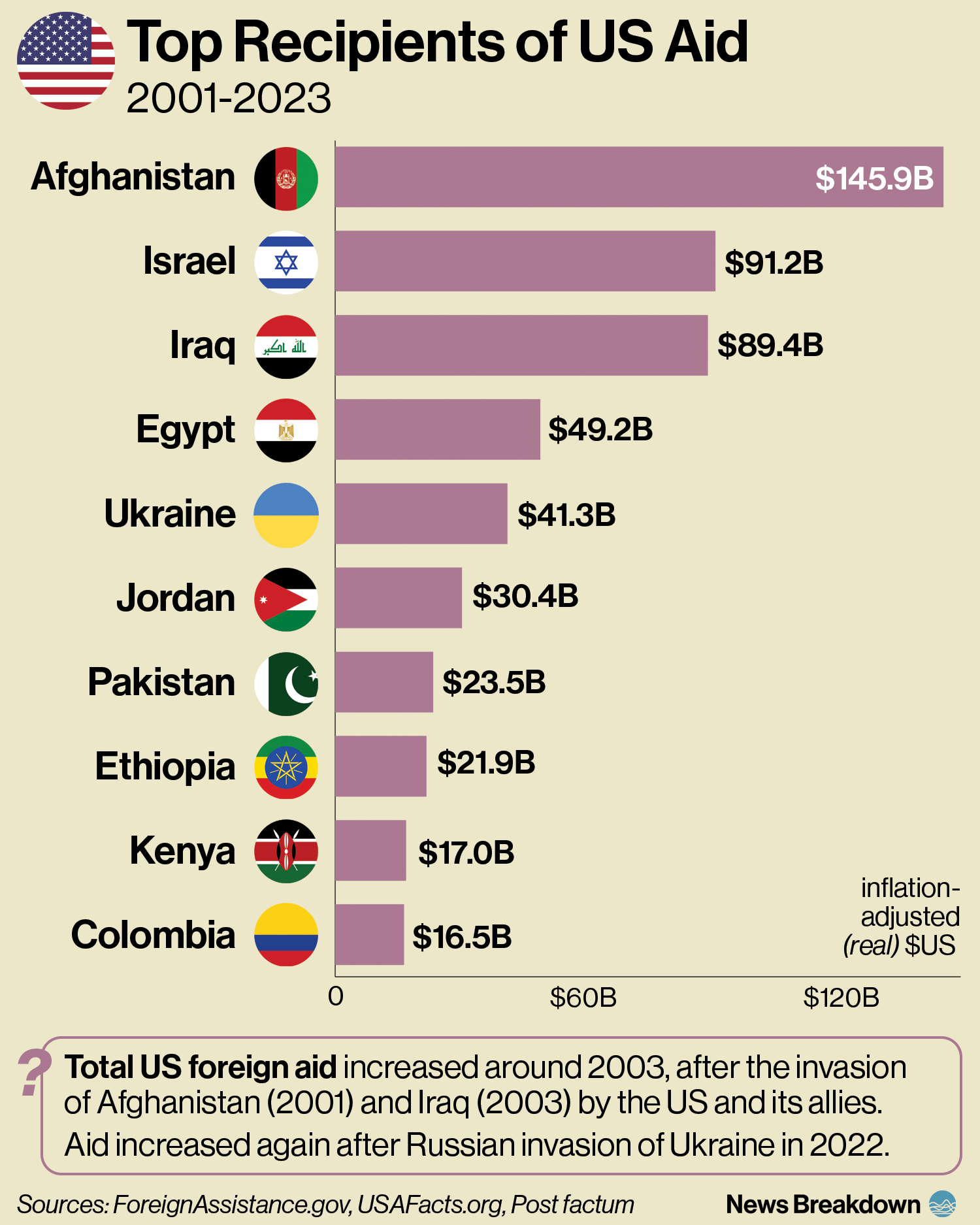
In 2001-2023, most foreign aid went to countries with US military presence: Afghanistan, Israel and Iraq.
USAID was also the world’s largest humanitarian donor.
It is estimated to have saved 91 million lives in the past 20 years from infectious diseases and humanitarian emergencies.
PEPFAR, a project fighting the spread of HIV/AIDS, has saved an estimated 26 million lives since 2003. It has strong support from both major US political parties, and is now managed by the State Department.
What is foreign aid criticised for?
Inefficiency
A significant share of aid funding (66% for PEPFAR) was spent on administrative, training and other organisational costs.
The system relies on many local partner-organisations in each country, as well as US-based workers involved in management.
In some cases, funding was allocated to groups that were unsuccessful in reaching their humanitarian goals but the funding continued.
Dependency
Some countries rely on foreign aid from the US or other donors for the provision of key health services.
In some cases, when the health services were set up, there was no local infrastructure available so it was created from nothing.
Misallocation
In some cases, aid funding ended up being spent on unintended purposes such as financing militant groups. In some cases, the funding was stolen.
The largest recipient of aid since 2001 was Afghanistan ($146B), which is now ruled by the Taliban, a terror group.
What has been the impact of aid cuts?
It is unclear how damaging the cuts have been or will be.
They have also affected data collection which further complicates analysis.
The initial freeze and the cuts have caused short-term disruption in some health services globally.
They have led to more outbreaks of and deaths from infectious diseases, as well as more deaths from other causes, like childbirth.
It is estimated that around 1 million lives are put at risk by the cuts to US global health funding in 2026:
Mostly from HIV (676,000), tuberculosis (169,000) and malaria (118,000).
However, this is likely to be an overestimation of the actual results:
Effectiveness: the figure assumes that any funding cut will result in proportional loss of lives saved. If less effective programs are cut more, the figure would decrease.
Other actors: the figure does not include any potential effort to replace the services by local governments, other countries or international organisations.
For example, South Africa is the largest recipient of HIV-related aid, and the target of 50% of the cuts to HIV funding.
It is also an upper middle income country, 10 times richer per person than some other recipients like Madagascar.
In October 2025, the US agreed to provide $115M to South Africa to keep funding the HIV programs for 6 more months.
New Global Health Strategy
In September 2025, Secretary of State Marco Rubio released the new “America First” strategy for health-related foreign aid.
It included:
Significantly reducing “non-frontline” spending (like organisation and training)
Keeping minimal spending on supplies and health workers
Prioritising disease outbreaks and preventing pandemics
Promoting US health technology and business interests
A promise to enter deals with recipient countries, creating a path to independence
The majority of the deals are promised to be signed by December 2025.
The strategy also promises 6-month “bridge” funding plans between October 2025 and April 2026. These were signed with South Africa and Mozambique by the time of writing.
Foreign aid spending is falling globally due to slower economic growth and higher spending on other goals like defense.
Aid from 17 largest Western donors is predicted to be 25% lower in 2026 than in 2024.
This creates additional pressure on aid-dependent countries as they are unlikely to attract significant foreign investment.
China does not engage in significant foreign aid instead using loans and infrastructure investment through its Belt and Road Initiative.
The US strategy document said that US agreements would not be loans, but will be conditional on co-investment by the local government in its own infrastructure, transitioning of costs towards the local government, and commitment to health goals.
It is hard to predict how well this will be realised.
While there is a possibility of long-term improvement, the disruptions and cuts to aid have already caused some short-term damage.
Sources and further reading are available below.
Thank you for reading!
Author Anton Kutuzov
Some Sources and Further Reading
The Economist: Aid cuts mean a new era in international development
CDG: A Million Lives at Risk?
Carnegie: Trump’s Foreign Aid Cuts Aren’t What You Think
US State Department: “America First Global Heath Strategy”
CFR: A Brief History of US Foreign Aid
US Government: Foreign Assistance (Aid) Data