
Syria: Fall of Assad
Published: June 19, 2025
Important! This report follows the outdated format of Post factum Pro.
Back then, we focused on analysing how other media outlets covered the event.
Let us know if you want to see more of something like this!
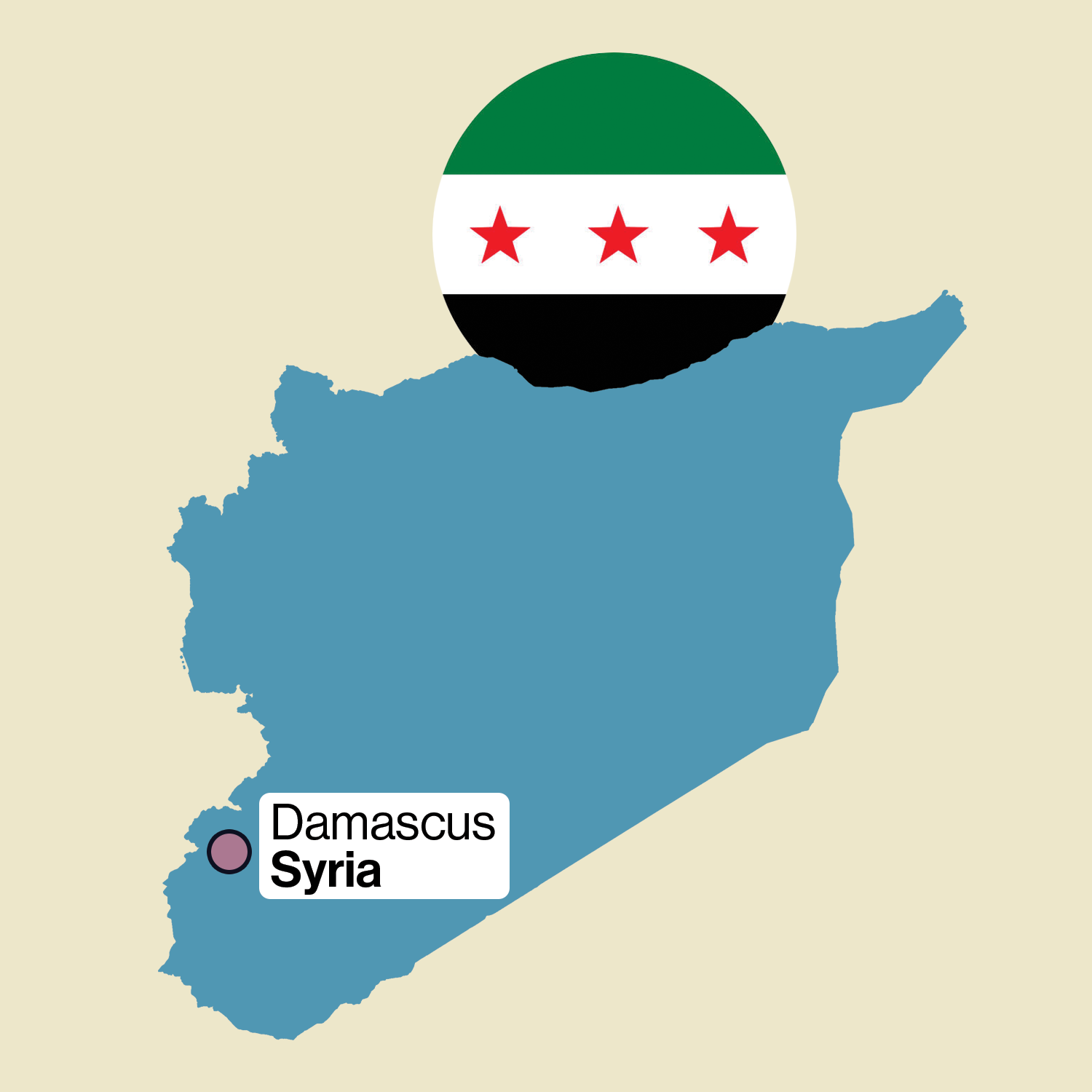
On December 8, 2024, the totalitarian regime of Syrian dictator Bashar Assad collapsed during a major offensive by the opposition forces, bringing an end to the Civil War.
The offensive was led by a group called HTS.
HTS is an Islamist group with the goal of establishing “Islamic governance”. It was previously aligned with al-Qaeda but later rebranded into a more moderate Syrian nationalist force.
HTS has set up a successful administration in the part of Syria that it controlled in recent years, which ran effective social services and was not highly repressive.
Turkey played a major role in supporting their offensive on Assad’s forces.
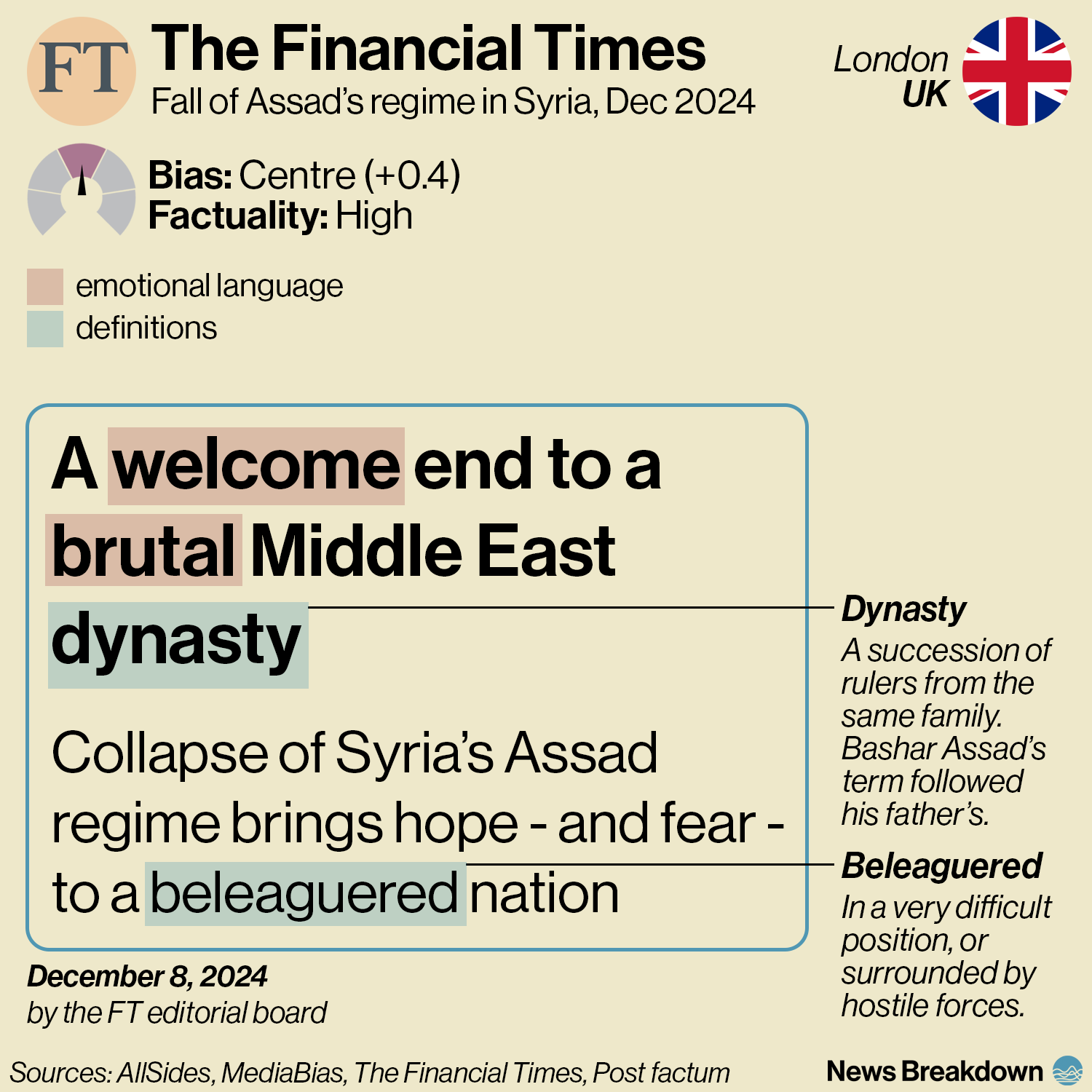
The Financial Times: a British daily newspaper
Business: focused on reporting economic affairs
Owned by Nikkei, a Japanese media giant
FT begins with a clearly negative description of Assad’s fallen regime, mentioning:
State repression
Corruption
Torture
War and destruction
The article says that this is a “watershed moment” (turning point) for the Middle East.
It explains that the fall of Assad decreases Iran’s and Russia’s influence in the region.
FT argues that:
Russia’s failure to keep the Assad regime in power in Syria underlined how the war in Ukraine had stretched Russia’s resources.
Hezbollah (Iran’s proxy group in Lebanon) had also supported Assad militarily but was no longer able to do this after its recent conflict with Israel.
The article says that “the only obvious winner” is Turkey, which backed the rebel coalition that defeated Assad.
Turkish President Erdogan negotiated with Assad to achieve a closer political alliance with Syria. After a rejection, he allowed the HTS-led offensive.
FT argues that it is still uncertain what kind of Middle East would come out of the “conflict and carnage”.
But it said that Syria now faced two possible futures: “The first is the reignition of the civil war… The second is a stabilisation…”
FT calls on countries with influence over HTS — “Turkey and perhaps also Qatar” — to push for the group to respect all religious communities.
The article noted that HTS leader was once linked to ISIS and al-Qaeda but was now modelling himself as a statesman.
Another op-ed in the FT wrote: "The fall of a brutal regime that is aligned to other brutal regimes is a good thing”.
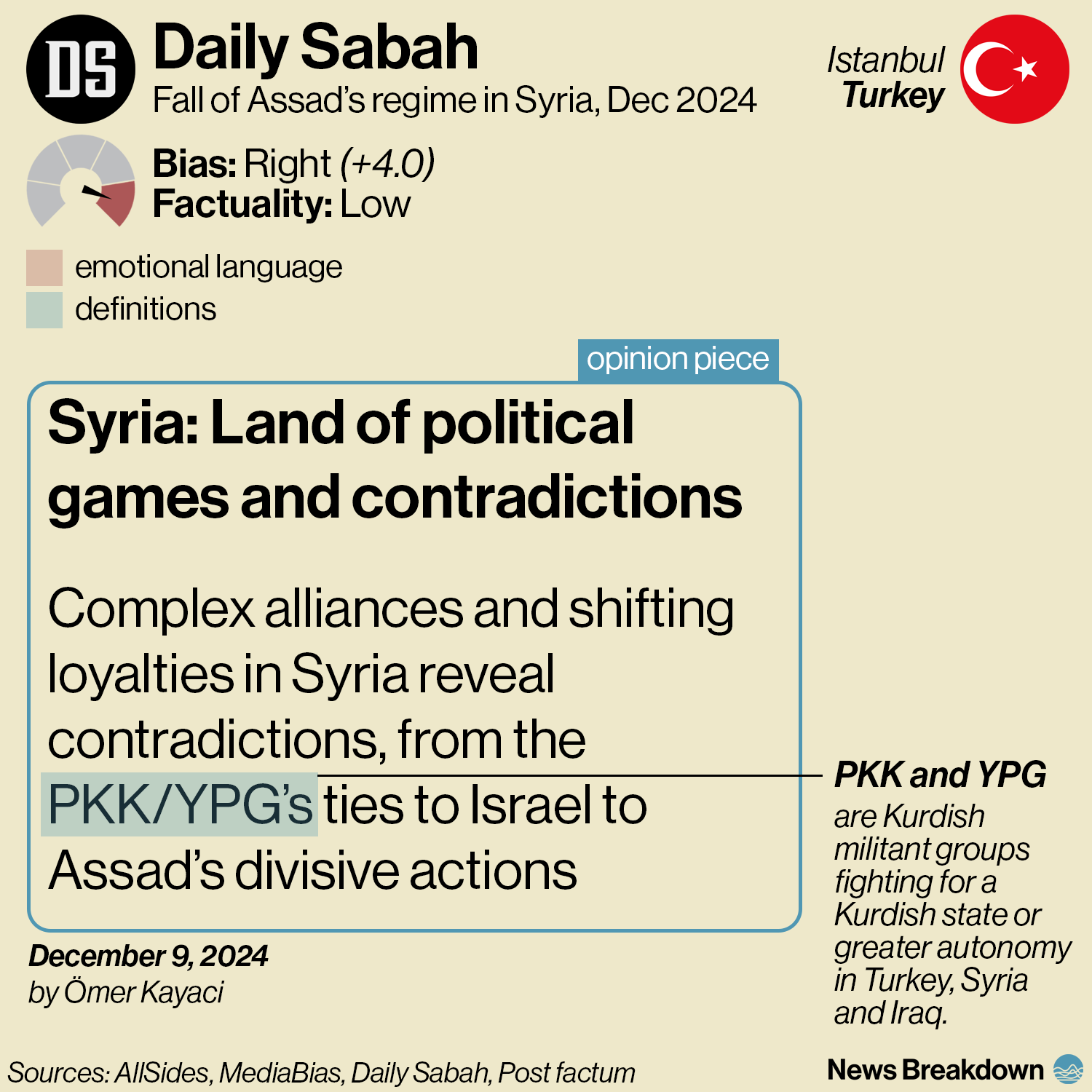
Daily Sabah: one of the most-read Turkish newspapers
Conservative and pro-government.
Owned by the son-in-law of the president.
Sabah argues that the fall of the Assad regime served the interests of Israel by “diverting global attention from the genocide in Gaza” and damaging “those in the region who have been challenging Israel" (Iran).
This article focuses on the Kurdish groups and their supposed ties with Israel.
The Kurdish people have been fighting for a separate state or greater autonomy within Turkey and in neighbouring countries for over a century.
Some of these groups were part of the Syrian Democratic Forces, which fought against the Assad regime.
The text described the Kurdish groups as Israel’s “main military and political apparatus in Syria” and asked why they were "not subjected to the same level of scrutiny” as the Assad regime had been. However:
Israel has only given limited support to the Kurdish groups. Instead, it conducted airstrikes on some military infrastructure in Syria, including chemical weapons facilities left from Assad’s regime, as well as occupying the buffer zone between Israel and Syria “indefinitely”.
Kurdish groups have not been accused of committing organised war crimes, and none of their actions compare to the atrocities of the Assad regime which included torture of thousands of Syrians.
The article does not directly criticise Assad’s regime, downplaying its wrongdoings as typical for the “monarchies of the region”.
Daily Sabah uses the spelling “Türkiye” instead of “Turkey”. In 2022, the Turkish government “rebranded” the country’s name and requested international diplomats to adopt this change.
[We would like to hear your opinion: should Post factum spell it “Turkey”, “Türkiye” or “Turkiye”? – send us a reply]
In general, this Sabah article reflects how Turkey’s already tense relations with Israel have declined since the war in Gaza began in 2023.
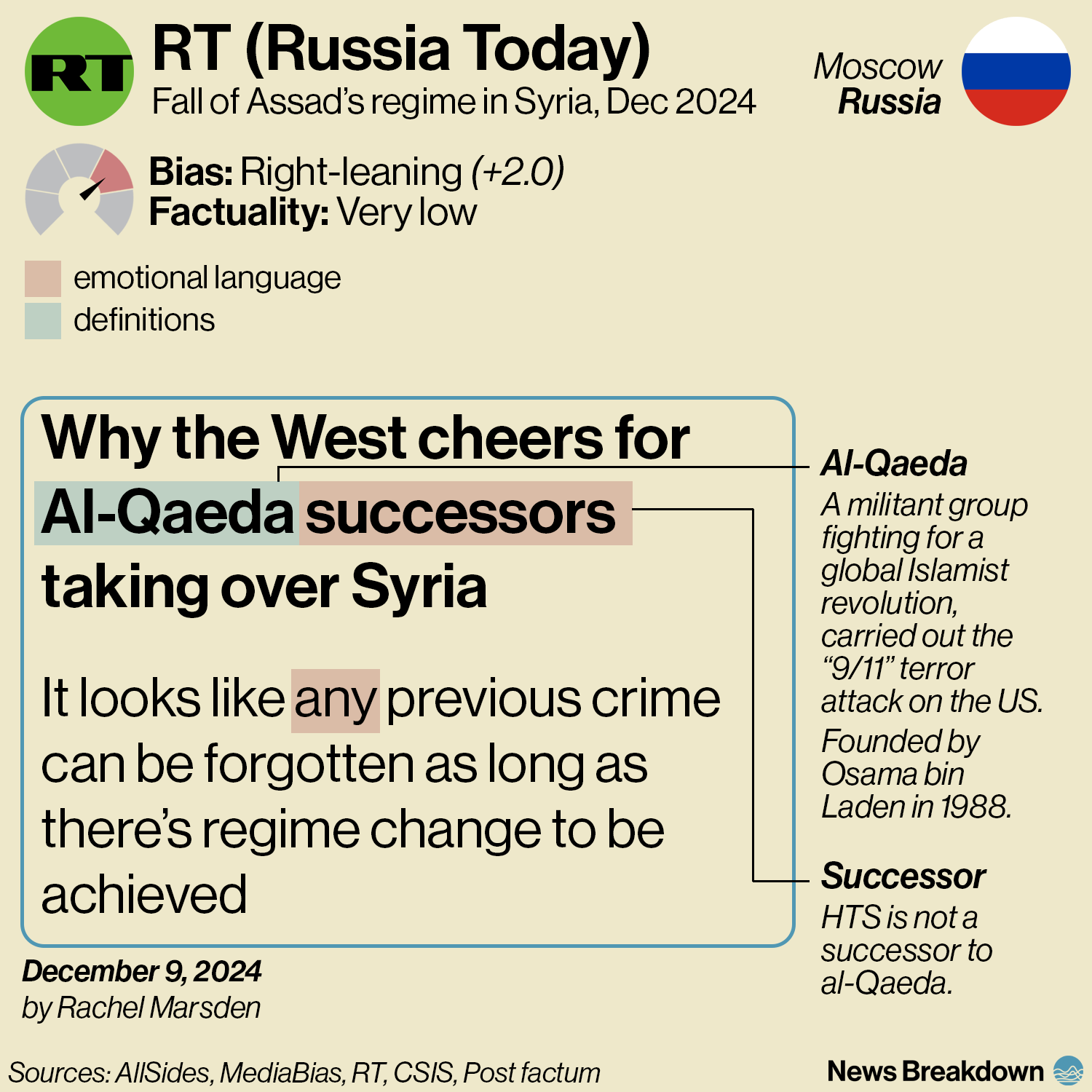
RT (formerly Russia Today): a state-run outlet
International: focused on audiences outside of Russia.
Propaganda: tasked with promoting national interests.
The article accuses the West of double standards for criticising the regime of Assad while supposedly downplaying the dangers of HTS.
HTS has had links to al-Qaeda, which fought the Assad regime during the Syrian Civil War.
Russia gave critical military support to Assad that allowed him to remain in power in 2015 and hold on since.
In return, Russia gained two military bases in Syria – a naval base (in Tartus) and an air base (in Khmeimim).
Those were its only major footholds in the Middle East.
The new Syrian government did not want the Russian military to remain in the country for their role in supporting Assad’s dictatorship, including airstrikes that killed rebel fighters and local civilians.
In January 2025, Russia lost control of the Tartus sea port and naval base, as the lease contract was cut short. As of June 2025, Russia still has control of the Khmeimim air base, but most of the equipment has been shipped away.
The tone of the article is sarcastic, and critical of Western attitudes: “What reasonable person wouldn’t give terrorists the benefit of the doubt?” it said. “Maybe banking on jihadists will work out this time, eh? If not, the West can always just bomb them into oblivion.”
Some analysts described the collapse of the Assad government as a defeat for Vladimir Putin, whose government had long invested in supporting Assad and has now granted his family political asylum in Moscow.
Another RT op-ed piece also stressed the downside of Assad’s ouster. It said Syria’s future was now “dangerously uncertain” with the possibility of a “Taliban-style takeover” by HTS.
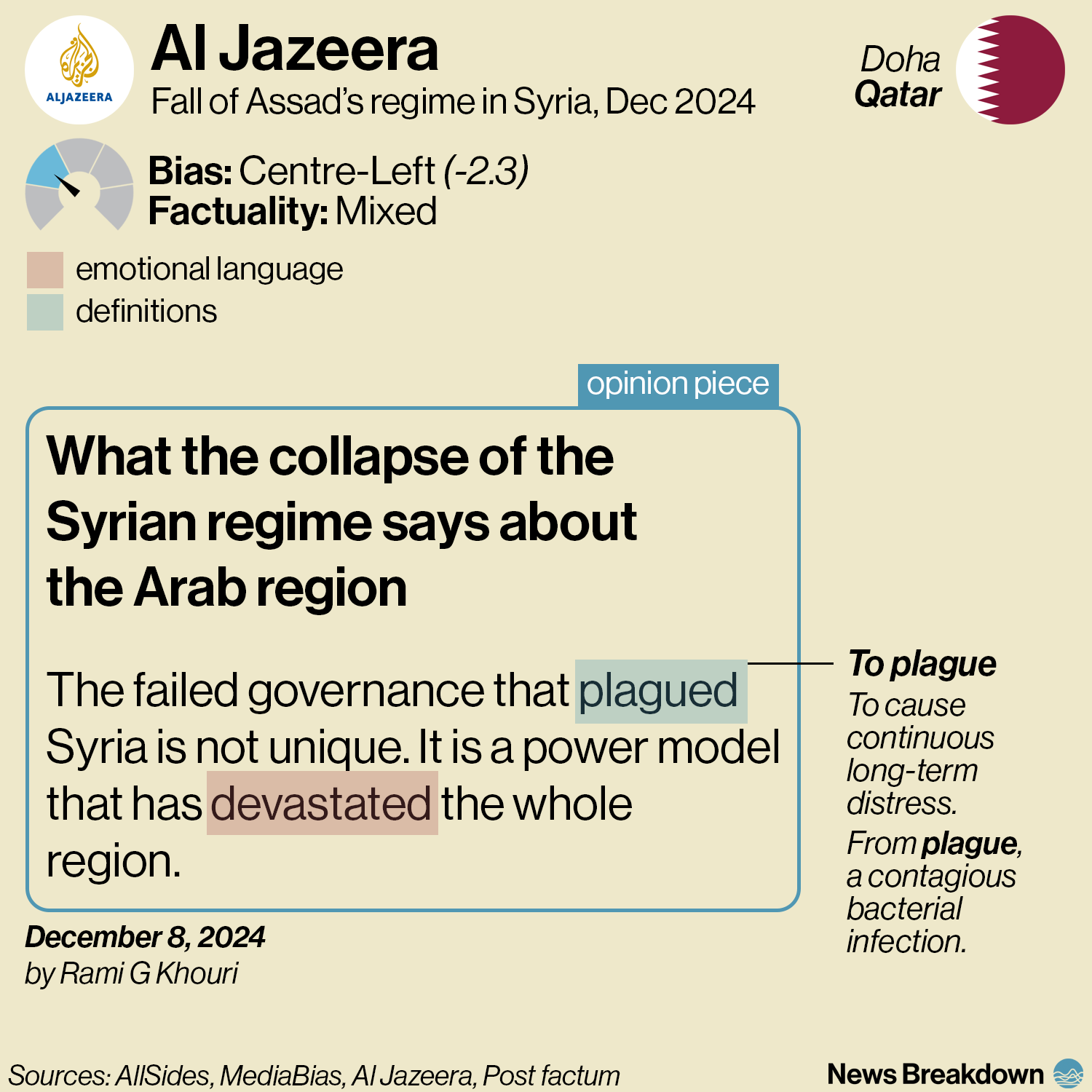
Al Jazeera: private media network based in Qatar
Alternative: Focuses on issues affecting the Global South.
International: Global focus, broadcasts in English and Arabic.
Partially state-funded by the government of Qatar, but editorially independent.
This article frames the downfall of the “vicious” Assad regime as a turning point for the Middle East. It is critical of abuses of power by other Arab governments.
The article argues Assad’s fall marked “a definitive break with the legacy of military-anchored Arab autocrats who have long dominated and ravaged Arab societies”.
It added that “Syria under the Assads was neither unique nor the work of just a few local brutes. Rather, it is an example of…often vicious, Arab state power that has ravaged the region”.
However, the article does appear to partially excuse the Gulf States, such as Al Jazeera’s own sponsor, Qatar.
It says “…a small percentage of Arabs (mostly in the oil-producing states and among small elites elsewhere) live comfortable lives, while the majority enjoy neither political rights nor a decent material life”.
Another Al Jazeera piece said that a process of national reconciliation (coming back together) would be vital for the reconstruction of Syria.
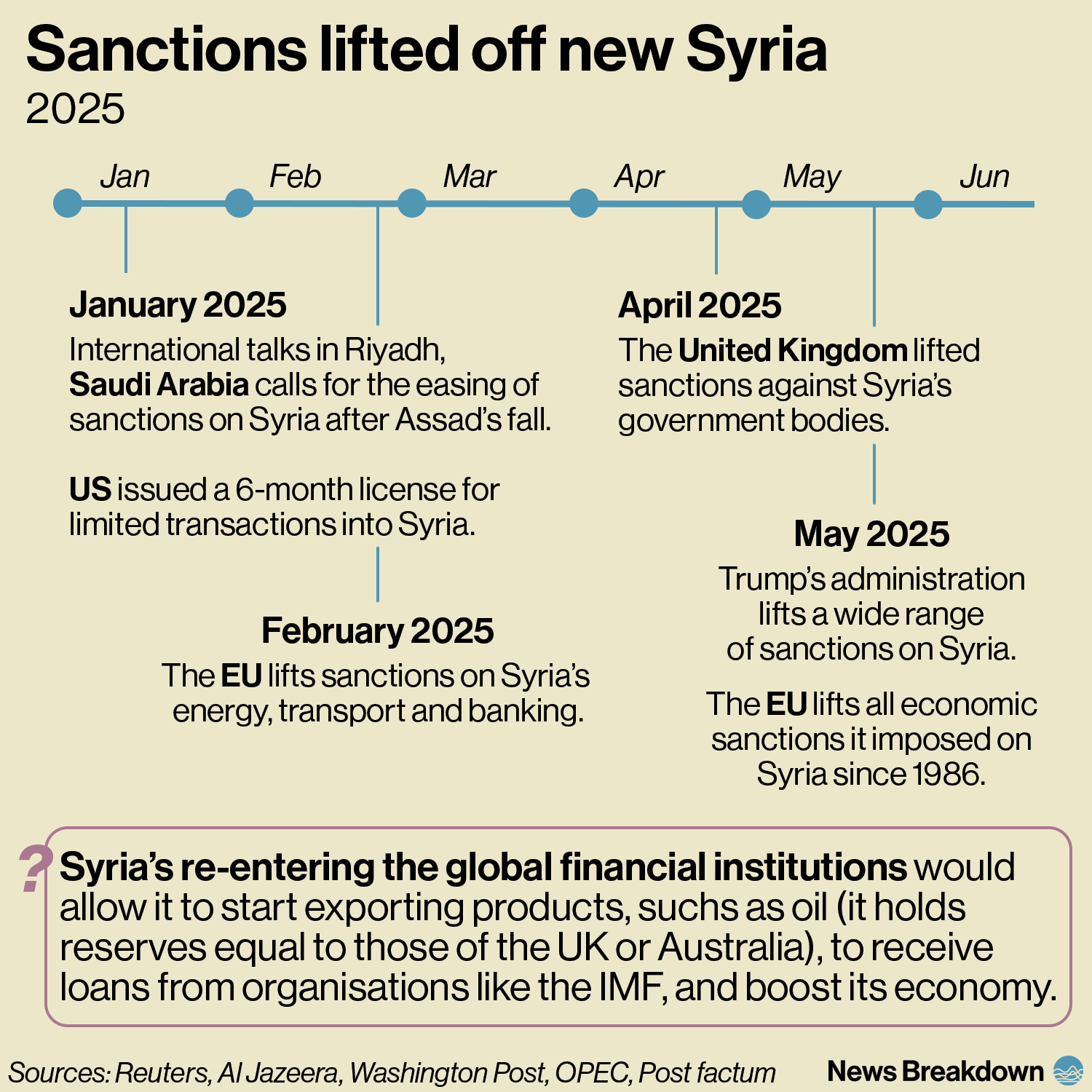
Ahmed al-Sharaa, leader of HTS, cooperated with Assad’s Prime Minister to peacefully transition the state institutions under the control of the new government.
The Prime Minister of HTS’s administration in Idlib province was appointed to lead the caretaker government. It was planned to last for 6 months, while a new constitution is drafted.
“Free elections” are scheduled to take place after a further 12 months.
A temporary constitution and a transitional government for a five-year period were announced in March 2025.
This established a presidential system with ministers appointed directly, without the post of a Prime Minister. There are currently 23 ministers, with one woman among them.
The new constitution affirms the centrality of Islamic law. On paper, it also guarantees the independence of courts, women’s rights and freedom of speech.
An anti-HTS rebellion broke out in the west of Syria where Alawite communities live, with reports of unlawful executions. This is a religious minority that held political and economic power under Assad, who was part of it himself.
The government has called for all militant groups to integrate into the army. Most agreed, but many continue fighting for power or defending their territory.
The Kurdish-majority SDF continued to control its territory but in March 2025 signed an agreement with the caretaker government to eventually dissolve and integrate into Syria’s new state.
The government rejected the idea of an autonomous Kurdish region, instead suggesting that no ethnic repression or discrimination would take place under central rule.
This came as Turkey signed a deal with its own rebel Kurdish group (PKK), in which the PKK agreed to dissolve.
This means that, in both Syria and Turkey, Kurdish groups have abandoned the fight for independence, instead hoping that they will achieve better representation or more autonomy within the existing state systems.
Thank you for reading!
Author Michael Day
Editor Anton Kutuzov