
Tensions over the panama canal
Published: September 4, 2025
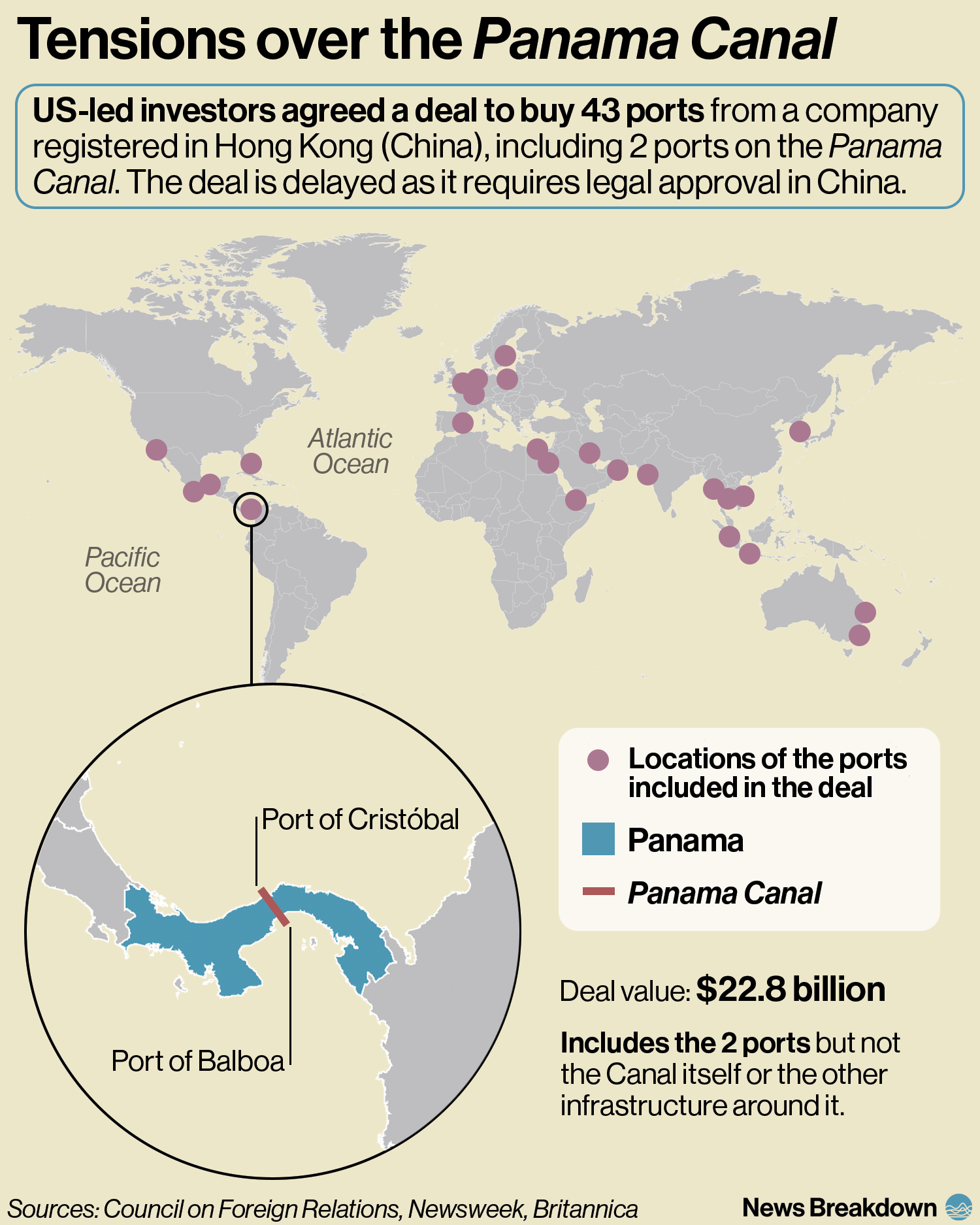
In March 2025, US investors, led by the largest asset manager BlackRock, agreed a deal to buy 43 ports in 23 countries from a company registered in Hong Kong (China), CK Hutchison.
The deal is valued at $22.8 billion.
It includes 2 major ports on the Panama Canal, one of the global trade chokepoints.
Months earlier, President Donald Trump had said the US would “take back” the canal from alleged Chinese control.
Panama did agree to leave China’s Belt and Road Initiative, a foreign investment scheme, around the same time.
The canal itself is owned by the government of Panama. There are multiple companies owning other infrastructure involved in the transit through the canal.
The purchase of the ports promised to expand US influence over the waterway which is crucial to its exports and imports.
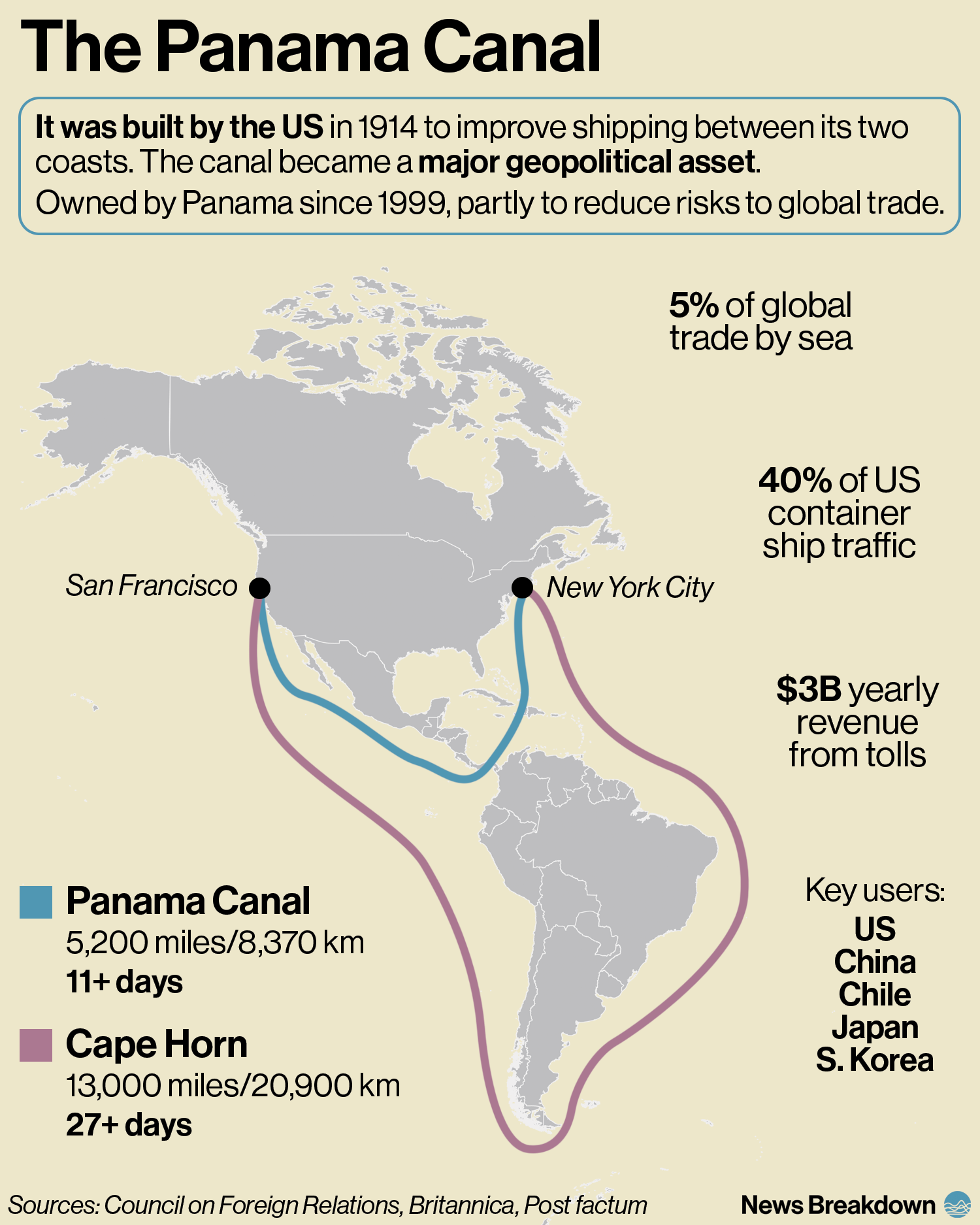
40% of US container ship traffic comes through the Panama Canal.
70% of the canal’s traffic is going either to or from the US.
Donald Trump claimed the deal as a victory.
However, it requires legal approval from China, Panama, US and others.
5 months after the deal was announced, the sale is yet to happen. Instead, it is now in the middle of a growing dispute between China and the US.
In this report, we look at how the situation has developed and its significance for the coming decades.
We also look at media perspectives that reveal the delicate geopolitical nature of the deal.
What happened after the deal was announced?
China has delayed the deal, concerned it would reduce its influence over the Panama Canal.
China started a legal review of the deal, saying it had concerns that the sale would reduce market competition.
This meant that the deadline for exclusive talks between CK Hutchison and the BlackRock group of companies expired.
From then on, other buyers could bid on the ports.
What is happening to the deal now?
China is allegedly willing to allow the deal on the condition that a Chinese company becomes one of the buyers.
In August, China’s state-owned shipping giant COSCO reportedly demanded a 20-30% stake in all ports covered by the sale.
If COSCO gains this share in the deal, it could block any decisions about the running of the ports that would go against the interests of the Chinese government
Why is the Panama Canal important?
The Panama Canal holds unique commercial and military value, making it a geopolitical asset.
The route cuts shipping time between the Pacific and Atlantic Oceans by 10-15 days.
It is important to the US’ ability to supply itself and reposition its military.
Each year, around 5% of global trade (by value) passes through the canal, half of it between Asia and the East Coast of the US.
Ports are commercially important because:
80% of global trade is shipped by sea.
Port ownership gives states influence over the global movement of goods.
States can make decisions that favour domestic or allied ships.
Access to ports and global trade reduces dependency on neighbours and allies.
Ports are militarily significant because:
They can double as naval bases or serve as a centre of intelligence operations.
Foreign ports can help states to sustain military activity abroad.
One concern the US government has about CK Hutchison owning the Panama Canal ports is that the company is subject to Chinese national security laws.
This means CK Hutchison must cooperate with the Chinese government on intelligence and military operations when requested.
The context of US-China trade war
The deal aligns with Trump’s other policies on China.
One goal is reducing US imports from other countries, especially from those it has a trade deficit with (imports above exports), like China or Mexico.
Port ownership could increase US control over what imports are coming into itsmarkets.
Port operators can do this by favouring certain ships and companies, such as by allowing them to dock and unload faster, giving easier market access.
Trump is also trying to increase US manufacturing exports.
The Panama Canal is the only practical trade route between the US and Asia.
US wants to ensure that China cannot interfere with its access to these markets.
Media review
Times of India
Oldest English-language newspaper in India
Largest English-language newspaper circulation globally in 2016
Favourable to India’s ruling conservative BJP party.
India and China have long been political and economic rivals.
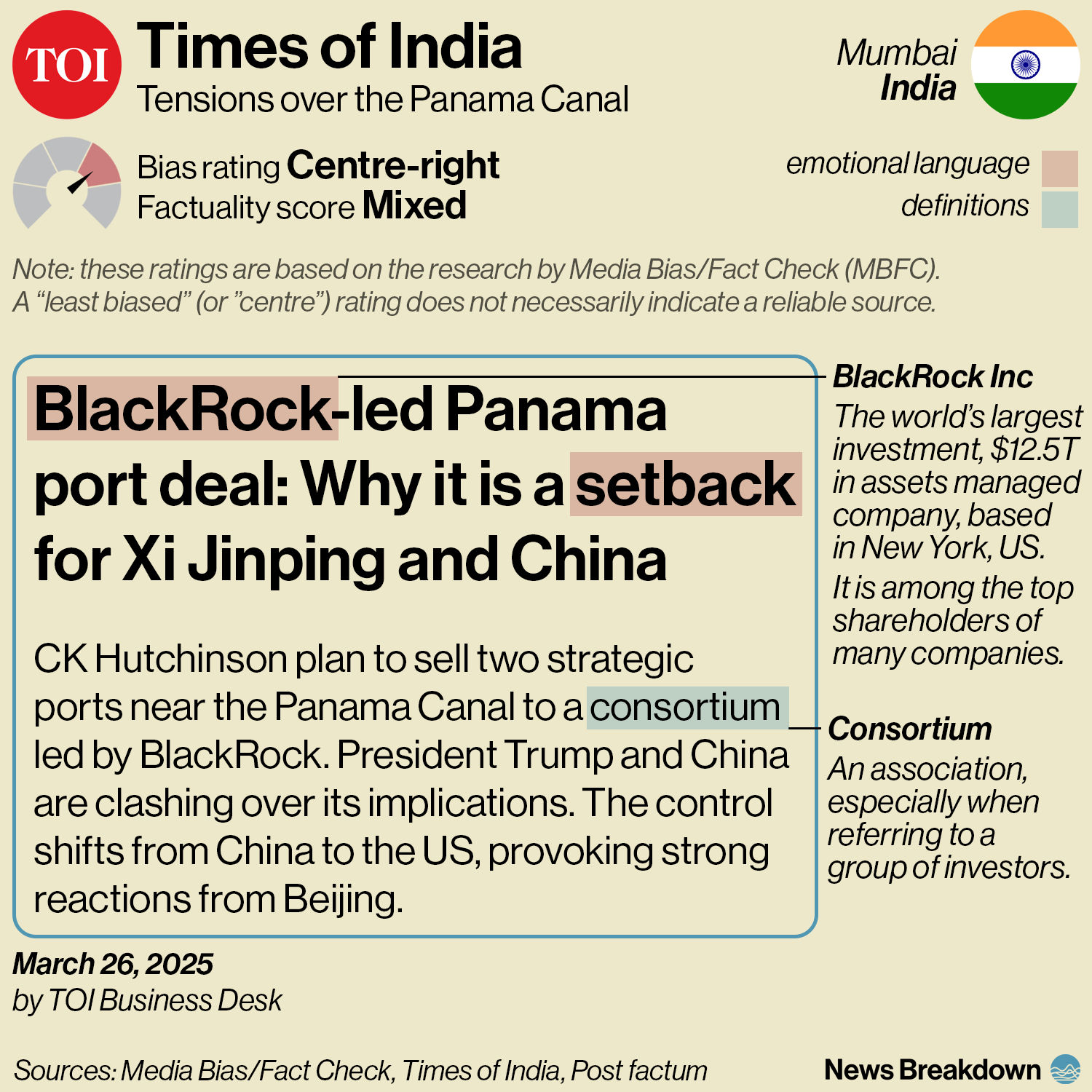
The article portrays the deal as geopolitical rather than purely commercial:
This counters pro-Chinese narratives that claim Chinese foreign investments are not politically motivated.
The article also frames the deal as a defeat for the Chinese governmentdomestically.
The article portrays CK Hutchison, the company selling the ports, as an underdog standing up to the Chinese government by doing business with the West.
This suggests that the Chinese state is vulnerable to internal opposition.
Further, the idea of a smaller entity standing up to the Chinese state aligns with the themes within Indian nationalism.
India is the second most populous Asian country behind China.
However, it is sometimes seen as having fallen behind China economically over the past decades.
The nationalist-conservative ruling party emphasises the goal of catching up with China and challenging its economic power in Asia.
India has recently displayed warmer ties with China and Russia, facing increased economic and political pressure from the US.
Al Jazeera English
Qatar-based: Launched in 2006, partly state-funded.
Critical: Brands itself as an outlet that covers underreported topics, regions and views.
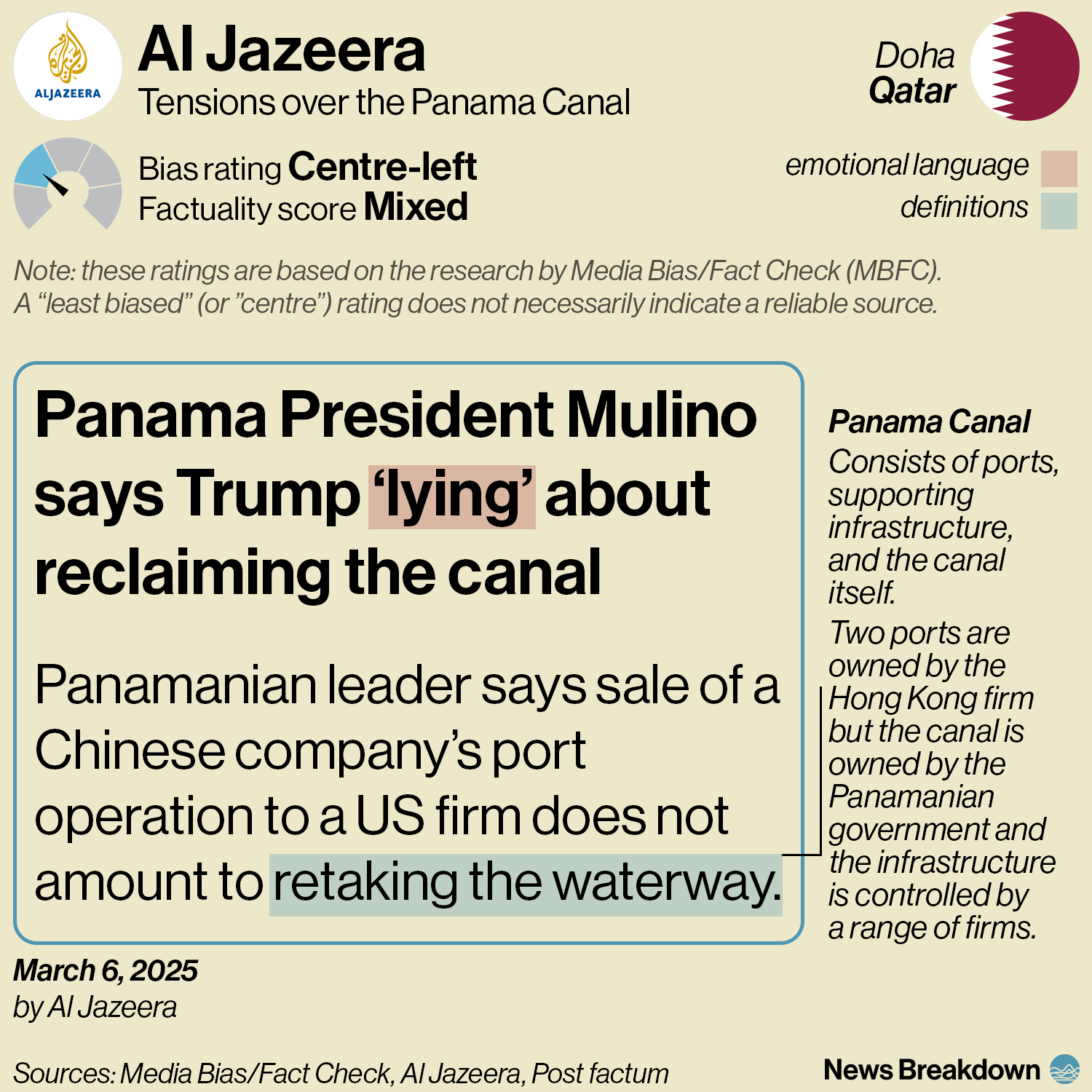
Al Jazeera (AJ) emphasises claims by Panama and China that the canal is not under any foreign geopolitical influence at all.
Early paragraphs contain statements like: “Panama maintains it has full control over the canal”, and “Panama rejected that China had any influence over canal operations. Beijing has also consistently denied interfering in the canal”.
This supports pro-Chinese narratives that deny political motivations behind its foreign investments.
China is a close trading and investment partner of Qatar, which is also a member of the Belt and Road Initiative.
The article challenges Trump's claims that the BlackRock deal benefits the US geopolitically.
It also counters statements by Western mainstream media more generally that China tries to influence developing countries through infrastructure investment there.
This article aligns with AJ’s typical line on Chinese foreign investments: that they are commercially motivated and not geopolitically motivated, to the benefit of developing countries.
AJ defines itself as a media outlet that reports from the perspective of developing nations.
This often means portraying developing nations as being independent of foreign oppression, whether by China or the US.
Why else does the deal matter?
Different interest groups have specific reasons for watching the deal closely.
Investors will be interested in whether Trump will stick to international norms and laws in handling the canal dispute.
Trump’s disregard for trade relations and norms has created economic uncertainty since he took office this year.
Geopolitical analysts will be interested in what it says about the risk of military conflict between China and the US.
The US has long seen Central America as its “sphere of influence”. This means it believes it can exercise legitimate military, political, and economic influence over the region while other states cannot.
This case could show how far China is willing to go to defend its economic interests in a distant region where the US has dominated historically.
Finally, central and South American governments will be interested in the balance of US and Chinese power in their region.
China has invested heavily in Central and South America. However, the US remains a powerful presence economically, politically and militarily.
Central and South American governments are therefore pulled in opposite directions as tensions between their largest trade and investment partners grow.
Panama has already indicated it is moving closer to the US:
It is also trying to cancel CK Hutchison’s port ownership contract on legal grounds. This would stop the Chinese state having a say in the deal altogether.
Thank you for reading!
Author Rosalind Rei
Editor Anton Kutuzov