
LEBANON: ISRAEL’S 2024 Invasion
Published: June 26, 2025
Important! This report follows the outdated format of Post factum Pro.
Back then, we focused on analysing how other media outlets covered the event.
Let us know if you want to see more of something like this!
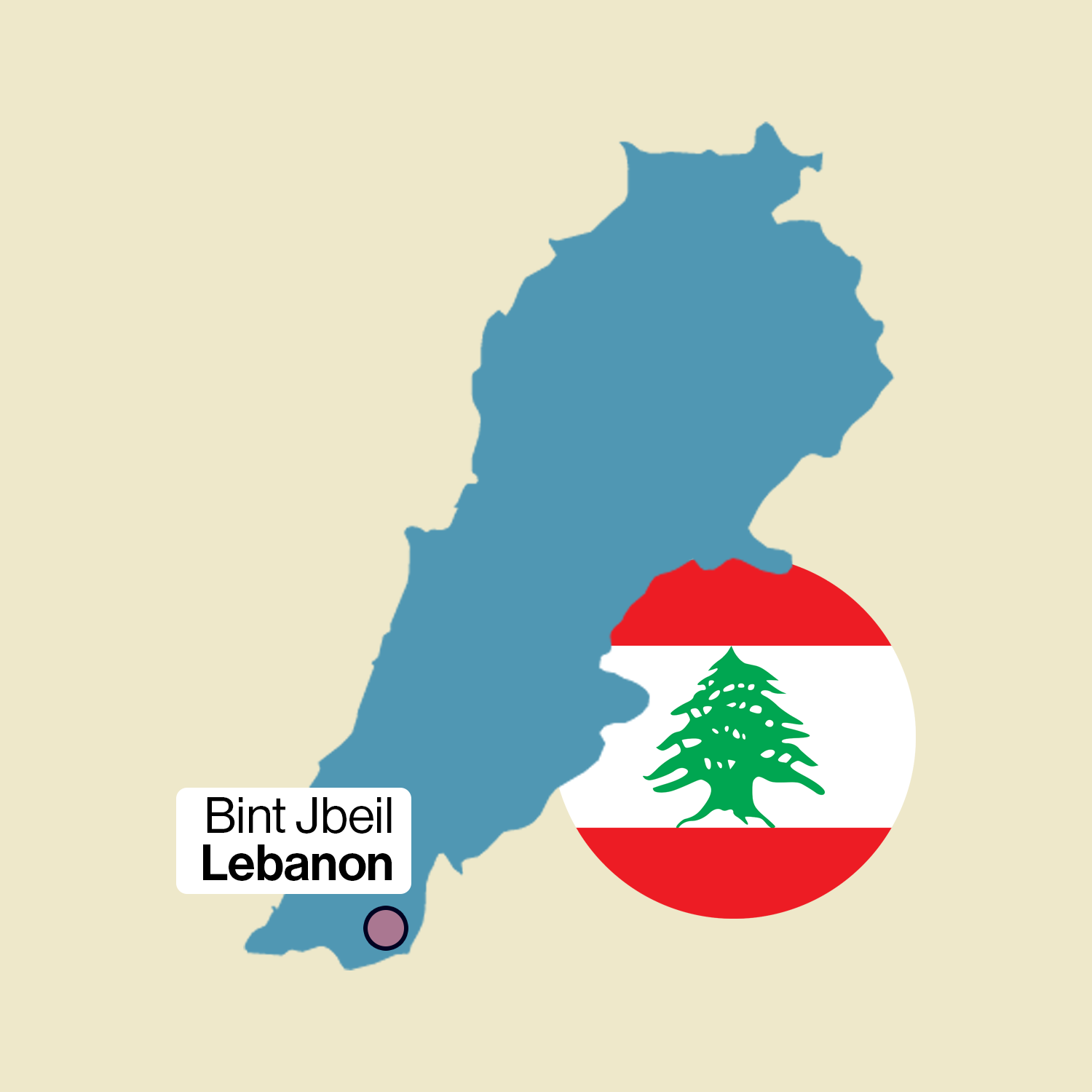
How media covered Israel’s invasion of Lebanon?
What were its actual results?
On October 1, 2024, Israel announced a “limited” ground invasion into its northern neighbour Lebanon, targeting the anti-Israel militant group Hezbollah.
The goal: to destroy Hezbollah military infrastructure and allow Israelis living near the border to return home.
Hezbollah began firing rockets into northern Israel in support of Hamas after its attack on Israel on October 7, 2023.
Hezbollah’s political organisation and social services form a "state within a state", often competing with the Lebanese authorities.
The three ways of describing Hezbollah
Negative: “terror group”, “terrorist organisation”.
Sources with anti-Hezbollah bias use this term without clarifying that many in the region believe their resistance is justified.
In particular, it ignores the legitimacy of Hezbollah’s political wing and the value of its welfare services.
Used by pro-Israel and right-wing outlets, such as the Times of Israel or Fox News.
Positive: “resistance movement”.
This term portrays Hezbollah as a group that only reacts to Israel’s aggression, rather than also carrying out attacks themselves.
Hezbollah’s attacks on civilian targets are considered to be acts of terrorism under international law. Hezbollah denies Israel’s right to exist.
Used by pro-Hezbollah outlets, such as Iran’s Press TV or Russia’s Sputnik.
Neutral: “armed group”, “militant group”.
This conveys its use of violent means, while avoiding the description as a “terror” group.
Nuanced reporting notes, in addition, that it is considered to be a “terrorist organisation” by some countries, including the US and the UK.
Used by more neutral outlets such as the BBC, Al Jazeera or the Financial Times.
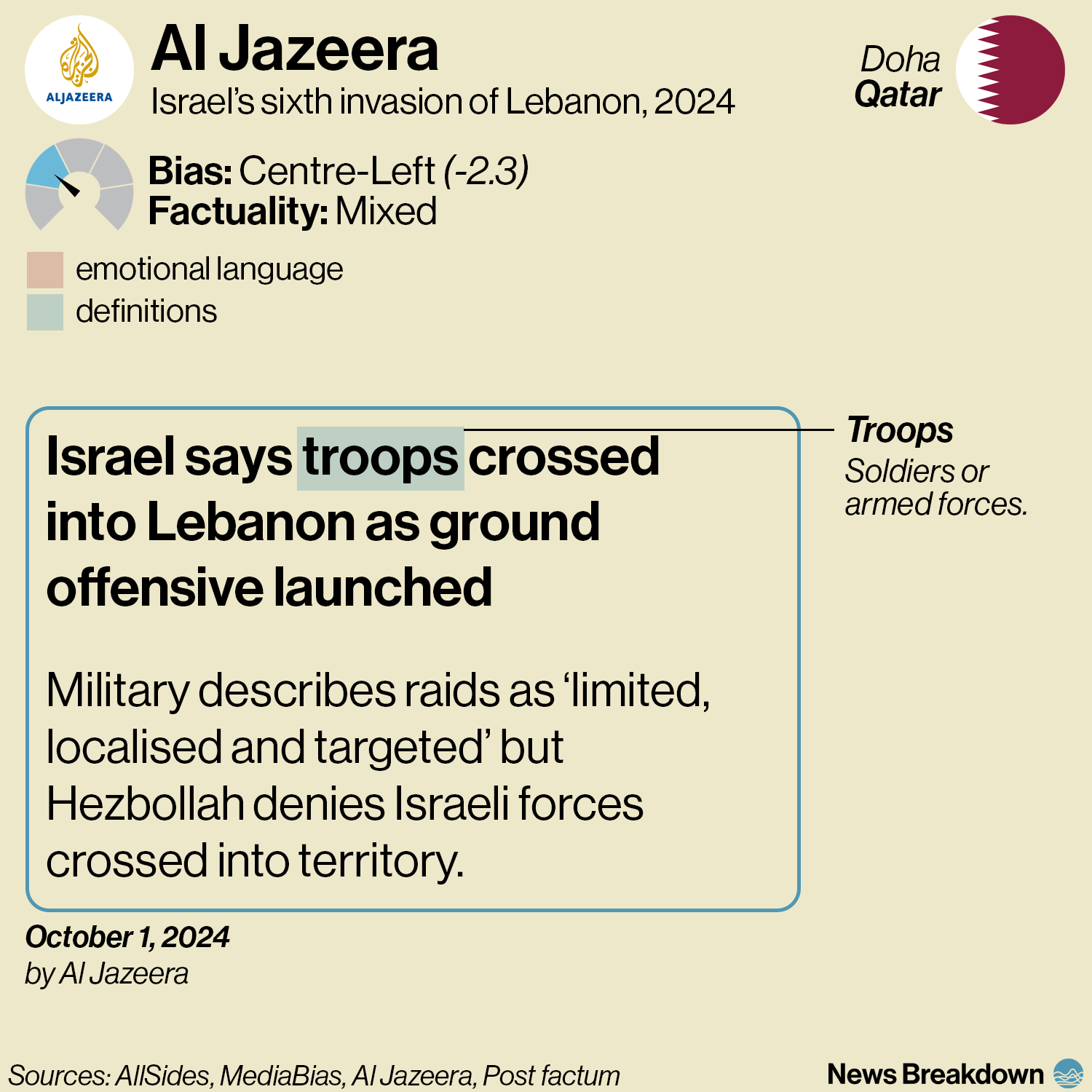
Al Jazeera (AJ): international, Global South-oriented, partly funded by Qatar.
Angle: Israel’s growing confidence, and US support for the invasion.
Al Jazeera covers the basic facts in a neutral way.
The outlet describes Hezbollah impartially as an “Iranian-backed Lebanese armed group”. However, it does not mention its designation as a terror group in some countries, like the US.
AJ opens by directly reporting what the Israeli army stated about the “limited, localised and targeted” invasion into southern Lebanon.
It adds context by describing airstrike damage in the capital Beirut, not in southern Lebanon, but clarifies that Hezbollah has presence there, and that Israel “ordered residents to evacuate”.
Al Jazeera gives a say to Hezbollah’s press service denying the invasion:
“All Zionist claims that [Israeli] occupation forces have entered Lebanon are false”.
The article backs up this quote by writing that no direct contact between Israeli and Hezbollah troops was reported.
AJ reports Israel's earlier successes against Hezbollah:
Explosive pagers attack that killed 39 and injured thousands.
Assassination of Nasrallah, the long-standing leader of Hezbollah.
However, it focuses on the risks of “overconfidence” claiming that “some Israeli analysts expressed concern” about it.
AJ quotes Israeli PM’s controversial claim that “there is nowhere in the Middle East Israel cannot reach”.
The article mentions US support for the invasion but highlights the conflicting claims about it from US officials.
AJ reports that Israel’s air campaign in Lebanon killed over 1,000 people, not specifying whether civilian or not. It describes Israel’s airstrikes emotionally as “ferocious assaults”.
In the last paragraph of the article, AJ mentions the United Nations resolution requiring Hezbollah to not operate south of Litani River in Lebanon.
Hezbollah does not follow the resolution, which is part of the reason for the Israeli invasion, although the article does not explain this.
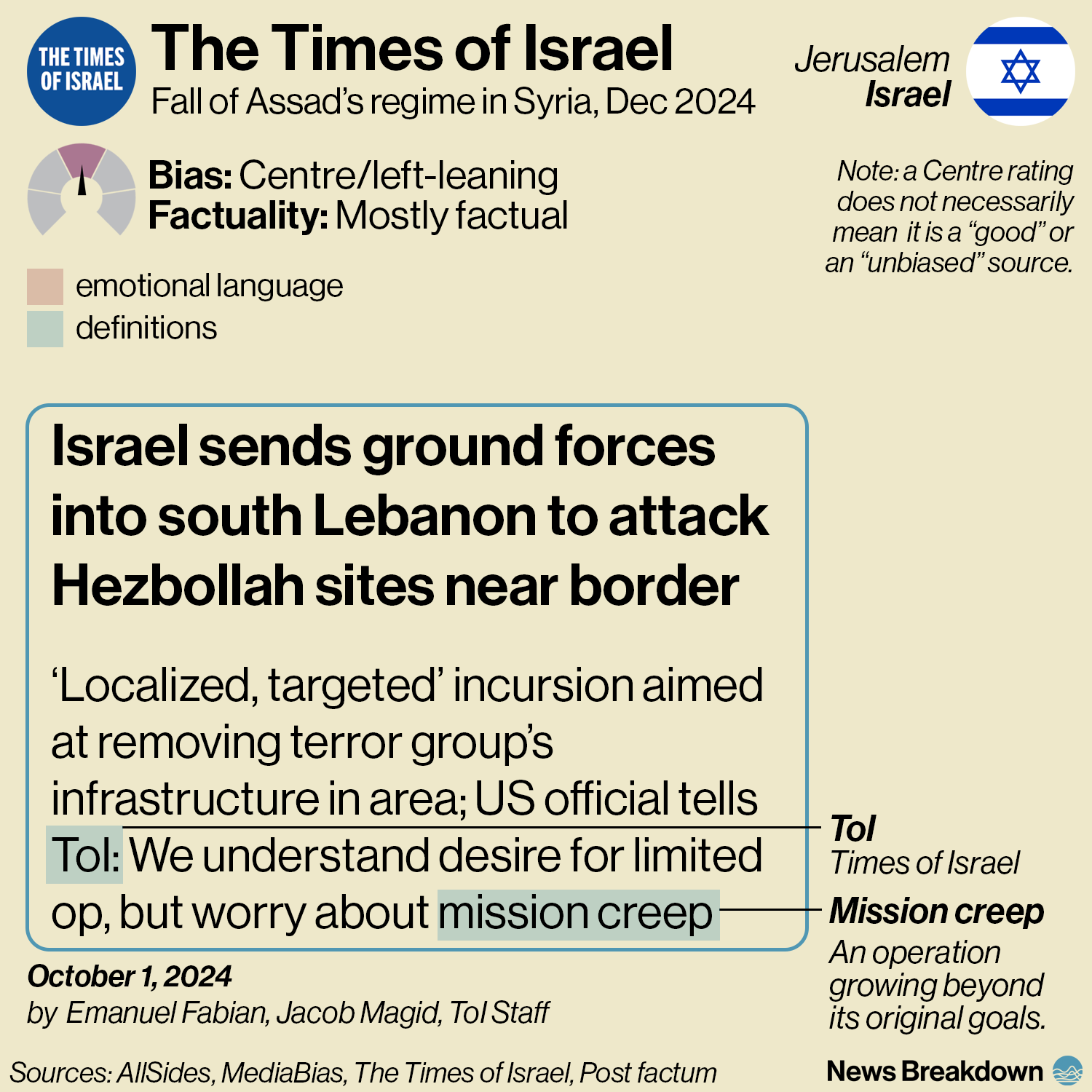
Times of Israel (ToI): one of the most read English-language Israeli news media.
Angle: Uncertainty of US support for Israel’s invasion.
Times of Israel refers to Hezbollah as a “Lebanese terror group”, displaying pro-Israeli bias.
It is considered a terror group in countries like the UK, the US and Israel, but this definition ignores the legitimacy of Hezbollah’s political wing, and the fact that the group often confronts the Lebanese state.
The article begins with detailed reporting of the Israeli army’s statements.
ToI mentions “conflicting reports” that the invasion was or wasn’t happening, referring to Hezbollah denying it.
ToI then mentions that the Lebanese army had retreated 5 kilometres from the border in an attempt to stay out of fighting between Israel and Hezbollah.
It highlights that while the US “warily” (carefully) supports a limited invasion, Biden’s administration is concerned about “mission creep” (the expansion of an operation beyond its original goals).
Article notes that a supposedly “limited” invasion in 1982 turned into an 18-year occupation of southern Lebanon by Israel.
ToI mentions the explosive pagers attack but said that it took “1,500 fighters out of action”: ignoring reported casualties and suggesting that the only people injured were Hezbollah militants.
The article explains the 2006 United Nations resolution that requires Hezbollah to leave southern Lebanon: a pledge it did not hold.
The article describes both Israeli and Hezbollah bombings during the day. This can be seen as trying to downplay the extent of Israel’s aggression.
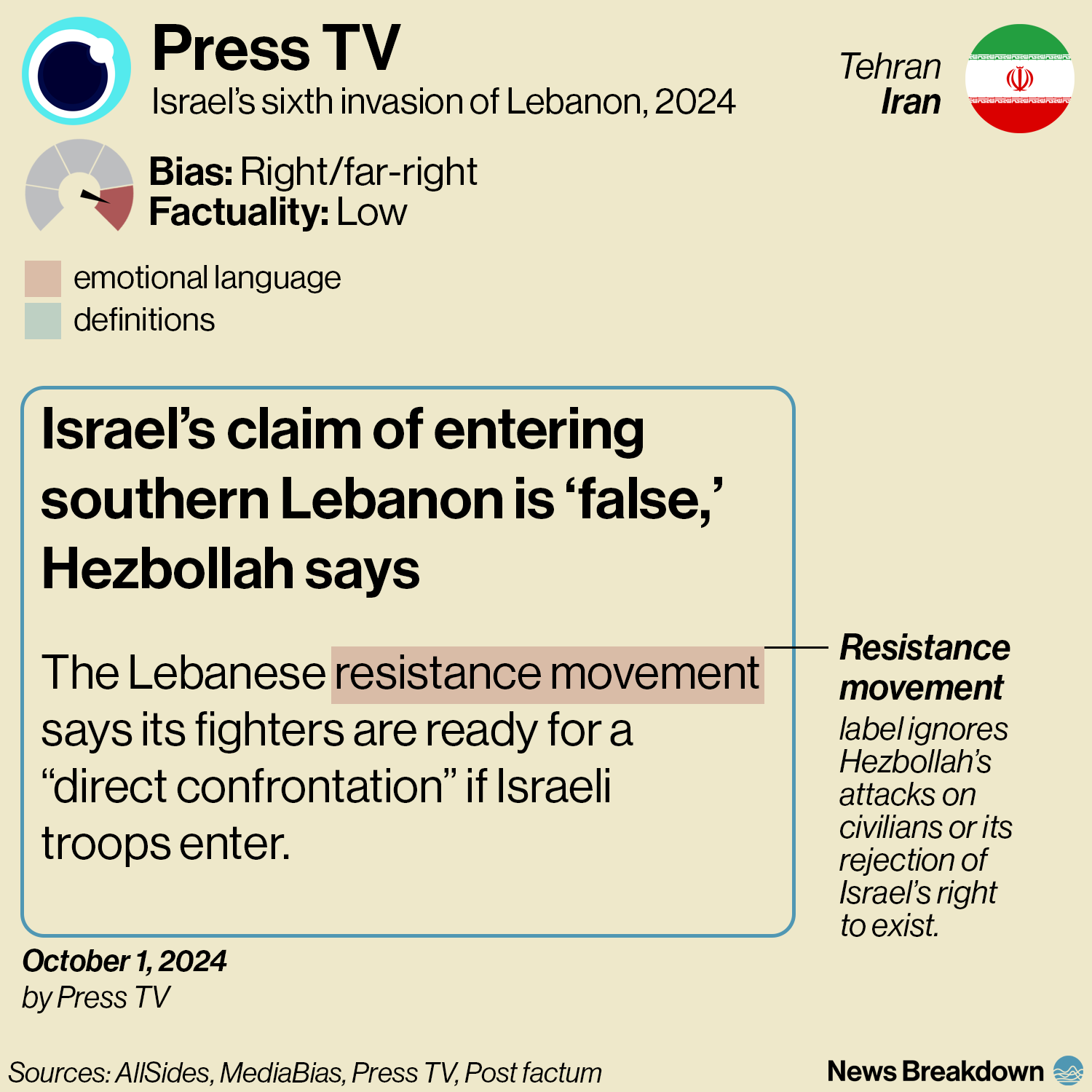
Press TV: Iranian state-owned news media
Angle: denying the invasion taking place.
The article refers to Israel’s prior strikes, including those killing Nasrallah, as “acts of terror and aggression in Lebanon”.
Hezbollah has close ties with Iran, which provides the group with financial and military support.
Iran uses proxy groups, like Hezbollah, as a way to attack Israel without doing so directly.
Press TV shows support for Hezbollah, giving priority to reporting their statements and actions, while providing limited context or opposing views.
It describes the group sympathetically as a “Lebanese resistance movement”.
The article quotes Hezbollah spokesman saying their “fighters are ready for a direct confrontation” and to “inflict casualties” on the enemy.
It also quotes the threats to continue missile strikes on central Israel, referring to it as “the central part of the occupied territory” (meaning, of Palestine).
It mentions that Hezbollah targeted a military base and Mossad (Israeli secret service) headquarters on the outskirts of the capital Tel-Aviv with “salvos of Fadi-4 rockets”.
Fadi-4 rockets are not precision guided and can only strike a broad area. Salvo refers to the launch of multiple missiles at once.
The article mentions the Lebanese military calling on civilians to leave all areas south of Litani River (PressTV misspells it as “Litani Rover”).
It does not explain why this area is key to the conflict: Hezbollah’s refusal to withdraw from the area as per the 2006 UN resolution.
PressTV articles often used emotional language in describing Israel, writing of its “barbarism” in Gaza, and its “psychopathic” bombardment of Lebanon.
One text states that the Lebanon invasion means that “more blood is on the hands of the Israeli regime and its backers on the western hegemonic front”.
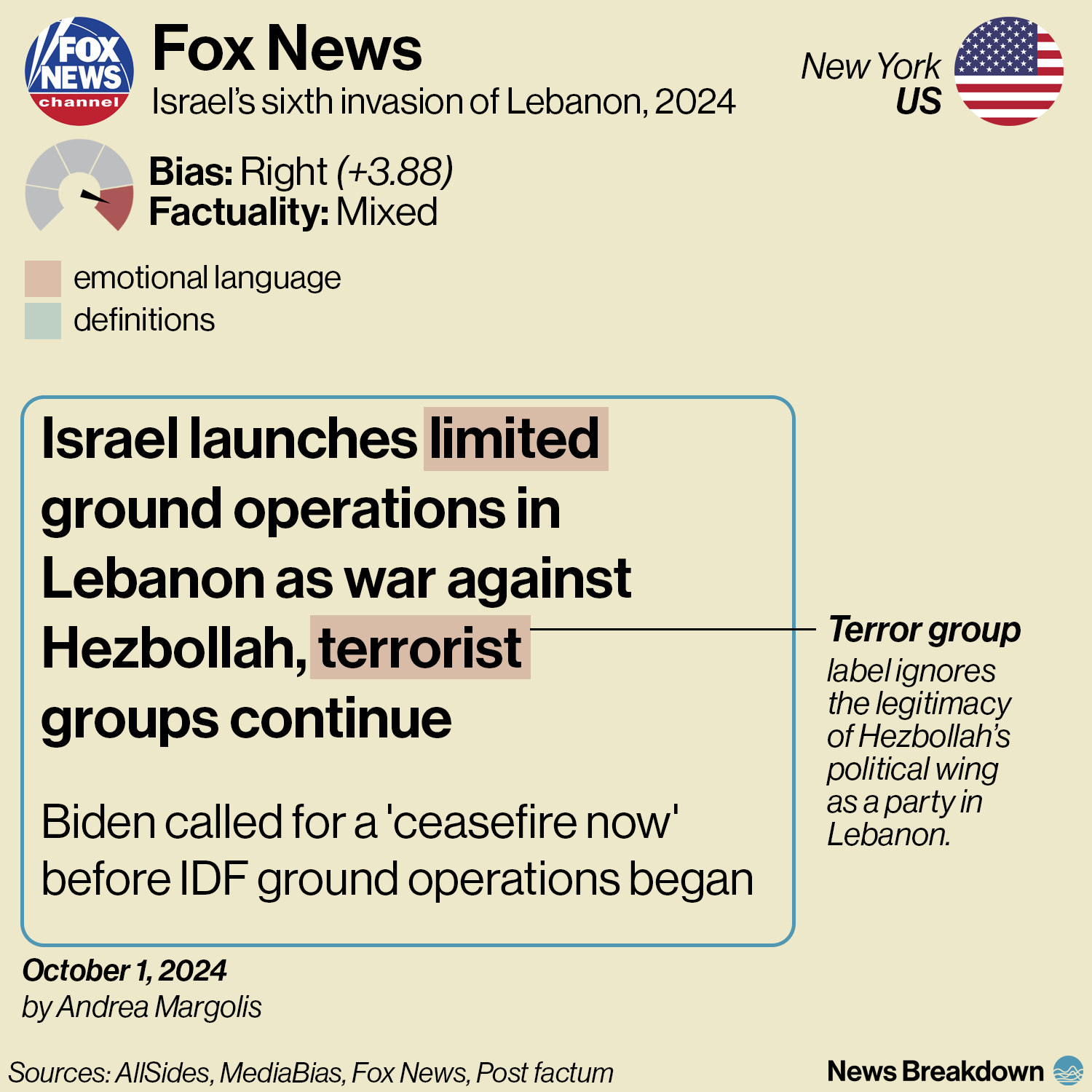
Fox News: conservative (Republican) US news broadcaster, offers political commentary.
Angle: focus on the United States and legitimising Israel’s invasion.
Fox News opens by describing the invasion as “limited” and “localised”.
While accurate, these characteristics are subjective and may be aimed at downplaying Israel’s actions.
The text then describes Hezbollah as “Iran-backed terrorist group”, in an open pro-Israel stance.
The invasion is placed in the context of Israel’s “successful” earlier attacks against Hezbollah that led to the death of its leader, Hassan Nasrallah.
The article quotes President Biden’s calls for a “ceasefire now”, saying they happened “before ground operations began”.
It notes that Biden had “expressed disapproval” about the potential invasion, but Fox describes it as “imminent”: this suggests that Biden did not have any influence on the situation, portraying him as weak.
The text does not mention broader support for the invasion from the Biden administration.
Because Fox had openly backed the Republican candidate, Donald Trump, and Israel’s actions in Lebanon, they were inclined to present Joe Biden as weak and opposing a “good” decision.
In another report, Fox focuses on the Pentagon’s plan to send more troops to the Middle East, shortly after President Biden said he would not do so.
By November, Israel was able to claim a partial victory over Hezbollah.
The group has been significantly weakened but not completely eliminated.
IDF (Israeli army) claims that they have destroyed around 70% of Hezbollah’s “strategic weapons” during the invasion, including various missile types and rocket launchers.
Lebanon’s health ministry reported Israel killing 3,538 people in the country, mostly civilians.
This reported figure includes 231 children, which was confirmed by the United Nations.
An independent CNN toll reports at least 2,267 casualties.
The IDF claims that it killed 2,762 Hezbollah fighters.
BBC investigated a particular case of a strike on an apartment block in Beirut, that killed 73 people:
IDF claimed it to be a “terrorist command centre”.
Out of 68 victim identities verified, 62 were civilians.
23 of the victims were children.
6 of the killed were identified as linked to Hezbollah, but not of senior rank.
5 victims remained unidentified.
Over 1.2 million Lebanese civilians were displaced, and 41 Lebanese army soldiers were killed.
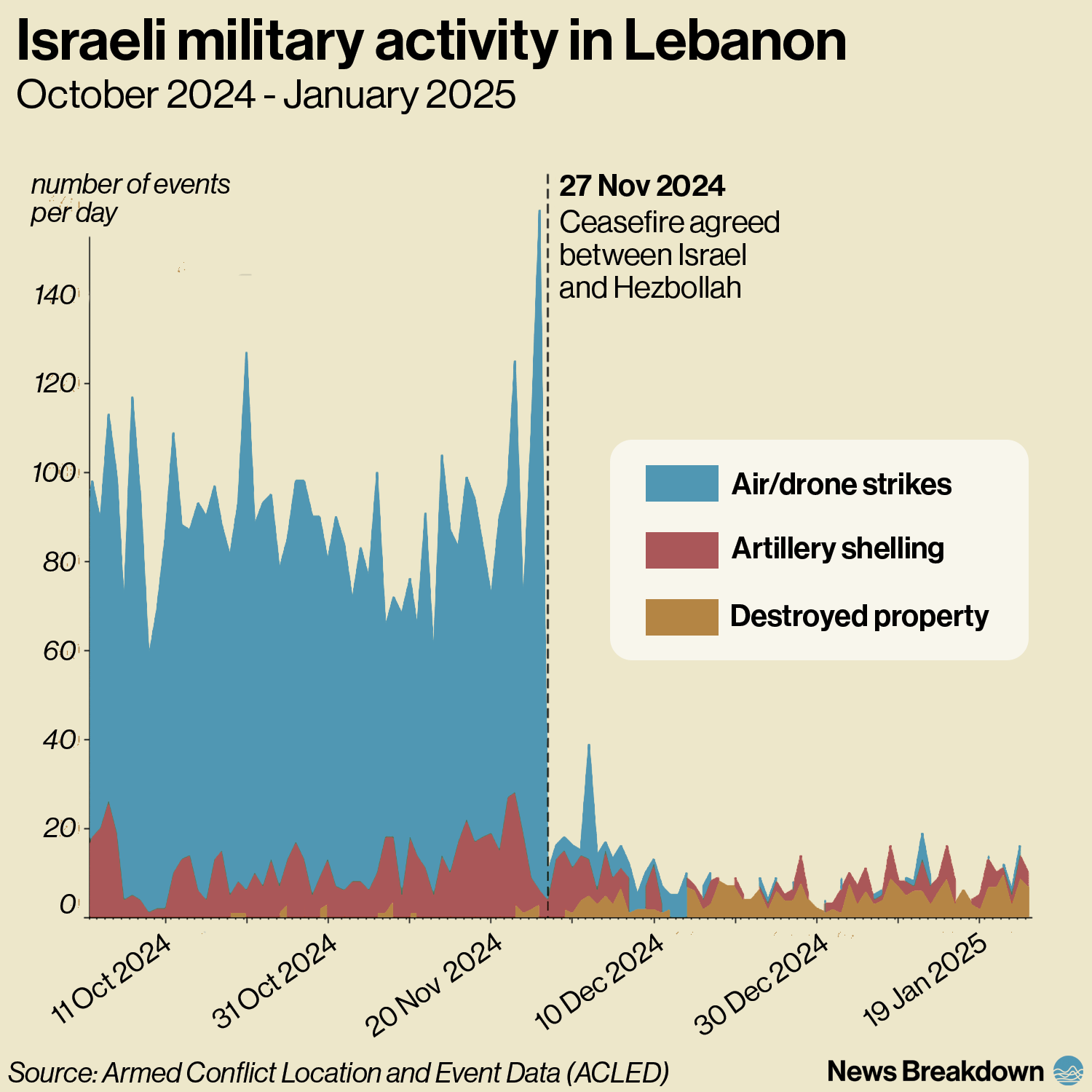
On November 27, 2024, a 60-day ceasefire was signed between Israel and Hezbollah, mediated by the US, France, Türkiye, Qatar and Egypt.
* Both Israel and Hezbollah agreed to withdraw from southern Lebanon and stop the fighting.
By February 2025, Israel withdrew from southern Lebanon but stayed in 5 “strategic” locations along the border, contrary to the ceasefire which has now expired.
By April 2025, Hezbollah reportedly withdrew from southern Lebanon, handing over its positions to the Lebanese army.
The Lebanese army has been working to dismantle Hezbollah’s military infrastructure along the Israeli border.
Thank you for reading!
Author Benedict Mander
Editor Anton Kutuzov