
CONGO-RWANDA FAILED PEACE DEAL
Conflict for $24T of Mineral Wealth
Published: January 1, 2026
In June 2025, the Democratic Republic of Congo (DRC) and Rwanda signed a peace deal brokered by US President Trump.
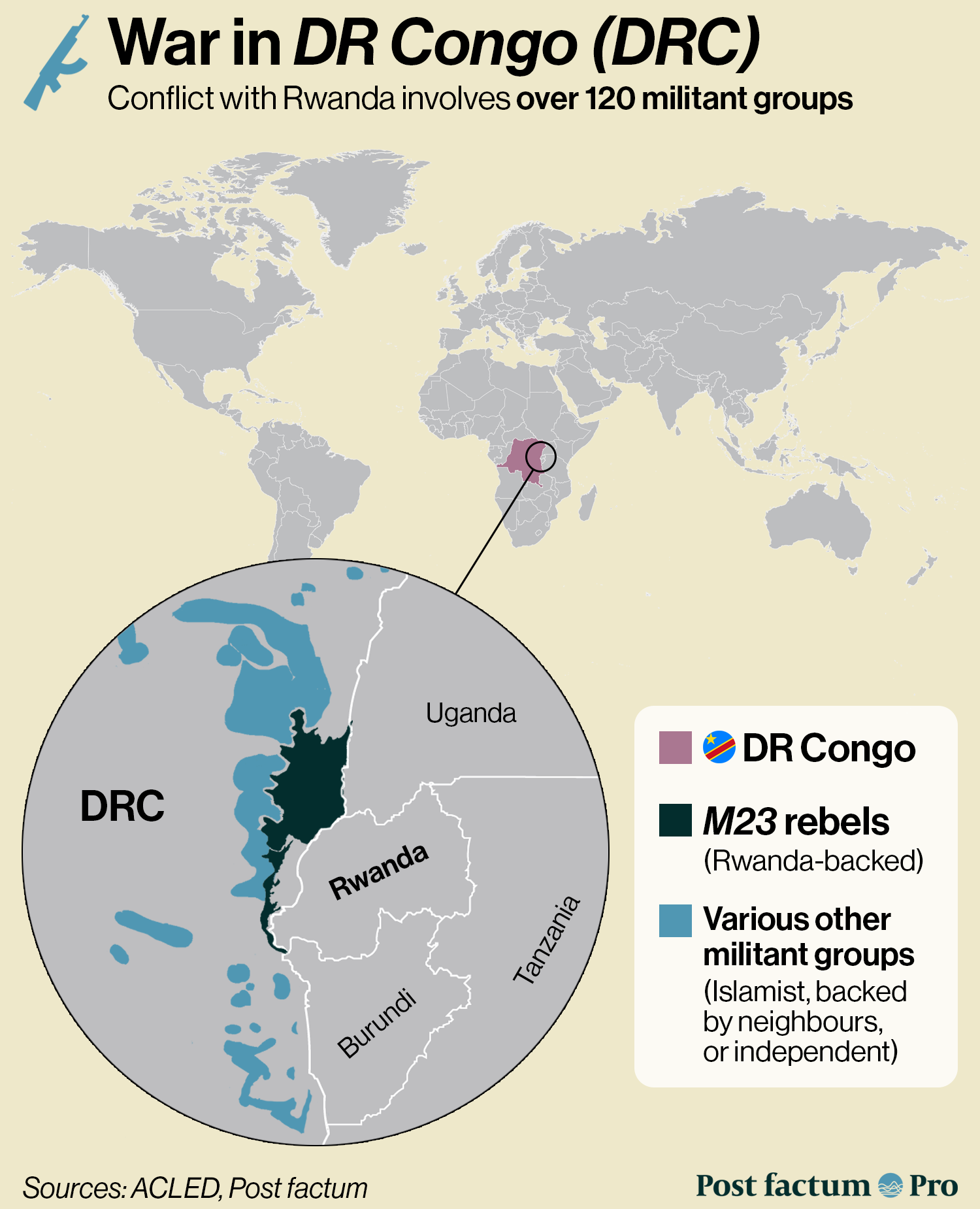
The deal did not achieve peace, mainly because it did not include M23, the largest of over 120 militant groups involved in the conflict.
Key background: 1994 Rwandan (Tutsi) genocide.
In 1994, over 500,000 people, mostly men of the Tutsi ethnicity, were killed by militants of the Hutu ethnicity.
Over 250,000 Tutsi women were raped. Some moderate Hutus and other people were also killed.
After Tutsi-led forces ended the Hutu ruling regime in Rwanda, over 2 million Hutus (including some genocide perpetrators) fled to the DRC.
Hutu militants regrouped and launched cross-border attacks against Rwanda. It responded by sending military forces into the DRC.
The following Congo Wars (1996-97, 1998-2003) killed over 6 million people and resulted in continued destabilisation of the region.
The 2025 peace deal between the DRC and Rwanda formally included:
Stopping hostilities and respecting borders
Stopping any support for militant groups
Disarming and/or integrating the groups
Withdrawal of Rwandan troops
Cooperation in trade and mining
The problem: the peace negotiations did not involve the M23group, a Rwanda-backed ethnic Tutsi militant group controlling territory in East DRC.
M23 is one of over 120 armed groups fighting for control of the DRC's estimated $24 trillion mineral wealth.
Fighting along the Rwandan border revolves around tin, tungsten and tantalum reserves (“3Ts”).
However, the region is also rich in diamonds, lithium, gold and other resources, including world-class deposits of copper and cobalt.
Some of the militant groups smuggle minerals to Rwanda (or other neighbours, like Burundi and Uganda), where they are mixed with local output and re-exported.
Evidence: Rwanda's mineral exports in 2024 exceeded its own production.
Mineral smuggling damages state authority, as armed groups replace the government in controlling mining areas and trade routes.
China controls 72% of the DRC's cobalt-copper mines, with exports routed eastward and shipped to China for processing.
China is the world leader in the processing of many minerals and metals, including the 3Ts, lithium, copper, cobalt, coltan, rare earths and more.
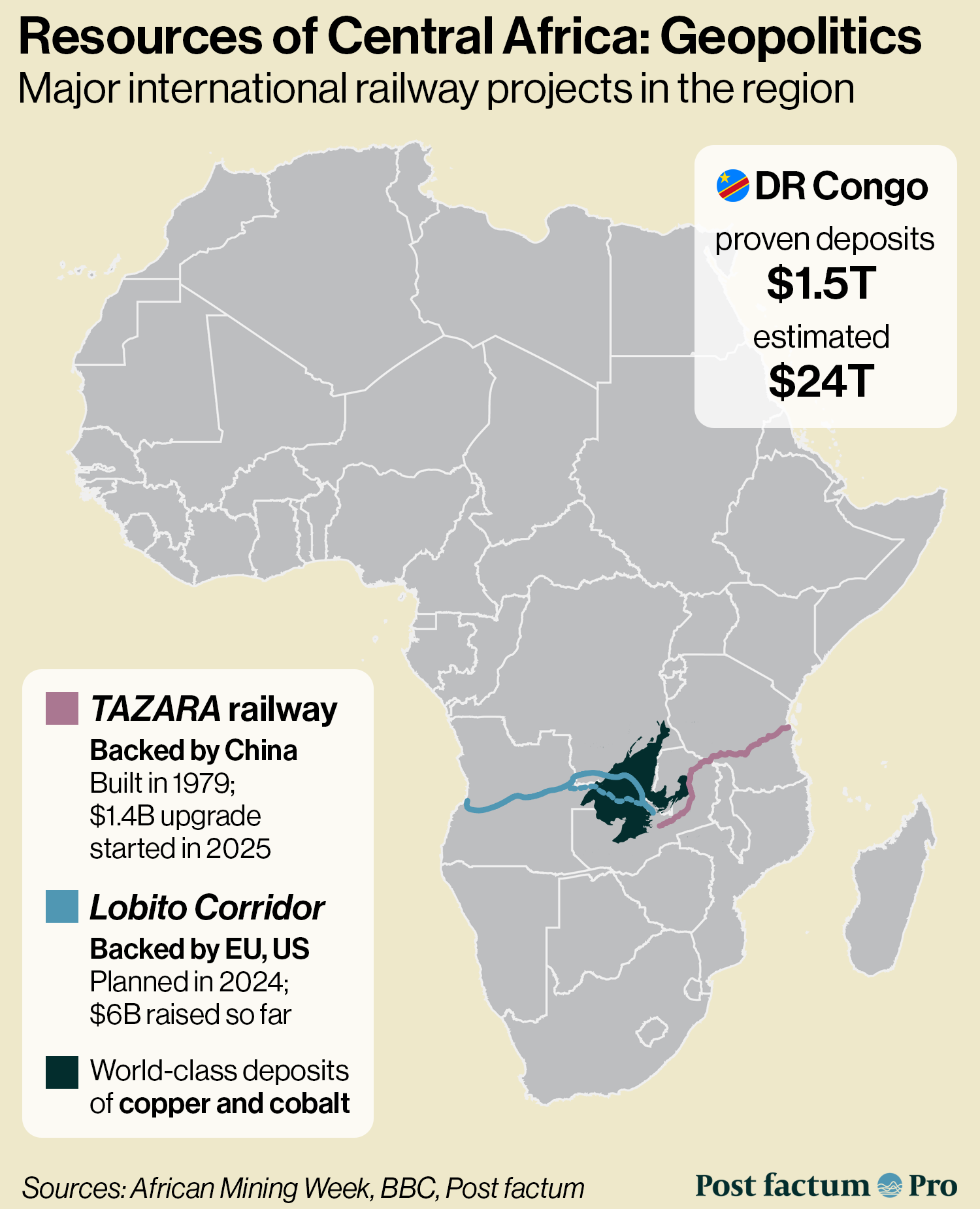
The Lobito Corridor is a rail route that moves minerals westward from the DRC and Zambia to a port on the Atlantic.
The US and the EU support the Lobito Corridor as a counterweight to China's dominance in the DRC's mining sector.
US investment in the Lobito Corridor totals $4 billion, compared with China's $1.4 billion investment in the Tanzania–Zambia railway upgrade project.
In August 2025, the US sanctioned a DRC-based armed group, as well as Chinese and Congolese companies involved in illegal mineral smuggling and violence against civilians.
The sanctioned group controlled a mineral-rich area supplying about 15% of the world's coltan from 2022 to 2024, but it has since lost this territory to the M23.
The US excluded M23 from these new sanctions to support its diplomatic talks with the DRC.
In December 2025, the DRC and Rwanda signed a declaration confirming the June 2025 peace deal.
Despite the declaration, M23 continued fighting and captured a strategically important city in eastern DRC.
Days later, M23 withdrew from the city following US pressure, but nearby fighting continued and US officials reported being “not satisfied” with the withdrawal.
Congo-M23 negotiations
M23, formed in 2012, is supported by Rwanda with troops, training, and weapons.
M23 aims to reorganise the DRC into a federal state, granting significant autonomy to its eastern regions.
It has captured mineral-rich areas, fighting the Congolese army and rival militias.
In 2024, M23-held mining zones supplied about 7–10% of the DRC's total cobalt output.
In early 2025, the DRC banned mineral exports from conflict zones in the East. Weak state control in these zones limits enforcement.
In January 2025, M23, supported by about 4,000 Rwandan troops, captured Goma, a city of about 3 million inhabitants.
This resulted in around 1,500 deaths and the displacement of tens of thousands of people.
M23 also seized the Goma airport, closing it to all visitors and blocking humanitarian aid.
M23 aims to control (1) mineral reserves, (2) cities and (3) key infrastructure to increase its diplomatic and economic strength.
The group established its own administrative and judicial systems in the territories it captured.
In April 2025, the DRC and M23 agreed to a temporary truce, followed by a peace declaration in July that reaffirmed it.
However, the fighting on the ground continues.
Throughout 2025, M23 seized more territory, killed hundreds of civilians, and forcibly repatriated some Hutu refugees to Rwanda.
In November 2025, Congo and M23 signed a peace framework in Qatar based on July 2025's principles, which included:
Ceasefire monitoring
Prisoner exchanges
Restoring state authority in eastern DRC
Disarming foreign militant groups
The framework is not a peace deal and requires further negotiations.
Thank you for reading!
Author Elia Preto Martini
Editor Anton Kutuzov