
Gen Z Revolution in Bangladesh
What happened? Why is it important?
Published: September 18, 2025
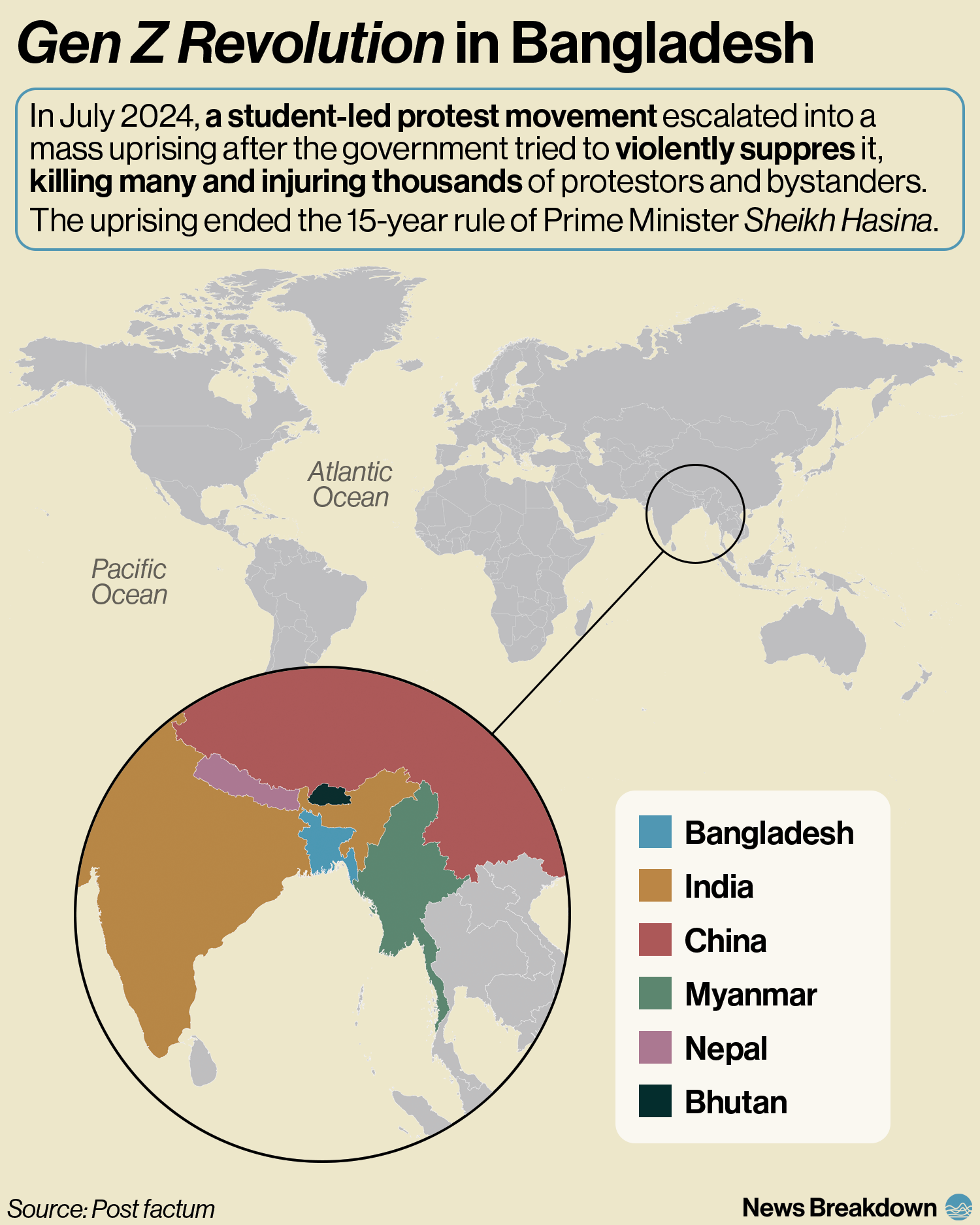
Why is Bangladesh important?
Bangladesh is the 8th most populous country in the world, with over 170 million people.
Matters for the rivalry between India and China, with both competing for influence through infrastructure and investment projects.
Bangladesh is a central player in the humanitarian crisis facing the Rohingya. Over a million refugees have fled to Bangladesh from neighbouring Myanmar.
Global fashion supply chains depend on Bangladesh as the world's 2nd largest exporter of ready-made clothes (garments).
What happened in 2024?
On 5 August 2024 Bangladesh’s Prime Minister Sheikh Hasina resigned and fled the country to India after more than 15 years in power.
Sheikh Hasina is now 77-years-old, her father led Bangladesh in its War of Independence against Pakistan in 1971.
She had become the world’s longest-serving female head of government (2009-2024).
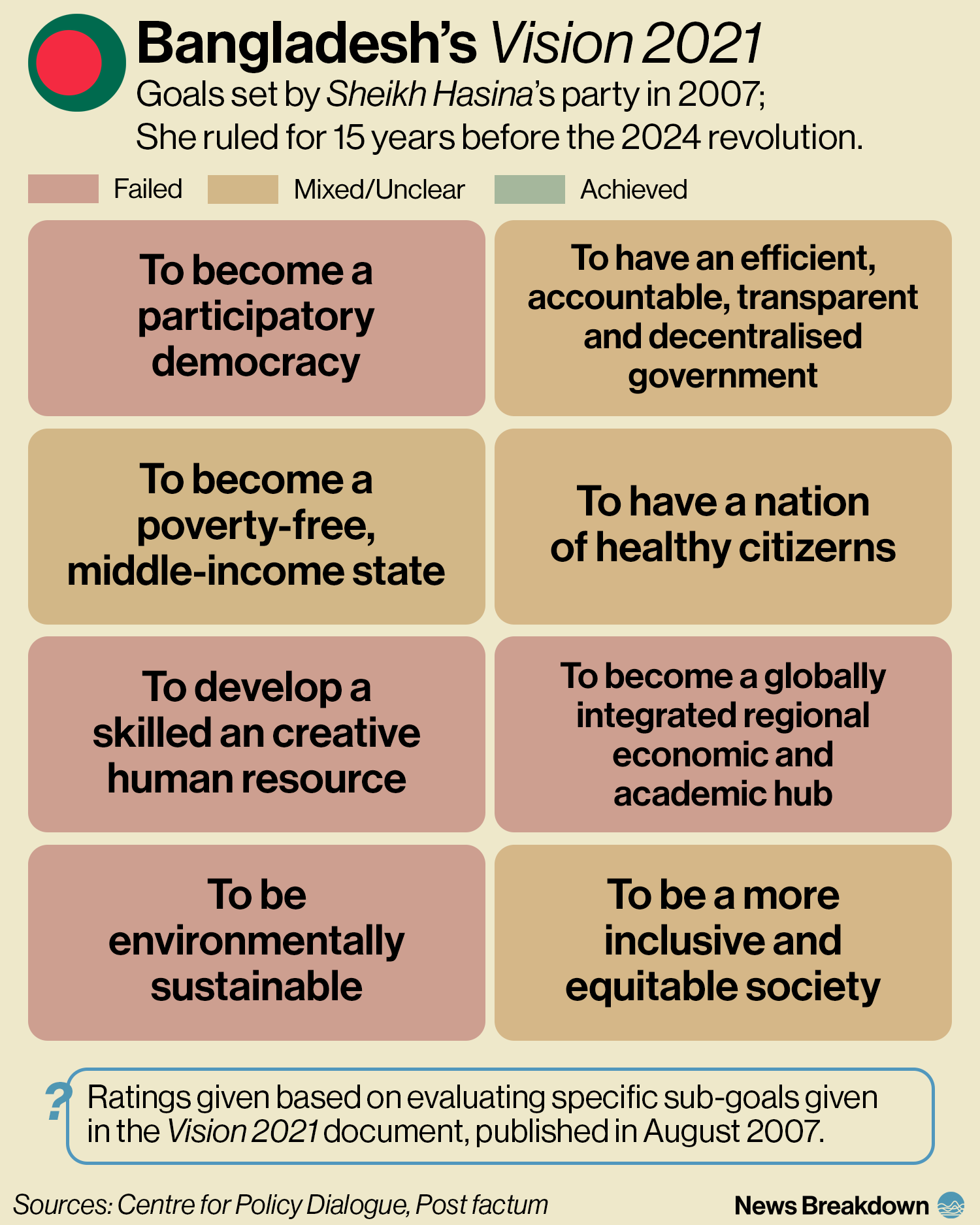
Her government has achieved some progress in economic and social development but was characterised by dictatorship, corruption and crimes against humanity in the later years.
The collapse of the Hasina government was caused by a mass uprising that started in June with peaceful student demonstrations.
The government tried to violently suppress the protest. 300-1,000 people were killed and many more injured.
Student protesters were joined by many others dissatisfied with the government due to:
Authoritarianism: Hasina’s government prevented free elections such as by banning independent observers and cracked down on its opponents.
Corruption: government projects and officials were involved with bribery and money laundering.
Human rights abuses: Hasina’s government has used violent and illegal methods against its political opponents.
Inequality: the economic situation was unstable with high inflation and widespread poverty.
Led by young people born since the mid-1990s, the uprising has been called the first Gen Z revolution.
Social media played a key role, with protesters using platforms like Facebook, TikTok, and WhatsApp to communicate and coordinate.
It was also a decentralised and leaderless movement, making it harder to suppress.
After the army's refusal to fire on the protesters prompted Hasina’s flight to India, military leaders helped agree a deal between student leaders and civil society representatives.
Bangladesh’s military has long played a leading role in politics, with more than 20 successful and unsuccessful attempts to change the government (coup) since 1971.
The military announced that a temporary (interim), unelected government would be led by Nobel Peace Prize winner Muhammad Yunus, serving as “chief advisor” (equivalent to prime minister) leading a council of non-partisan advisors.
The interim government’s goal: overseeing the transition to democracy by holding new elections.
One year after the collapse of the Hasina regime, Bangladesh is still in transition.
The country is struggling with political infighting and economic instability.
The main promise of holding free and fair elections has still not been achieved.
Elections are currently due to be held in February 2026.
Elections have been delayed mainly due to the interim government’s commitment to reforms first so that the elections can be free and fair, and to prevent a return to authoritarianism.
Key areas for reform include: the election commission, the police and judiciary, and the constitution.
However, there is disagreementbetween political partieson the scope of reforms.
The interim government has also failed to fully restore law and order, with a rise in violent crime since the revolution.
Few officials involved in the crackdown during the uprising have been held accountable. Many of the accused are in detention with their bail applications refused.
Bans on some political parties have been lifted, including the country’s largest Islamist party.
The currency and financial markets have somewhat stabilised, with support from the International Monetary Fund.
Tensions with India
There has been a shift in foreign policy after the collapse of the pro-India Hasina regime.
Relations with India have suffered due to India’s refusal to extradite Hasina (hand her over for a trial).
The interim government wants Hasina to face charges of crimes against humanity and corruption.
This has fuelled anti-India sentiment in Bangladesh, where the "India Out" movement has become popular. Some protesters have targeted Indian products.
The interim government has also accused India of spreading misinformation about the security of theHindu minority in Bangladesh to destabilise the new administration.
These tensions have disrupted trade between the two countries. India has prevented Bangladeshi exporters from using Indian ports, damaging the country’s textile industry.
Business uncertainty has also delayed infrastructure projects that were important to India's regional connectivity strategy.
For India, the collapse of the Hasina regime is a security setback, as it helped to control insurgent groups in India's northeastern states.
Relations with India’s rivals improve
A strategic pivot by the interim government has seen relations improve with India’s rivals, China and Pakistan.
China wants to deepen its influence in the strategically important Bay of Bengal (sea to the east of India).
Bangladesh is partnering with China to modernise its ports, as well as to invest in energy projects and industrial zones.
Bangladesh is also in talks to buy Chinese military equipment.
Relations with Pakistan have been difficult since Bangladesh became independent in the 1971 war.
There have been unprecedented efforts towards reconciliation with a series of high-level diplomatic missions to improve cooperation in trade and even defence.
Both countries are interested in diversifying their alliances and reducing India's regional dominance.
Bangladesh has also improved its relations with the US and the EU.
Western powers had been concerned about human rights and democracy under the Hasina government.
They have welcomed the interim government’s commitment to free and fair elections, and institutional reform.
The US and the EU have shown their support with economic incentives, including discussions on new trade agreements and investment.
Thank you for reading!
Author Benedict Mander
Editor Anton Kutuzov