
Armenia-Azerbaijan War and Peace
Geopolitics of South Caucasus, explained
Published: October 23, 2025
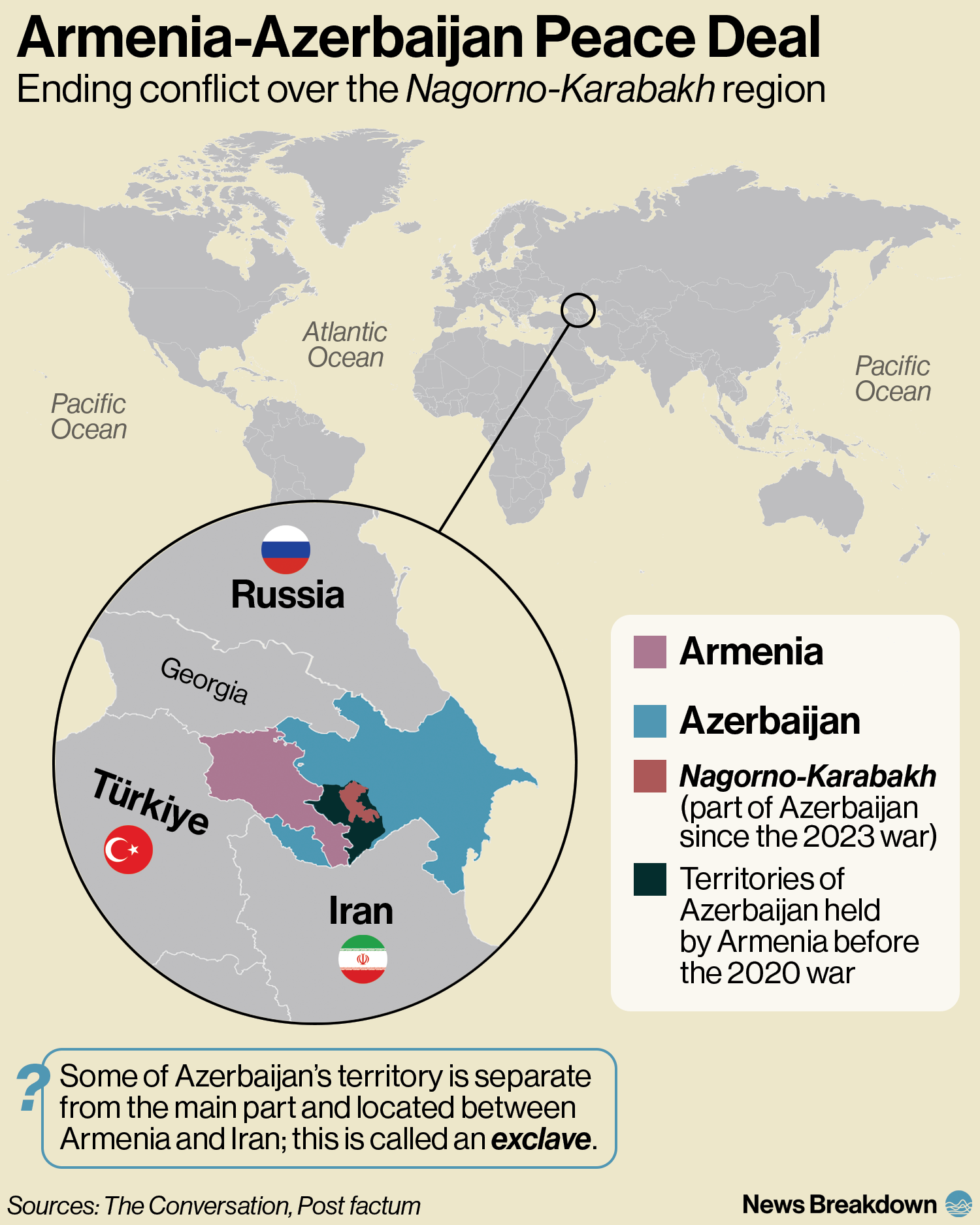
In August 2025, Armenia and Azerbaijan formally ended their 37-year conflict over the Nagorno-Karabakh region.
The deal, brokered by Donald Trump, is signed but awaiting approval from both countries’ parliaments.
The fighting actually ended in 2023, when Azerbaijan fully retook the region in a quick military attack.
Soviet origins: Nagorno-Karabakh (NK) was a part of the Azerbaijani Republic within the Soviet Union but had an Armenian majority population.
After the Soviet Union’s fall in 1991, Armenia and Azerbaijan gained independence, and a full-scale war over NK started.
Local Armenian militias backed by Armenia conquered NK.
They also took control over some surrounding territories of Azerbaijan without an Armenian-majority population.
Over 20,000 soldiers died in the war for both sides combined. It ended in 1994 with a ceasefire deal brokered by Russia.
An independent state of Artsakh was created, but it was not internationally recognised, even by Armenia.
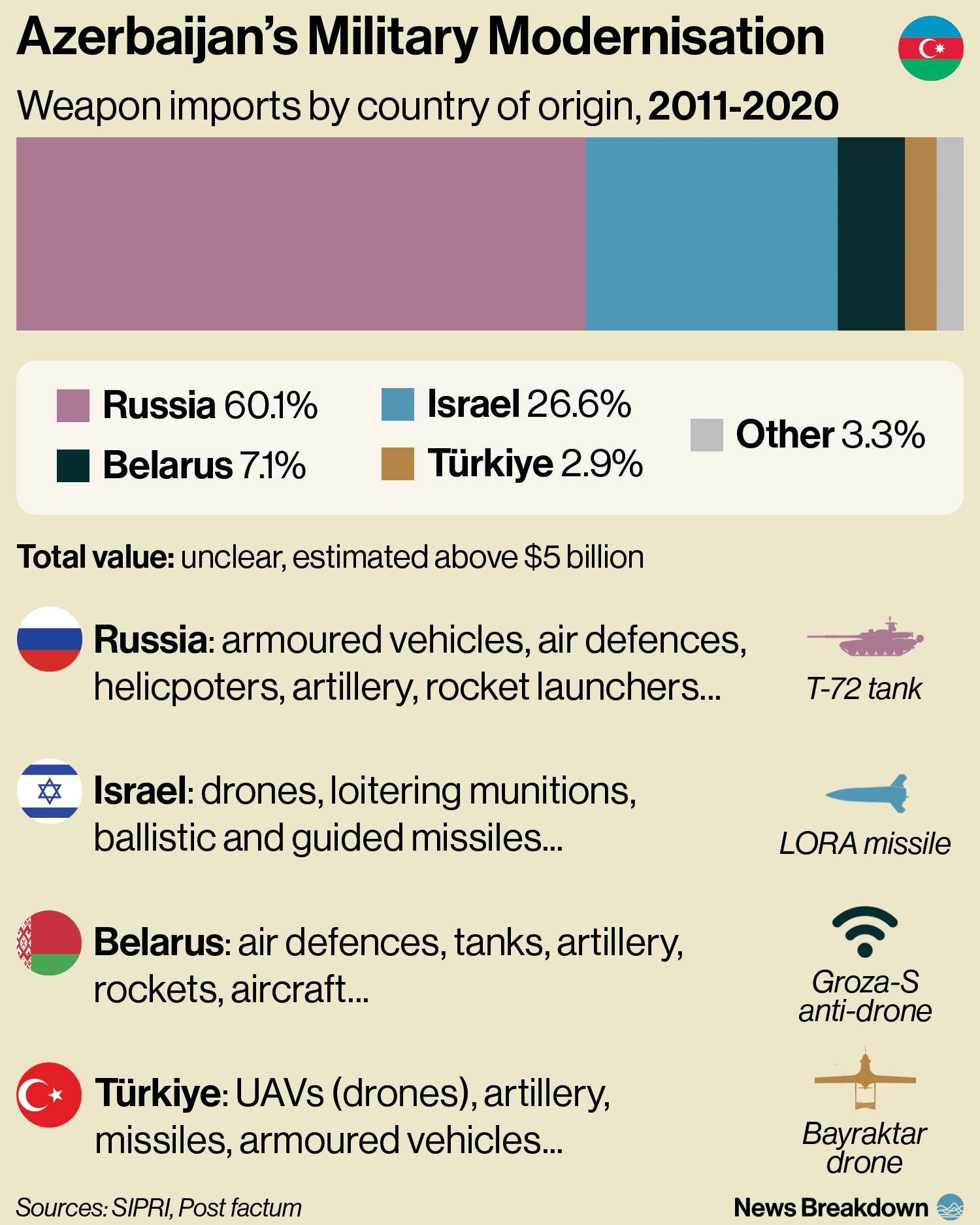
1994-2020: Azerbaijan used oil and gas revenues to modernise its military and buy advanced weapons from Russia (60%), Israel (27%), Belarus and Turkey.
2020: Azerbaijan attacked, taking back around 30% of NK territory and all the surrounding areas it had lost in the 1990s.
In later years, Azerbaijan used hybrid tactics in the Armenian-controlled areas, such as a blockade that caused a shortage of food and fuel.
2023: Azerbaijan launched a decisive final offensive and successfully took over the rest of NK.
Around 120,000 Armenians fled NK to Armenia.
After another Russia-brokered peace, the state of Artsakh was dissolved and its military disarmed.
Armenia did not actively defend Artsakh in 2023 (unlike 2020), and neither did the Russian peacekeepers deployed in the region.
In August 2025, Armenia and Azerbaijan signed a formal peace deal in Washington (US), solving their territorial disputes and agreeing to peaceful existence.
While the conflict was resolved, both sides were interested in favourable attitude from the US, as well as the formal peace.
To ratify a deal is to make it official and legal within a country, often done by a parliament.
Azerbaijan will not ratify the deal until Armenia removes the claims to Azerbaijani territory that it currently has in it constitution.
Armenia is drafting a new constitution for a public vote (referendum), with no foreign territorial claims and some political reforms.
By mid-2025, around 15% of Armenians support the constitutional changes.
Armenia, Azerbaijan and the US agreed to establish a corridor linking Azerbaijan to its exclave, located between Armenia and Iran.
The US will oversee its creation and development for 99 years.
The corridor will include railways, oil and gas pipelines, fibre-optic cables and electric power lines.
It will also integrate with the existing land route that connects Europe and China while avoiding Russia and Iran.
Geopolitics: foreign actors
Russia
Russia has historically acted as a peacekeeper between Armenia and Azerbaijan.
Both sides use mostly Russian- and Soviet-made weapons.
Russia has a defensive alliance with Armenia and operates a military base there.
Russia cooperates with Azerbaijan on energy and transport, with the country serving as an essential link to Iran.
Russia was the largest arms supplier to both Armenia and Azerbaijan before the 2020 war.
Russia-Azerbaijan ties worsened after Russia shot down an Azerbaijani passenger plane while defending against a Ukrainian drone attack in late 2024, killing 38 people.
After almost a year, Russia acknowledged responsibility for the incident and began repairing the diplomatic relationship.
Since the war in Ukraine, Russia's influence in the wider region has decreased, along with its ability to maintain security commitments to Armenia.
Both Armenia and Azerbaijan increasingly act independently of Russia and cooperate with other major powers like the US, Türkiye, Israel and Iran.
Türkiye
Türkiye has a pro-Azerbaijan position.
Turkish weapons, including Bayraktar drones and military guidance were used in the 2020 offensive.
Türkiye invests in Azerbaijan’s infrastructure projects and imports its oil.
Türkiye and Armenia do not have diplomatic relations due to the 1915 Armenian genocide carried out by the Ottoman Empire, something that Türkiye refuses to acknowledge.
Türkiye closed the border with Armenia in 1993, imposing a partial blockade together with Azerbaijan.
Israel
Israel takes a pro-Azerbaijan position.
Israeli weapons, including drones, missiles and air-defence systems, were used in the 2020 offensive.
Israel imports about 30% of its oil from Azerbaijan, which in turn has invested in Israel’s gas sector.
Israel, the US and Azerbaijan are discussing an alliance aimed at enhancing regional stability and reducing Iran's influence.
Iran
Iran's main focus is on keeping strategic balance in the region, and surviving as a political regime.
Iran supports Azerbaijan's territorial integrity.
Why? Iran has a large ethnic Azeri population and shares the Shia Muslim faith with Azerbaijan.
However, Iran is concerned by Azerbaijan's strengthening and its ties with Israel, the US and Türkiye, all Iran’s rivals.
Iran is expanding military ties with Armenia. In 2025, the two held a joint exercise near Azerbaijan’s exclave.
The US
The US acts as a peacekeeper between Armenia and Azerbaijan.
The US, Russia and France led an international negotiations group for the conflict in 1995-2025.
Azerbaijan asked for the group to be closed as a condition for the signing of the 2025 deal.
US oil companies have invested in Azerbaijan's oil sector, which is now a strategic supply for its European allies.
The US has a large ethnic Armenian population (diaspora).
The US has signed a strategic partnership with Armenia in 2025, covering defence, energy, trade and more.
The EU
The EU has also acted as a peacekeeper, focusing on aid delivery.
Since 2023, the EU has provided about $24.5 million in humanitarian aid to Armenians displaced by the conflict.
Since the war in Ukraine, the EU increased its gas imports from Azerbaijan to reduce its dependence on Russia.
However, Azerbaijan imports gas from Russia, freeing up some of its own production for export to Europe.
Thank you for reading!
Author Elia Preto Martini
Editor Anton Kutuzov